Get Full Government Meeting Transcripts, Videos, & Alerts Forever!
Get email alerts on the Behavioral Health topic
No spam. Unsubscribe anytime.
Dane County behavioral-health subcommittee reviews JMI strategic plan, prioritizes crisis treatment access and reentry supports
Summary
Colleen (presenter, Office of Justice Reform) and Sharon (presenter, Office of Justice Reform) briefed the Community Justice Council Behavioral Health Subcommittee on a Justice Management Institute strategic planning framework and Sequential Intercept Model mapping that prioritized crisis-treatment access and reentry supports.
Colleen (presenter, Office of Justice Reform) and Sharon (presenter, Office of Justice Reform) briefed the Community Justice Council Behavioral Health Subcommittee on a Justice Management Institute (JMI) strategic planning framework and findings from a Sequential Intercept Model (SIM) mapping exercise.
The presenters said the SIM exercise — held in June at the Alliant Energy Center with more than 60 participants — identified gaps across the system and produced two priority areas: improving access to timely, appropriate treatment at intercept points, and strengthening reentry supports to ensure continuity of care and benefit access.
The plan’s data component will be led by the Office of Justice Reform, the presenters said, and will include an evaluation tool to track program performance and resource allocation. The presenters told the subcommittee they expect a final SIM report in October 2025 and said that report will go to the Community Justice Council executive body for review before final acceptance.
Why it matters: subcommittee members said those priorities affect system capacity, law enforcement diversion, jail operations and community providers. Several members urged concrete, staged deliverables (one-, two- and three-year steps) and asked that the subcommittee use its convening role to coordinate providers, share information and reduce duplication.
Discussion highlights
- Mapping and provider outreach: Pete Zoller said the subcommittee should ‘‘connect with who the providers are, who the peers are, recognize what services they do have’’ and use that map to engage organizations that may not realize they are part of the system. Zoller said, "being able to identify what services are already in effect and in play in our community on each intercept" would help target supports.
- Existing resources and underutilization: Multiple participants said Dane County has existing services that are underused; the subcommittee should identify those programs and the barriers to fuller use to avoid duplicative new programs.
- Triage center and peer supports: Pauline (Behavioral Health Division) said the division is ‘‘leading the charge in the triage center RFP process’’ and already holds multiple contracts for peer support services, making the division a natural partner for triage center development and expansion of peer supports.
- Warm handoffs and reentry: Several members supported adopting countywide warm-handoff practices so jail, community and crisis providers transfer care smoothly at release. A 911 representative said a behavioral-health diversion program tied to dispatch could route nonemergency calls to CARES or 988 and avoid unnecessary law-enforcement responses.
- Training and competency processes: Public Defender Middleton, and other members, pressed for provider training to improve retention of justice-involved clients in programs. Owais Khalil (Corp Counsel) said, "improving competency in chapter 51 processes makes a lot of sense for us to be heavily involved in," and encouraged formalizing efficient Chapter 51 procedures. Multiple speakers also noted limits tied to Chapter 51, Chapter 55 and HIPAA when discussing data sharing and clinical information flows.
Roles and capacity
Participants described potential roles for their offices: the behavioral health division for RFPs and peer contracts; 911 and dispatch for diversion and triage referrals; corrections and jail staff for reentry coordination; Corp Counsel for process design around Chapter 51; and law enforcement for pre-arrest diversion efforts. Lieutenant Prado (Milwaukee Police Department/MPD representative) said MPD will "continue to be involved in pre risk diversion and deflection efforts" and noted staffing changes may bring a new MPD representative to future meetings.
Coordination, data and limits
Members emphasized the need for an agency-level map and an outreach list to bring provider voices into the subcommittee. The sheriff's office described existing dashboards it can share within legal limits, and multiple members noted HIPAA and confidentiality rules constrain some data sharing. The Office of Justice Reform was named as the lead for building an evaluation tool that will guide priority setting and resource allocation.
Next steps and scheduling
Presenters said they expect the SIM final report in October 2025 and recommended the subcommittee review it with agency-specific lenses to select feasible recommendations. The subcommittee tentatively scheduled its next meeting for Nov. 12 at 12:15 p.m. in a hybrid format but noted that statewide conferences could prompt rescheduling; the subcommittee chair said they would reach out to members to select a date that maximizes participation.
Votes and formal actions
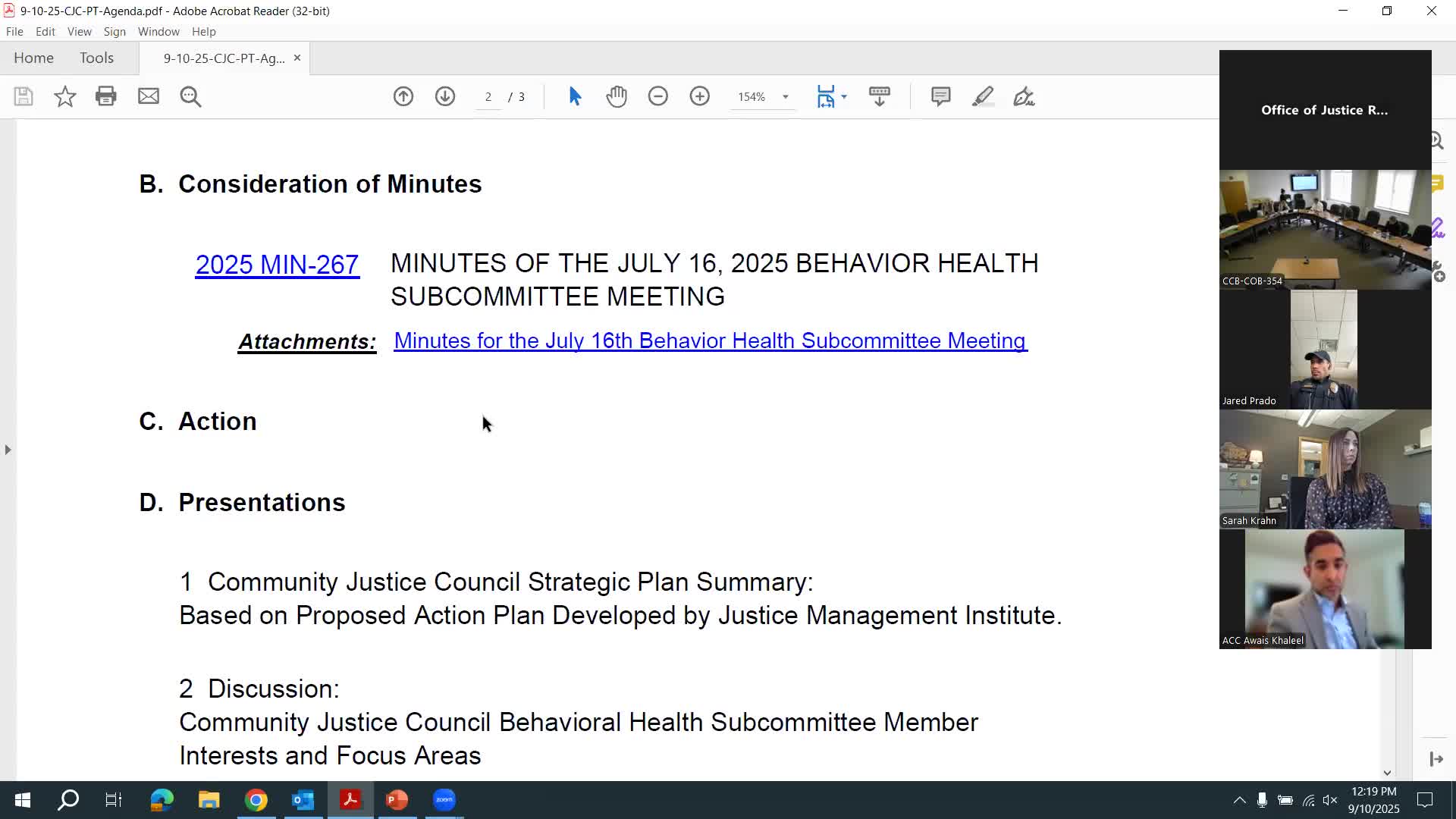
The subcommittee approved the minutes at the start of the meeting (motion and second recorded; outcome: approved). There were no policy votes or formal adoptions tied to the JMI plan during this session; the meeting consisted of presentations and discussion.
Taper: Members asked staff to circulate the SIM provider list and to plan for vendor and service-provider presentations in future meetings so the group can vet recommendations with on-the-ground providers once the final report is available.