Get Full Government Meeting Transcripts, Videos, & Alerts Forever!
Get email alerts on the Wireless Infrastructure topic
No spam. Unsubscribe anytime.
Yolo County planning panel approves 140-foot monopole south of Woodland
Summary
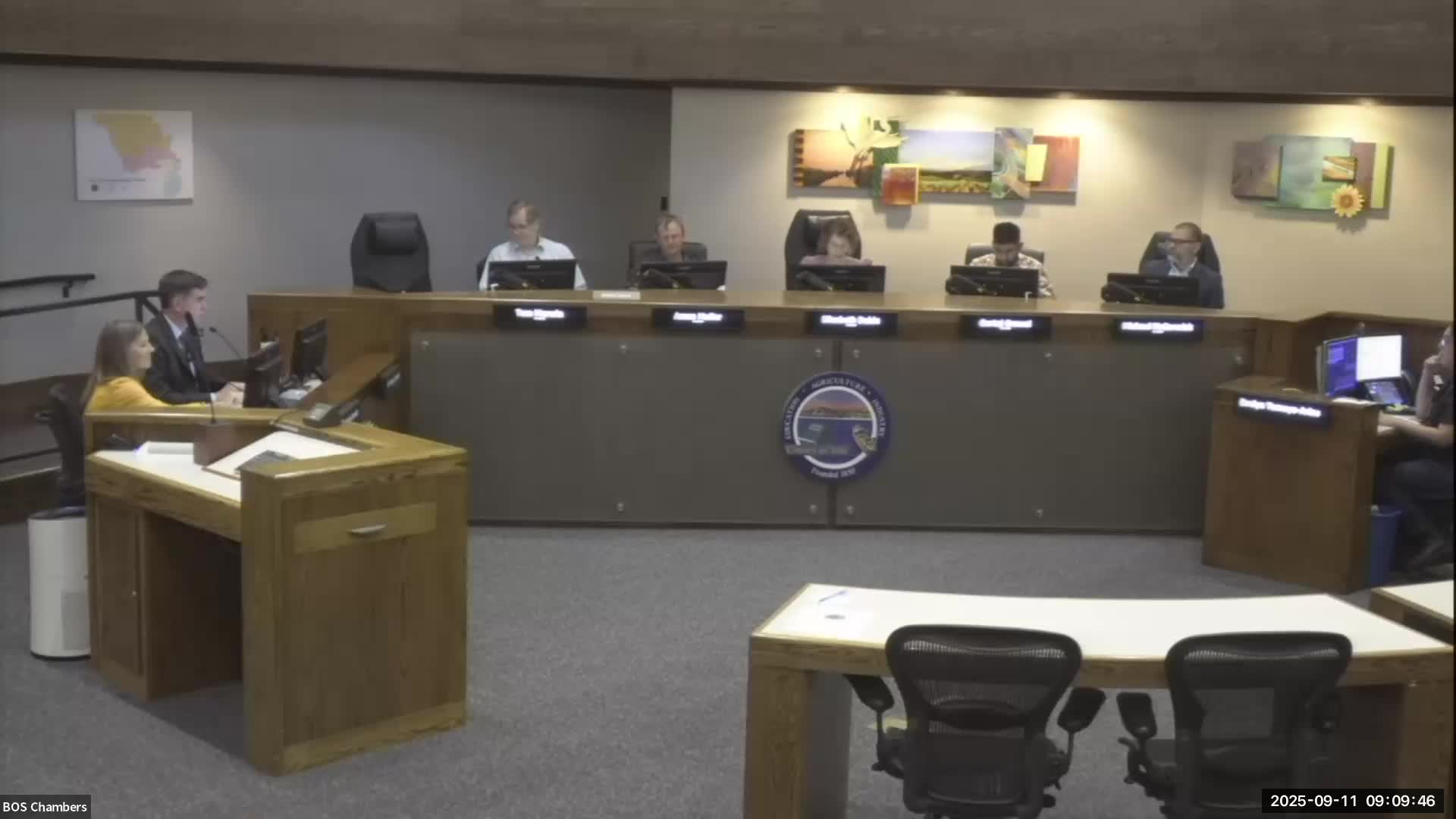
The Yolo County Planning Commission on a 5-0 vote approved a major use permit for a 140-foot monopole cell tower and associated equipment on a 23.79-acre parcel immediately south of the City of Woodland.
The Yolo County Planning Commission on a 5-0 vote approved a major use permit for a 140-foot monopole cell tower and associated equipment on a 23.79-acre parcel immediately south of the City of Woodland.
Staff and the applicant said the facility, to be sited on the Harlan Ranch property, is intended to fill a coverage gap for AT&T in southern Woodland and unincorporated Yolo County; the proposal includes a 900-square-foot lease area, a 30-kilowatt emergency backup diesel generator, and a 200-foot underground power trench to reach an existing utility pole near County Road 99. Aaron Brown, assistant planner with the county Community Services Department, told the commission the lease area sits about 500 feet south of the nearest Woodland residences.
The project was approved after a public hearing and a staff recommendation to adopt an initial-study negative declaration under the California Environmental Quality Act. "Staff recommends the Planning Commission ... adopt the initial study negative declaration, as the appropriate level of environmental review," Brown said during the presentation.
Why it matters
County staff and the applicant said the tower would extend reliable indoor and outdoor cellular service into a gap area that includes residential neighborhoods and the Woodland Memorial Hospital campus on the northern edge of the target coverage area. The applicant, Andrew Lisa of EPIC Wireless Group representing AT&T, said the proposed location "just south of the city limits fills that gap that we're seeing from the existing facility," and that other nearby towers could not deliver the same coverage to the hospital and surrounding neighborhoods.
What happened at the hearing
Staff described the project scope and the alternatives analysis the applicant submitted. Brown said the applicant evaluated about 10 alternate sites in Woodland but concluded the proposed site best met coverage goals and lease/land-acquisition constraints. The staff report and attachments note the applicant provided a radio-frequency emissions compliance report prepared by a third-party consultant (Waterford Consultants) concluding the design complies with Federal Communications Commission exposure standards. Brown reminded the commission that under the Telecommunications Act of 1996 the county may not deny a wireless project based on environmental or health effects of radio-frequency emissions where FCC compliance is demonstrated.
Public commenters voiced both opposition and support. Resident Steve Lonnie said he uses AT&T and argued there is not a demonstrated coverage problem where he lives; he cited concerns about property values, wildlife (bees and birds) and health studies he said showed elevated cancer risks near towers. "I've never had an issue with any calls being dropped," Lonnie told the commission. Property owner Blake Harlan, whose parcel will host the tower, said he has experienced dropped calls and intermittent connectivity for farm operations and agricultural equipment and supports the project. "I very much look forward to the increased coverage," Harlan said, and told commissioners he had discussed colocation with the applicant.
Applicant responses and technical details
Andrew Lisa said AT&T had pursued existing facilities and rooftop options but concluded a new monopole was required to meet service and capacity goals for the target area. He said each cell site will have power and a fiber connection; if fiber is not available the site can use microwave backhaul. He described the facility as unmanned and monitored remotely and noted the planned standby diesel generator would have dual-walled fuel tanks and remote monitoring. Lisa said the site was designed with room to accommodate colocation by other carriers in the future.
Commission discussion and conditions
Commissioners questioned the applicant and staff about alternatives, aesthetics, and whether the county could strengthen permit conditions to more firmly require or encourage colocation to limit proliferation of new towers. Staff and the applicant said the county code already requires new towers to provide opportunities for future colocation "to the extent feasible," and condition language in the staff packet (condition 6) was intended to address shared use and emergency access. Staff also noted countywide mitigation and habitat-permitting programs (county HCP/CCP) are incorporated by reference in project conditions where applicable (condition 16).
Decision
A commissioner moved to approve the project "as staff recommended"; the motion was seconded by Commissioner Grull. The roll call vote recorded "aye" from Commissioners Dubin, McCormick, Mueller, Grull and Sala (recorded as a 5-0 approval). The Planning Commission adopted the negative declaration and approved the major use permit subject to the conditions in the staff report.
What the approval does and does not do
The commission's action approves the permit and CEQA negative declaration as described in the staff report. It does not create or alter federal RF-safety standards; staff and the applicant said the site must comply with FCC limits during construction and operation and that additional carriers seeking to colocate would be required to demonstrate cumulative compliance with FCC standards. The permit also does not resolve broader community concerns about aesthetics, property values or biological impacts beyond the mitigation and review steps included in the CEQA and county conditions.
Next steps
With the planning commission approval, the project proceeds to required building and electrical permits, trenching and utility connection work, and any required coordination with utilities for fiber and power service. Staff noted that changes or expansions beyond the approved lease area or equipment could require additional county review or permits depending on their scope.