Get Full Government Meeting Transcripts, Videos, & Alerts Forever!
Get email alerts on the Special Education topic
No spam. Unsubscribe anytime.
Coronado Unified reports 436 students on IEPs; district outlines RBT training, diploma pathway expansion
Summary
Director of Student Services Nee Foley and special-education coordinator Ryan Keller presented the district's annual special-education report, showing 436 students with Individualized Education Programs as of June 2025 and total special-education expenditures of roughly $10.5 million. The report highlighted efforts to expand registered behavior-
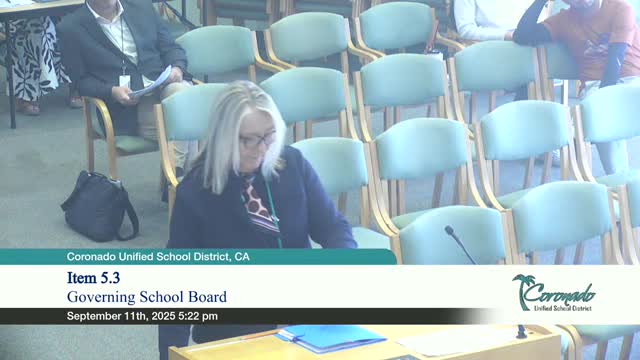
Coronado Unified trustees received the district's annual special-education report on Sept. 11, which showed 436 students identified with disabilities as of the district's June reporting period and outlined staffing, programmatic and fiscal priorities for 2025'26.
Director of Student Services Nee Foley said the report summarises student demographics, the continuum of services, staffing and costs. "Special education is specialized instruction and support designed for school-age children with disabilities," Foley said, citing the Individuals with Disabilities Education Act (IDEA) as the federal framework.
Key findings and numbers:
- Students with IEPs (snapshot, June 2025): 436. - Most common eligibility categories: specific learning disability (largest group), other health impairment (examples: ADHD, asthma), autism and speech-language impairment. - Estimated total special-education expenditures: about $10.5 million; roughly 80% of that is certificated and classified salaries and benefits, with the remaining 20% covering services, nonpublic placements, transportation and operating costs. - Section 504 plans: staff said the district serves roughly another 200 students under 504 accommodations.
Program and staffing priorities outlined:
- Growing an in-house Registered Behavior Technician (RBT) pathway: the district has partnered with adult education and its board-certified behavior analyst to train classified employees as RBTs, reducing reliance on contract nonpublic agencies. - Developing 'independence plans' for students: targeted stepwise plans in IEPs to increase student independence where appropriate, with measurable steps such as distance the instructional aide maintains during transitions. - Expanding alternate diploma pathways: the district described changes in California law that create alternate routes to a high-school diploma for some students with significant cognitive disabilities and said high-school staff are reviewing transcripts and options so eligible students can pursue a diploma while preserving transition services. - Continuing professional learning within site MTSS teams, increased SELPA partnership use for specialized services (orientation/mobility, audiology, OT) and support from a community advisory committee.
Staffing and inclusion approach: Ryan Keller, special-education coordinator, described the district's continuum of placement from full-inclusion general-education classrooms and co-teaching to pull-out resource classes and, as necessary, specialized classes or nonpublic placements. Foley and Keller said the district aims to move students down the restrictive continuum as quickly as feasible while meeting individualized needs.
Trustees and staff discussed challenges including turnover among instructional assistants, scheduling and classroom logistics when several aides are assigned to a single class, and balancing IEP-mandated services with general-campus counseling needs.
Foley and Keller closed with several implementation items for the year: restart the RBT training via adult education, continue building alternate diploma pathways and site-based MTSS professional learning, and expand tools to support independence planning inside IEPs.
Ending: Trustees thanked staff for the report and for outlining concrete next steps on staffing, training and program alignment. No board action was required; the presentation will guide staff work for the upcoming budget and program year.