Get Full Government Meeting Transcripts, Videos, & Alerts Forever!
Get email alerts on the Ebikes Age Limit topic
No spam. Unsubscribe anytime.
Carlsbad commission backs state pilot to bar under‑12 e‑bike riders, votes to seek wider local rules
Summary
The Traffic Safety and Mobility Commission unanimously recommended the City Council adopt San Diego County’s e‑bike pilot (AB 2234) to bar riders under 12, and passed additional advisory recommendations including a passenger restriction for riders under 16 and requests for staff study and state lobbying on registration, licensing and insurance.
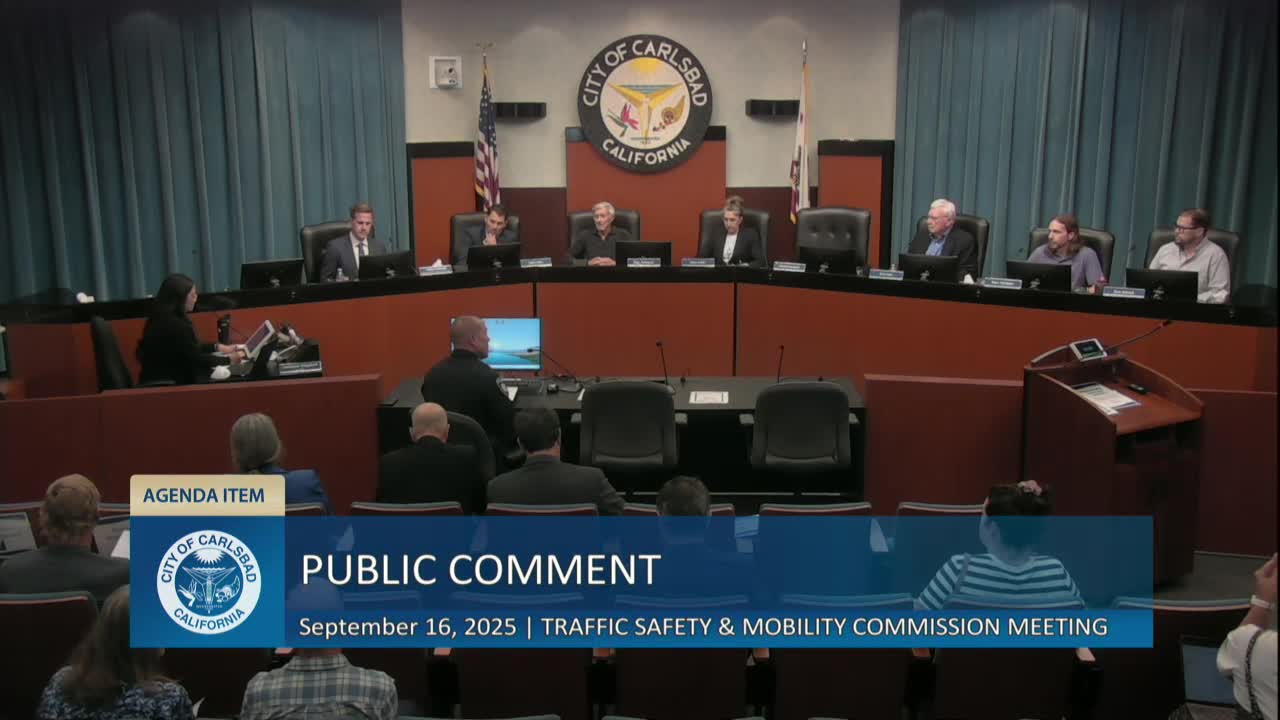
Carlsbad’s Traffic Safety and Mobility Commission on Tuesday recommended that the City Council opt into a San Diego County pilot program that would allow the city to prohibit children under 12 from operating class 1 and class 2 electric bicycles.
City Manager Jeff Patno opened the commission’s discussion by telling commissioners the item responds to a March 2025 City Council motion and to recent state legislation: “We are here this evening because the California state legislature established an e bike safety pilot program that grants cities in San Diego County the ability to prohibit children under the age of 12 from operating an e bike,” Patno said.
The recommendation is advisory; the commission voted unanimously to forward the endorsement to City Council. The vote followed a presentation from transportation staff and the Carlsbad Police Department summarizing local collision and enforcement data, public outreach and the pilot’s statutory limits.
Nathan Schmidt, Carlsbad’s transportation planning and mobility manager, told the commission AB 2234 “gives cities the option to set a minimum age of 12, for riding class 1 and class 2 e bikes. That age limit is set and specified in the law, and it cannot be lowered or raised locally.” Schmidt emphasized the bill requires a 30‑day education campaign before enforcement starts, 60 days of warning‑only enforcement, and that fines may be waived if a rider completes a safety class. The law also makes parents or guardians responsible for violations and sunsets in 2029.
Carlsbad Police Lieutenant Jason Arnotti described recent enforcement and education work and placed the pilot in context. “Since 02/2022, our officers have issued more than 230 warnings and a 180 citations linked to electric bicycles and electric motorcycles,” Arnotti said, and he noted summer enforcement efforts included nearly 180 proactive stops and 28 towed electric motorcycles. He also described school outreach and bicycle safety courses: 24 courses reaching more than 1,500 participants, and distribution of more than 100 helmets through an Office of Traffic Safety grant.
The commission and staff reviewed local collision figures presented by the police department. Over a recent four‑year window the department reported 204 e‑bike injury incidents, peaking at 59 in 2023 and declining thereafter; adolescents aged 12–17 accounted for about 49 percent of e‑bike injury collisions in the presented dataset, while riders under 12 made up roughly 4 percent (with 5 percent recorded as unknown when parties fled and could not be identified). Staff stressed the data is a factual baseline to inform local policy choices, not proof that any single measure will solve the problem.
Public comment at the meeting included parent and resident appeals for action and speakers urging caution about heavy enforcement. Christina McGoldrick, a District 2 homeowner and parent, said, “As both a parent and community member, I believe this is a reasonable, common sense measure to help keep our youngest riders safe.” Several other parents, a former middle‑school principal and a pediatrician expressed similar safety concerns. Conversely, Deborah Bodine, who identified herself as a grandmother and volunteer at local schools, opposed the minimum‑age restriction and warned that aggressive enforcement tools—drones, dedicated officers—risk criminalizing children who are primarily out riding for recreation.
Attorney Michael Harris, who said he represents families of injured children, described the stakes for some injured riders: “He’s got $750,000 in medical bills. His life is forever changed,” Harris said when discussing a current client who was hit while riding an e‑bike.
After public comment and staff responses, commissioners voted on a package of advisory recommendations to forward to City Council. In addition to the unanimous recommendation that City Council adopt AB 2234, the commission voted 5‑1 to advise City Council to adopt a local ordinance prohibiting passengers on e‑bikes for riders under 16 (a proposal modeled on recent actions in other cities). The commission also asked staff to research Marin County’s restriction on certain class‑2 e‑bikes and directed staff to return with a recommendation on whether the city could adopt similar rules. Finally, the commission voted 5‑1 to recommend the City Council lobby the state legislature to consider additional measures such as registration, rider licensing or certification, insurance requirements, and reevaluation of the pilot age threshold.
Commissioners and staff repeatedly framed the pilot as narrowly drawn. Staff reminded the commission the AB 2234 pilot specifically allows San Diego County cities only to set a minimum age of 12 for class 1 and class 2 e‑bikes; it does not authorize local licensing, registration or raising or lowering the age beyond what state law specifies. Those broader tools, several commissioners said, would require legislative change at the state level.
Commission discussion also covered deployment of police drones and targeted enforcement. Arnotti said drone use is limited by department policy to situations where officers reasonably anticipate investigating criminal activity that meets the department’s threshold for such deployments, and that drones are not used simply to monitor class 1 or class 2 juvenile riders.
The commission’s recommendations are advisory and will be transmitted to City Council for final action. Staff said the item’s fiscal impacts and a Council hearing date will be scheduled in a forthcoming staff report; commissioners asked staff to notify them of the Council date so a commissioner could present the commission’s recommendations if available.
Votes at a glance: the commission - Recommended City Council adopt AB 2234 (authorizing a San Diego County pilot to prohibit riders under 12): approved unanimously (6–0; Commissioner Newlands absent). - Recommended City Council consider an ordinance prohibiting passengers on e‑bikes for riders under 16: approved 5–1 (one opposing vote recorded; Newlands absent). - Directed staff to research Marin County’s restriction on class‑2 e‑bikes and report back: approved (motion carried). - Recommended City Council lobby the state to consider registration, licensing/certification, insurance requirements and reevaluation of the minimum age: approved 5–1.
Why it matters: the commission’s decisions will shape the next local step on a policy that combines education, enforcement and engineering—Carlsbad’s stated approach to reducing e‑bike collisions. Because AB 2234 is narrow and local options are limited, commissioners repeatedly urged Council and staff to pursue additional studies and state‑level changes if broader tools are deemed necessary.
The commission’s full packet includes staff collision charts, summaries of more than 550 public emails collected as part of outreach (staff described the email sample as qualitative and not statistically representative), and details on the state pilot’s education and enforcement timeline. City staff said they will return to the commission with requested follow‑up data, including a breakdown of collisions that involved passengers and a proposed schedule for presenting the commission’s recommendations to City Council.