Get Full Government Meeting Transcripts, Videos, & Alerts Forever!
Get email alerts on the Education Arts Funding topic
No spam. Unsubscribe anytime.
County education coordinator outlines how Prop. 28 funding works and local implications
Summary
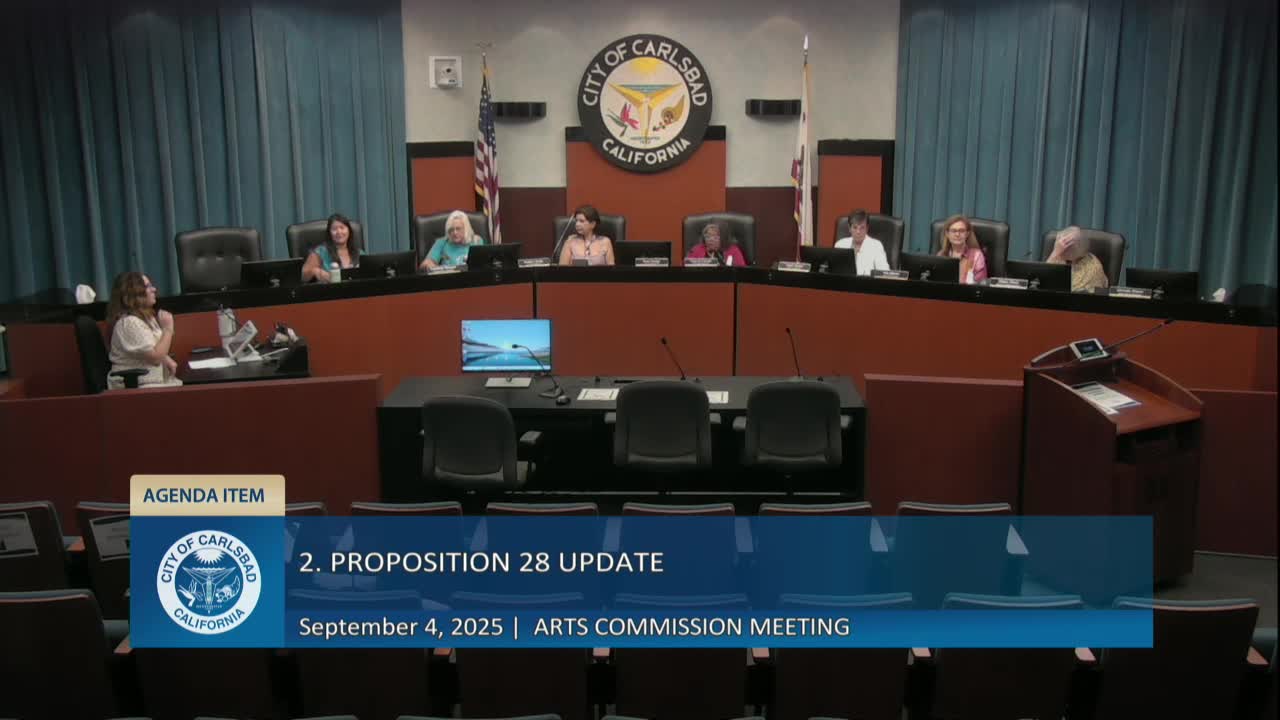
Pauline Crooks of the San Diego County Office of Education briefed the Arts Commission on Proposition 28 funding for arts education: how allocations work, allowable uses, reporting and the three-year spending window for each allocation.
Pauline Crooks, visual and performing arts coordinator at the San Diego County Office of Education, told the Arts Commission Sept. 4 that Proposition 28 provides ongoing, supplemental funding intended to expand and stabilize arts education statewide.
"Proposition 28 passed in November 2022," Crooks said. "It passed with a 64.4% approval rating." She summarized the law's intent, eligible uses, reporting obligations and implementation guidance developed by the California Department of Education.
Crooks emphasized that the funding is intended to supplement existing arts spending, not to supplant it. For districts with at least 500 students the law requires that at least 80% of an allocation be used to employ certificated or classified staff providing arts instruction; districts may retain up to 1% for administrative costs. Remaining funds may be used for professional learning, supplies, materials and arts partnerships with community organizations, but community partners count toward the 80% only if they are district employees.
She explained local implementation logistics aimed at site-level decisionmaking: each school has three years to spend a given year's allocation ("the 2023-24 allocation of money needs to be spent by 06/30/2026"). Districts must post an annual report on how funds were spent and the state is refining reporting tools. Crooks said the funds have already created jobs in some places but noted that many elementary allocations are not large enough to fund a full-time teacher at a single site; districts can pool allocations across sites to share teachers.
Commissioners asked whether Prop. 28 money is reaching North County districts and how to ensure funds are not redirected. Crooks said the allocation spreadsheets are public and counties are assigned a numeric code; she offered to look up specific Carlsbad-area allocations and emphasized that principals, teachers and families should be part of site-level spending decisions. She also encouraged community members to watch public district reports and to consult district legal teams when needed. "If they don't use it, it goes back to the CDE," she said, describing return-and-redistribution procedures.
Crooks recommended building local relationships, supporting arts-education career pipelines and helping districts hire arts educators; she pointed commissioners to CDE and county resources for further information.
The commission received the report; no vote or action was taken.