Get Full Government Meeting Transcripts, Videos, & Alerts Forever!
Get email alerts on the Municipal Finance topic
No spam. Unsubscribe anytime.
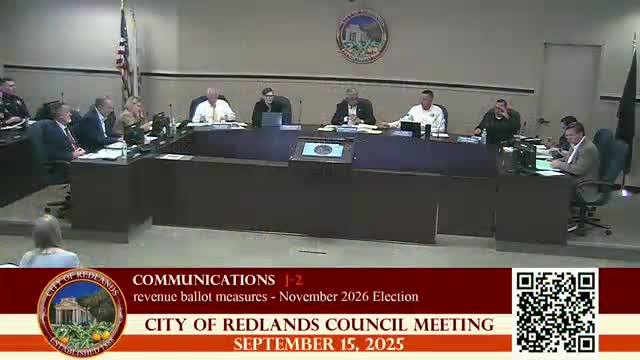
Redlands council directs staff to study paramedic tax, business-license changes for possible revenue measure
Summary
Councilmember Carlos Tejeda urged study of a paramedic parcel assessment, business-license adjustments for fulfillment centers and a possible parcel tax; council directed staff to return with internal calculations on the paramedic assessment by the next meeting.
Redlands City Council on Sept. 16 directed staff to produce detailed cost and revenue calculations for the city's paramedic parcel assessment and to research possible adjustments to business-license taxation for fulfillment and logistics centers as part of exploring a potential revenue measure for the November ballot.
Council Member Carlos Tejeda told colleagues the paramedic assessment, last adopted in 1982, has not kept pace with population growth and service costs. "One of those has always been the paramedic, the paramedic tax," Tejeda said, arguing the levy now contributes only a portion of the cost of paramedic services.
The request to study options was broader: Tejeda also asked staff to review a business‑license tax escalator for large fulfillment centers and to consider a parcel tax targeting distribution facilities. The council debated whether to spend funds on consultants for polling and fiscal analysis; several members instead asked staff to first prepare internal calculations on the paramedic assessment before contracting outside firms.
Public commenters at the meeting expressed strong opposition to new or higher taxes. A resident who spoke during public comment urged the council to reprioritize spending rather than seek new revenue and criticized prior uses of Measure T funds. Bill Blankenship, a Redlands resident who said he works in logistics, urged the council not to single out one industry for new taxes: "If it's decided that public safety is the goal that needs to be funded, I think it's the whole community's job to fund public safety, not one industry," Blankenship said.
City Manager Charles M. Duggan and finance staff told council members they can calculate current paramedic assessment receipts and an estimate of paramedic service costs and then model how different changes would affect revenue. The manager cautioned that timing matters for a ballot measure and noted the staff report listed an August 11 county notification date; he said staff would aim to return data at the council's next meeting so members have options and numbers to consider.
Council members asked for specifics: how the existing assessment allocates charges by building square footage, whether recalculating on a per‑square‑foot basis could reduce charges for smaller properties, and whether changes could unintentionally lower overall revenue without a careful formula. Finance staff said they would provide current receipts, estimated costs and modeling showing what rate changes would be required to close any shortfall.
The council did not vote that night to place a measure on the ballot. Instead, by consensus the body gave staff direction to prepare internal calculations and options focused on the paramedic parcel assessment, with additional outreach and analysis to follow if the council decides to pursue further steps.
Looking ahead, staff said it will return with figures and options at the next council meeting; if the council later chooses to pursue a ballot measure, additional analysis, public outreach and possible polling would follow.