
Stafford MSD reports mixed accountability results; board approves campus and district improvement plans
Get AI-powered insights, summaries, and transcripts
Subscribe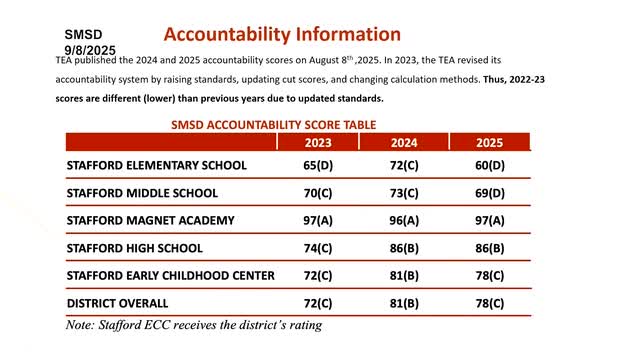
Summary
Superintendent and campus leaders presented 2023–25 accountability results showing gains at the STEM Magnet and declines at elementary and middle schools. Trustees approved campus improvement plans for all five campuses and the district improvement plan after discussion of targeted interventions, staffing changes and summer programs.
Stafford Municipal School District Superintendent Doctor Bostic and district academic staff presented the district—s academic progress report on Sept. 8, outlining gains and declines across campuses and the districtwide strategy to recover student performance.
The teachers-incentive allotment (TIA) and accountability changes at the state level were a recurring theme in presentations. District leadership told the board that changes in TEA—s accountability calculation and updated cut scores contributed to shifts in campus ratings published in August. The district—s STEM Magnet remained highly rated (mid-90s in the district—s accountability index), while the elementary campus and the middle school showed declines compared with the prior year.
Campus leaders described causes and targeted responses. Stafford Elementary reported declines in third- and fourth-grade reading and math and outlined a plan to increase tier-1 instruction fidelity, boost PLC time for teachers and launch earlier —just-in-time— interventions and tutorials. The elementary interim principal said teacher turnover and a need for stronger classroom walkthroughs and coaching contributed to reduced growth in meets/masters levels.
Stafford Middle School leaders told the board the most significant single driver of the middle school—s drop was algebra 1 performance. Board materials and presenters noted a state policy change that expanded placement of students into advanced middle-school math (top 40 percent), which district presenters said led to larger-than-expected algebra 1 enrollments and a weaker cohort performance that affected growth calculations. The middle school described deeper PLC work, data-driven tutorials and staffing changes in the math department, and said it had prioritized reducing teacher absences that had previously eroded instruction time.
Stafford High School officials said the campus remained stable overall but flagged algebra 1 and English I as areas to strengthen; the high school emphasized work to raise SAT/ACT and dual-enrollment performance to protect future CCMR measures.
Early childhood and STEM magnet leaders described separate gains: the early childhood campus reported meeting board literacy and math goals and opening an early STEM academy; the STEM Magnet highlighted student-led data conferences, project-based learning, partnerships with external institutions and plans to expand advanced-course offerings and internships.
Board action and next steps The board moved to approve campus improvement plans for all five campuses and the district improvement plan. Trustees emphasized that the plans must be executed quickly with early evidence of progress: more frequent walkthroughs, calibrated observations, increased coaching, and earlier intervention (including earlier tutorials) were cited as priorities.
Votes at a glance - Campus improvement plans (all five campuses): motion to approve carried unanimously, vote recorded 6-0. Motion moved by Trustee Hanejosa, seconded by Secretary Sosa Montelongo (recorded on the transcript as the motion and second); board approved the plans as presented. - District improvement plan (2025–26): motion to approve carried unanimously, vote recorded 6-0. - Procurement and other approvals (see below): the board approved several year-long food procurement contracts and other routine purchases (motions and votes recorded during the same meeting, see —Votes at a glance— section below).
Why this matters The accountability changes and campus-level drops affect state ratings, federal reporting and grant eligibility and shape district operational choices for curriculum, staffing, tutorials and supplemental programs. Board members pressed district leaders to surface and fix structural issues earlier in the school year so students do not lose an entire academic year before corrective measures take hold.
Ending District leaders said they will return to the board with implementation evidence, including data on PLC activity, tutorial participation, staffing stability, and the early outcomes of the —just-in-time— intervention model. Trustees asked administration to bring any urgent requests for reclassification or additional staffing back to the board as soon as the need is validated.