Get Full Government Meeting Transcripts, Videos, & Alerts Forever!
Get email alerts on the Budget topic
No spam. Unsubscribe anytime.
Port Arthur council grills budget contingency, seeks line‑item detail before adoption
Summary
Council members pressed city finance staff for itemized explanations of a proposed $777,995 contingency and large contractual‑services totals in the draft FY 2025–26 budget, asking for historic spend breakdowns and planned uses before final approval.
Port Arthur City Council members pressed city finance staff on Thursday over large contingency and contractual‑services figures in the proposed FY 2025–26 operating budget, requesting itemized explanations and prior‑year reconciliations before the council votes to adopt the plan.
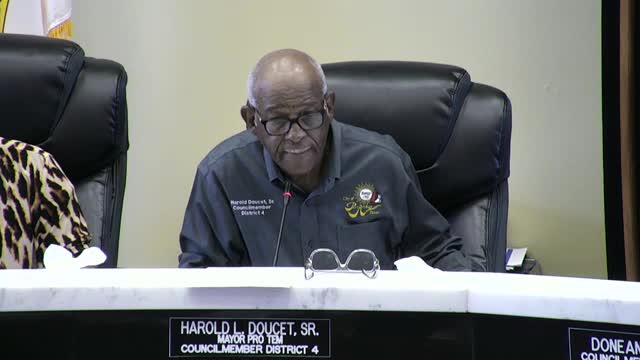
Council member Roy Doucette led the questioning, saying the proposed contingency of $777,995 appeared large compared with recent years and asking for a breakdown of what drove prior contingency spending. Financial staff said the city used a 3% rule of thumb for contingency in the current operating budget and that the proposed amount reflected the limits of available general‑fund capacity under current revenue assumptions.
Why it matters: Councilors framed contingency and “other/contractual” accounts as core accountability items. Doucette said budgets should reflect planned priorities, not catch‑alls, and asked finance to reconcile why contingency rose from prior years’ actual uses (council discussion cited $245,000 used in a recent year) and to show what was spent and on what before vote.
Staff response and next steps: Lynn, the city’s financial director, said the contingency recommendation followed prior guidance to set aside roughly 3% of operating revenues and offered to produce a list of last year’s contingency expenditures. Lynn also pointed council members to details in the budget packet showing contractual‑services line items across multiple department pages and agreed to provide a clearer itemization before the next workshop.
Supporting details: During the workshop councilors referenced several large contractual totals on pages in the packet (development services contractual services aggregated to about $2,000,037 across multiple divisions, and nondepartmental activity lines were highlighted as drivers). Doucette pressed staff to explain why contingency had grown and sought specific line‑by‑line information that staff agreed to supply at the next briefing.
Council direction: Councilors asked staff to return with (a) an itemized reconciliation of contingency spending for the most recent fiscal year, (b) a breakdown of the proposed contractual‑services totals by vendor and purpose, and (c) clarity on which amounts represent one‑time or carryover commitments. Finance agreed to provide those documents for the next budget workshop.
Ending note: The workshop continued into detailed departmental questions; councilors emphasized that final adoption should follow clearer documentation so elected members can see what they are approving and how prior contingency and “other” dollars were spent.