Get Full Government Meeting Transcripts, Videos, & Alerts Forever!
Get email alerts on the Retiree Health Insurance topic
No spam. Unsubscribe anytime.
Leander firefighters propose employee-funded retiree insurance pool
Summary
Leander firefighter negotiators proposed a self-funded retiree medical plan funded by payroll deductions and administered by the city during bargaining, with tiered coverage based on years of service and discussion of implementation details and legal/benefit implications.
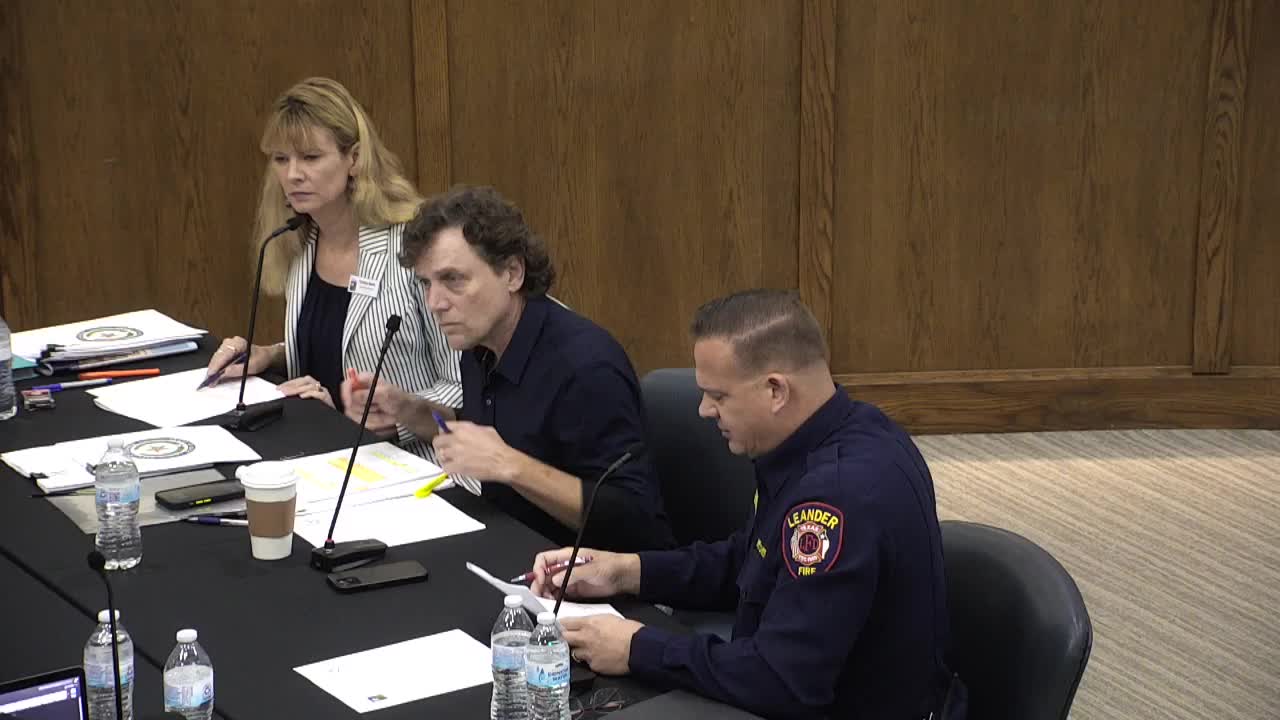
Leander firefighters and city negotiators discussed a proposal on Sept. 12 to create a self-funded retiree medical plan paid by employee payroll deductions.
The Leander Firefighter Association’s proposal, presented by Dan (Association representative), would require a per-pay-period payroll deduction from employees into a department-managed fund that would pay post-retirement medical premiums for eligible retirees. “The plan will be funded by payroll deductions of $30 per pay period from each employee,” Dan said when outlining the proposal, adding that the city would maintain the insurance program’s administrative functions.
Why it matters: negotiators said the plan aims to guarantee medical coverage for retirees without placing the full future funding burden on the city budget. Under the association’s draft, eligibility and maximum years of paid coverage would scale by total years of service — for example, employees with 20 or more years would be eligible for up to five years of retiree coverage or until Medicare eligibility, whichever comes first. The union’s working estimate used a 450-employee base and $20–$30 per pay-period deduction, which the association calculated would produce roughly $216,000 annually at $30 per pay period based on that head-count.
Details and open questions: negotiators debated several implementation points but did not reach final agreement. The association described the plan as a vehicle to pre-fund retiree coverage: “We’re putting money into a bank now, so it’s there when we retire,” Dan said. City staff (Christy, HR representative) and the fire chief raised operational and fiscal considerations, including the mechanics of tying the plan to the city’s existing insurance program, how premiums would be set if carriers change, and whether the deduction would be mandatory or voluntary. City staff noted existing procurement and administration constraints, and said proposals to change insurance design would require additional analysis and vendor procurement in some cases.
Staff identified several follow-ups the parties agreed to pursue: collect more detailed premium and enrollment assumptions, run fiscal scenarios showing short- and long-term fund balance trajectories, and research alternate voluntary programs and third-party structures used in other Texas cities. City staff also flagged potential legal and benefit interactions (for example, interactions with federal benefits and Medicare) and agreed to research whether any city or insurer rules would restrict a local self-funded retiree pool.
Outlook: union negotiators said they will supply written language to memorialize the association’s intent to create a retiree fund and to flesh out eligibility tiers and funding assumptions; city staff said they will return with cost models, procurement options and legal/benefit considerations. No binding decision or vote was taken at the meeting.
Ending: Both sides agreed to continue the discussion in upcoming bargaining sessions and to provide the additional data requested before drafting final contract language.