HFSC says firearms backlog will take years to clear as staffing, training lag behind demand
Loading...
Summary
Houston Forensic Science Center President and CEO Peter Stout told the board that firearms case turnaround remains the center's largest operational challenge, driven by long training timelines, a national shortage of examiners, court backlog and prior budget gaps; seized-drug and other disciplines have improved.
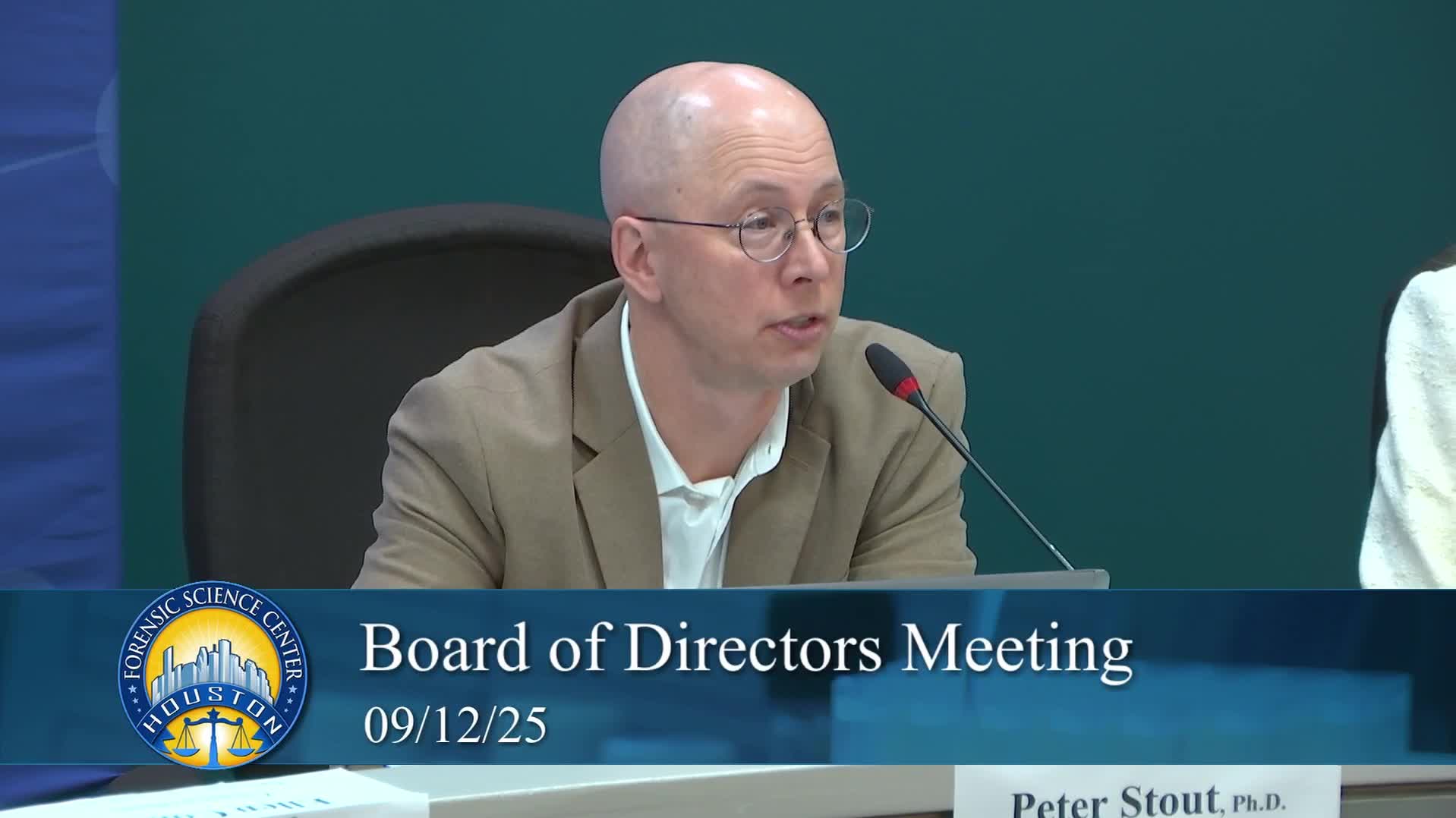
Houston Forensic Science Center President and CEO Peter Stout told the HFSC board that the center’s longest-running operational problem is its firearms backlog and that clearing it will take years even with recent budget increases.
Stout told the board that construction work at the center is progressing and that many basement permits are complete, but the urgent operational pressures are forensic backlogs — particularly firearms. “Firearms is the single biggest pain point,” he said, noting a national shortage of examiners and slow, multiyear training requirements.
The issue matters because firearms evidence is commonly central to violent-crime prosecutions and because court slowdowns during and after the COVID-19 pandemic amplified demand. Stout said courts’ heavier caseloads in 2022 and 2023 contributed to a spike in subpoenas and that the court backlog preceded and then exacerbated HFSC’s own backlog.
Stout described multiple contributing factors. He cited a reagent manufacturing problem from QIAGEN that temporarily delayed forensic-biology testing and that was reflected in longer turnaround times for DNA work. He said seized-drug turnaround has improved steadily as analysts were cleared for production. Digital multimedia and some other sections have returned toward pre-pandemic turnaround times, he said.
But firearms work has a much longer training arc. Stout said the state of Texas has about 72 licensed firearms examiners statewide, a figure he used to illustrate the nationwide scarcity. He described HFSC’s staffing and training plan in detail and warned that the center cannot compress established competency requirements. “If we don’t pull examiners to train new people, we’re never going to get trainees through,” Stout said. He estimated that a hire who already has firearms experience would require about six months to be signed off on HFSC casework because they must learn HFSC’s quality systems and reporting tools. By contrast, academy-style training for novices can take roughly two years to produce fully independent examiners.
Stout gave numbers discussed during the meeting: HFSC currently has four people in firearms training, plans to post five additional positions that would enter training, and has four technicians in training in related roles. He said the center’s staffing goal is to reach 13 firearms examiners but acknowledged recruiting experienced examiners is difficult. He said HFSC is issuing a request for proposals for external trainers to accelerate the training pipeline.
On funding, Stout traced the recent budget history and said the center saw one-time increases from American Rescue Plan Act funds and more substantive recurring increases under the current mayoral administration. He said earlier flat budgets set the conditions for the present backlog and that steady, recurring staffing funding is necessary to avoid repeating the problem.
Stout also updated the board on hemp- and THC-related testing uncertainty. He said a recent executive order from Gov. Greg Abbott — issued after the presentation slide was prepared — sets a minimum purchase age of 21 for cannabis products and attempts to address chemical-conversion issues, but that “we are in the same kind of murky circumstance that we've been for the last six years” on which compounds laboratories must analyze. That regulatory uncertainty, he said, has lengthened training and testing complexity for seized-drug toxicology and contributed to longer seized-drug turnaround times compared with the pre‑HB 1325 period when seized-drug turnaround could be about seven days.
Stout closed by describing HFSC’s involvement with the statewide forensic apprenticeship program established by recent legislation. He said available funding covers 18 apprentices statewide and that HFSC is working with the Texas Forensic Science Commission and the Office of Court Administration to stand up rules and implementation over the next 12 months.
The board did not take formal action on operational items at this meeting; Stout’s report was informational. He and the board discussed recruitment strategies, realistic productivity expectations for newly signed-off examiners and reliance on external training contracts as a near-term mitigation.