Get Full Government Meeting Transcripts, Videos, & Alerts Forever!
Get email alerts on the Disaster Coordination topic
No spam. Unsubscribe anytime.
Houston Ready roundtable urges improved communications, data‑sharing and neighborhood-focused recovery planning
Summary
Kelly Hearn of the mayor’s office reported roundtable work that identifies communication preferences, data-sharing gaps, phased food responses and handoff strategies for housing and recovery, and cited recent assistance for a local apartment fire.
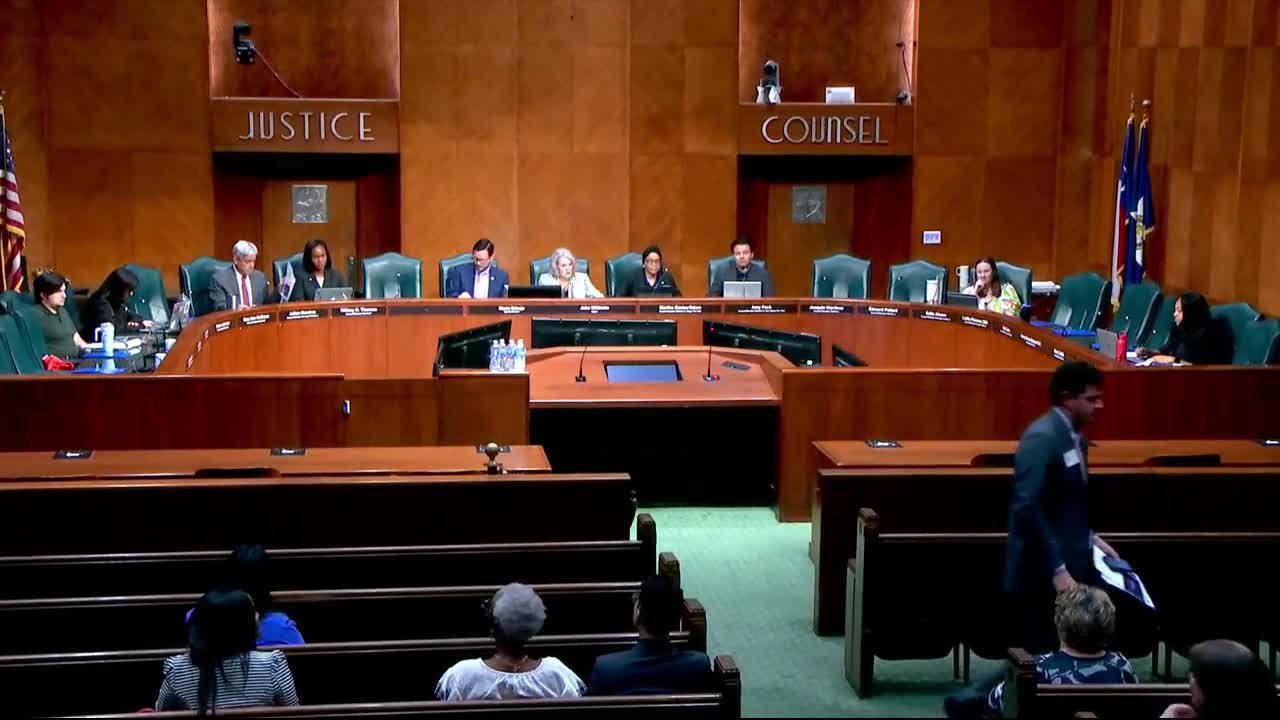
Kelly Hearn of the mayor's office briefed the Resilience Committee on Sept. 18 about the Houston Ready roundtable’s work to better align city departments, nonprofits and neighborhood leaders around preparedness, communications and recovery handoffs.
Hearn said the roundtable has met seven times and established subgroups focused on vulnerable populations, financing, volunteers, food, handoffs, readiness and neighborhood approaches. "We wanted to give the groups a chance to start to work together," Hearn said, describing an exercise that simulated a disaster that took out infrastructure and made communications difficult.
Hearn summarized three main themes that emerged: tailoring communications to community preferences and trusted messengers; prioritizing cleanup and services for vulnerable populations; and improving data sharing so residents do not repeatedly recount the same information to multiple caseworkers.
On communications, Hearn said strategies include door‑knocking, recorded community meetings, canvassing and neighborhood-captain training (for example through CERT) to reach residents who do not use social media or trust traditional media. She also recommended linking city volunteer departments directly with volunteer organizations and using multilingual robocalls and visual evacuation plans for accessibility.
On services for vulnerable populations, the roundtable recommended mapping and pre-staging resources for rapid deployment within 72 hours, coordinating debris removal with VOADs and crisis-cleanup partners, and expanding transportation options (Metro, ADA-compliant providers, church support) for people with mobility needs.
Hearn highlighted food coordination changes from the roundtable: dividing response into three phases — life-sustaining (first 96 hours), replacement and recovery — and setting triggers for organizations to switch phases to avoid duplication and ensure equitable distribution.
The handoff subgroup has mapped the housing-delivery sequence and is drafting memoranda of understanding and data-sharing agreements to improve case management continuity for renters and homeowners, Hearn said. "We need to make sure there's that continuity there with their data," she said.
Hearn cited recent roundtable coordination after a fire at the Three Corners apartment complex, which affected nearly 400 people; she said 56 families "lost everything" and 52 units had smoke or water damage. Hearn said partners including Memorial Assistance Ministries, Red Cross and United Way helped, a private funder supported immediate needs and the Small Business Administration was opening a location for low-interest disaster loans "starting, I believe, today."
Hearn said groups will revisit goals and invite additional neighborhood leaders to the next meeting tentatively scheduled for Nov. 20.