Get Full Government Meeting Transcripts, Videos, & Alerts Forever!
Get email alerts on the Coastal Conservation topic
No spam. Unsubscribe anytime.
Homeowner outlines dune walkover mitigation after unauthorized construction; planning commission opens hearing but takes no action
Summary
The Planning Commission heard a public hearing about required dune mitigation at 23623 FM 3005 after a beachfront walkway extension caused unauthorized impacts to dune vegetation. The property owner described a recent rattlesnake bite to a family member and the mitigation plan; commissioners closed the hearing and took no formal action.
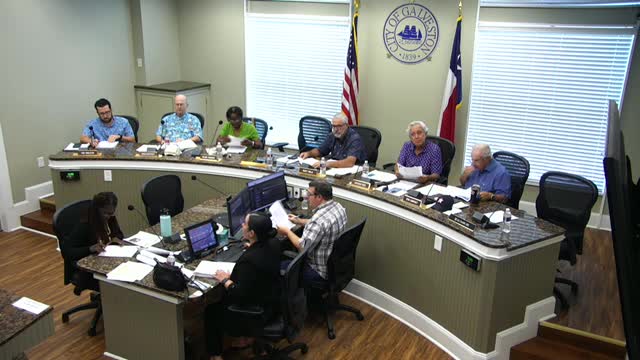
The Planning Commission opened a public hearing Sept. 16 on mitigation for unauthorized impacts to a dune system at 23623 FM 3005 after a dune walkover extension affected dune vegetation. Staff described the site, presented Bureau of Economic Geology erosion maps and photos of the impacted dune, and said mitigation was required for unauthorized sand and vegetation disturbance identified during compliance inspections.
The property is in the Miramar subdivision and consists of two platted lots described in staff materials as Abstract 121 Miramar Lot 14 (0.521 acre) and Lot 13 replat (0.6958 acre). Staff cited a Bureau of Economic Geology erosion rate in the area of about 1 foot per year.
Homeowner Bob Baker spoke at the hearing and described why his family reconstructed and extended the walkover. Baker said his wife had been struck by a six‑foot rattlesnake at the base/top of the dune while using the old, low walkover, which motivated the owners to raise and reconfigure the structure to increase clearance. Baker described construction details, including piling work and a mitigation plan developed in coordination with the city’s coastal resources liaison, and said vegetation regrowth was already visible in the weeks after construction. "After 36 hours in the UTMB ICU and $30,000 worth of rattlesnake antivenom, thank God she's okay," Baker said, describing the incident that prompted the reconstruction.
Commissioners asked whether the walkover had been permitted; staff said the walkover had been permitted but that while construction was in progress contractors created unauthorized sand and vegetation impacts that staff observed during compliance inspections. Commissioners also discussed visual evidence of other mid‑dune walkovers on adjacent properties and asked about enforcement resources; staff said compliance inspections are routine but enforcement is limited by staffing.
Outcome: The commission closed the public hearing and recorded that no formal action was required on the mitigation plan that evening.
Context and next steps: Staff noted a mitigation area of record for the unauthorized impacts and said the mitigation plan allows up to three years for vegetation regrowth, with the developer/homeowner able to plant native species or seeds to accelerate recovery if natural regrowth was insufficient. The staff report and photographs are part of the administrative record. If the mitigation schedule or practices do not meet permit conditions, the city’s compliance process could trigger additional enforcement or follow‑up inspections.
Quotes: "This is a public hearing for dune mitigation associated with the extension of a dune walkover," a staff member said in opening the item. Homeowner Bob Baker said the reconstruction was motivated in part by a recent rattlesnake strike on his wife: "After 36 hours in the UTMB ICU and $30,000 worth of rattlesnake antivenom, thank God she's okay."