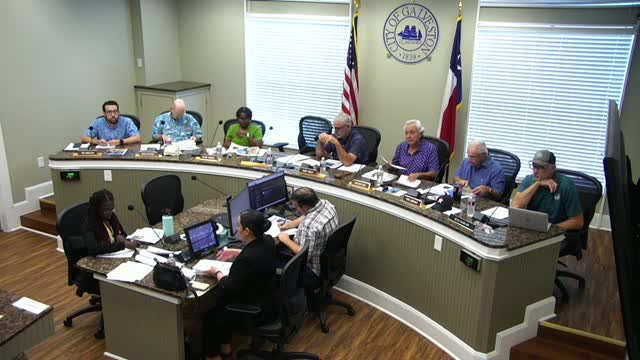
Planning Commission recommends PUD for Seawall project after airport safety debate, adds noise disclosure and housing conditions
Loading...
Summary
The Galveston Planning Commission on Sept. 16 recommended approval of a Planned Unit Development application for 10302 Seawall Boulevard, a multi‑building mixed‑use proposal that would include two condominium towers, a 216‑key hotel and retail, subject to added conditions requiring a full buyer disclosure about airport noise and a developer commitment for workforce and J‑1 student housing.
The Galveston Planning Commission on Sept. 16 recommended approval of a Planned Unit Development application for 10302 Seawall Boulevard, a multi‑building mixed‑use proposal that would include two condominium towers, a 216‑key hotel and retail, subject to added conditions requiring a full buyer disclosure about airport noise and a developer commitment for workforce and J‑1 student housing.
The project, presented by architect Steven Beagle and developer Mohammed Aldaway of Royal Crown Enterprise LLC, proposes three buildings along Seawall Boulevard and two residential buildings behind them on a 15.2‑acre site. The applicant said phase 1 would include two condominium towers (about 150 condominium units total), a 216‑key Renaissance Marriott hotel, roughly 70,000 square feet of retail and parking mostly under podium decks. The applicant said phase 1 construction cost is estimated at about $400 million, with phase 2 at $140 million, for a combined $540 million development.
City staff and the applicant told commissioners the development team reduced the proposed maximum building height from an earlier 155 feet to 145 feet after consultations with federal aviation authorities. Tim Tejans of the City’s Development Services Department summarized project studies including a traffic impact analysis and a stormwater/drainage analysis and noted the site is within the HDDZ (height and density) overlay and AE‑12 FEMA flood zone; base finished floor elevations for habitable structures would be about 13.5 feet because of freeboard requirements.
Why it matters: the site lies near established approach and traffic patterns for Galveston’s airport. Airport director Mike Shahan said the FAA had issued a “determination of no hazard to air navigation” for a structure topping out at 145 feet, but urged the city to protect airport operations through local zoning, deed restrictions and advance coordination for temporary construction equipment such as cranes. Shahan warned extended crane operations can penetrate approach surfaces and temporarily raise approach minimums, potentially affecting landings in poor weather, and said noise complaints from high‑value nearby residents are a frequent cause of pressure on airports elsewhere. "The FAA puts the burden on the city to protect the airport," Shahan said.
Developer and architect presentations: Architect Steven Beagle described project components, podium parking, and the applicant’s plan to keep the towers’ design within the FAA’s 145‑foot determination. Beagle said the applicant will provide retail, restaurants and amenities intended to activate the West End and anchor future visitor demand. "We backed off from 155 to 145," Beagle said, citing the FAA review that found no hazard at the lower height.
Airport concerns and mitigation: Mike Shahan told commissioners he had recommended the developer obtain a separate FAA determination for temporary construction equipment (tower cranes) because equipment heights can exceed the structure height and would require separate notice to FAA. He also recommended deed restrictions or disclosure statements to prospective buyers acknowledging airport noise and potential operational impacts. Shahan urged the city to pursue airport‑adjacent zoning changes on a separate track so the airport is protected from incompatible future land uses.
Public comment split: Speakers included residents, pilots and business representatives. Supporters — including representatives of Tiara on the Beach and the Galveston Economic Development Partnership — emphasized the project’s potential tax and job benefits, and said modern, higher‑density investment is needed on the West End. Opponents and pilots raised safety and noise concerns; several airport advisors urged stricter limits on height and on construction timing/permits.
Commission action: After deliberation commissioners moved to recommend approval of the PUD with added conditions. The planning commission vote approved the applicant’s request but the commission amended the recommendation to include two explicit stipulations: (1) a full disclosure statement or deed restriction requiring prospective buyers to acknowledge potential excessive aircraft noise and the presence of the airport; and (2) incorporation of the workforce and J‑1 student housing commitments described in the applicant’s narrative into the PUD commitments (the developer had proposed that 25% of rear phase apartments be dedicated to J‑1 student visas and 25% to workforce housing). The motion carried and will be forwarded with the commission’s recommendation to City Council.
What remains: The FAA letter covers the studied permanent structure height (145 feet) but it does not cover temporary construction equipment; the airport director asked that the developer obtain FAA review for any cranes or derricks that would exceed the studied height during construction. The developer and staff also acknowledged outstanding engineering items: revised sealed dates and coordination with TxDOT on driveway placement per the traffic impact analysis, additional downstream drainage improvements and profile surveys requested by CenterPoint Energy to confirm utility clearances.
Quotes: "The FAA only checks whether development poses a hazard to our airspace," Mike Shahan, airport director, said, adding that "the FAA puts the burden on the city to protect the airport from other develop[ments] for incompatible land uses." Architect Steven Beagle said, "We backed off from 155 to 145," describing the design change after FAA review. Developer Mohammed Aldaway said the project is intended as a long‑term investment in Galveston and to create jobs and restaurants for the West End.
Ending: The Planning Commission’s recommendation — including the added noise‑disclosure and housing stipulations — goes next to City Council for final action. Council will also receive the staff technical studies (traffic, drainage) and the FAA correspondence attached to the record.