Get Full Government Meeting Transcripts, Videos, & Alerts Forever!
Get email alerts on the Land Use Rezoning topic
No spam. Unsubscribe anytime.
Brownsburg council advances first reading for mixed I‑1/C‑2 rezoning along U.S. 136 after developer adds commitments
Summary
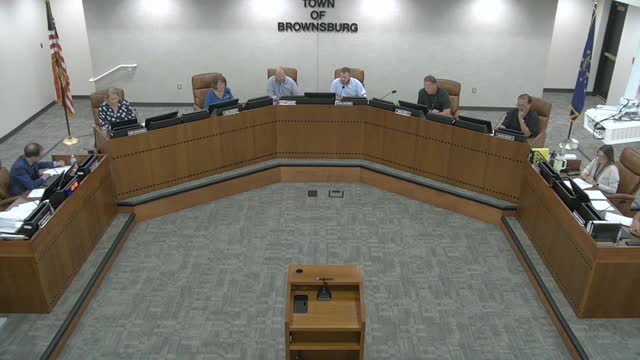
The Brownsburg Town Council on Sept. 11 advanced a proposed rezoning for two parcels at 10310 and 10508 East U.S. Highway 136 to second reading after the developer agreed to file written commitments addressing height, traffic and leasing priorities.
BROWNSBURG, Ind. — The Brownsburg Town Council on Sept. 11 moved a proposed rezoning of two parcels at 10310 and 10508 East U.S. Highway 136 to second reading after the petitioner pledged written commitments addressing height, traffic and leasing priorities.
The proposal seeks to rezone the property to a mix of I‑1 (light industrial) and C‑2 (commercial) to allow flex industrial buildings and small commercial storefronts along the U.S. 136 frontage. Planning staff and the Advisory Planning Commission (APC) both recommended an unfavorable vote, saying the town’s comprehensive plan designates the site for residential use and that industrial zoning would not complement surrounding neighborhoods or existing recreational uses.
Why it matters: The site borders the Cadence Midwest Sports Complex and residential neighborhoods. Councilors and staff warned that light‑industrial uses could generate truck traffic and create a character mismatch if the industrial portion expands beyond the commercial frontage. The rezoning would change what can be built on a site that has been vacant since 2007.
Planning staff gave the council the recommendation and a planning analysis that noted the future land‑use map calls for residential, that existing park/recreational zoning sits nearby and that wastewater utilities are outside the Brownsburg service area (Citizen Energy Group/other utilities handle sewer). Staff also flagged the need for an INDOT (Indiana Department of Transportation) traffic study for state‑controlled access on U.S. 136.
The applicant’s attorney, Tim Oakes of Ice Miller, told the council the project team has since expanded outreach and produced additional commitments that were not in the APC record. “This property has actually been vacant since 2007 for 18 years,” Oakes said, urging the council to consider both the comp plan and market realities that have left the site unused. He said INDOT staff reviewed an access concept and told the applicant the planned access point was permittable subject to a required traffic study.
Conrad Jacobs of Affinity Corp, the project developer, described building types they plan to deliver: a shallow‑bay “Building 2” for small local businesses and a second building intended for tenants in the 20,000–25,000 square‑foot range. Jacobs said most small tenants he targets do not generate regular semi‑truck traffic and offered to limit the number of dock doors installed on Building 1 and keep some as knockouts that would be added only if needed.
The petitioner also offered a list of commitments for council review prior to second reading. The commitments discussed in the meeting included a maximum building height of 25 feet, an agreement not to seek tax abatement, a contribution toward resolving certain nearby drainage issues, and a leasing priority reserving a share of space for sports‑ and recreation‑related tenants for a limited term. The petitioner initially proposed reserving 15% of Building 2’s leasable space for sports/recreation tenants for four months; councilors asked for longer and the applicant agreed to revise the commitment (council discussion favored extending to 12 months or adjusting building finishes so the space better suits small tenants).
Council debate focused on two main points: preserving commercial development on the U.S. 136 frontage (C‑2) while avoiding heavier industrial uses inland (I‑1), and ensuring the development does not generate heavy truck traffic incompatible with nearby residential streets. Several council members said they supported retail and restaurants at the frontage but were wary of semis using neighborhood roads; the project team responded that INDOT‑required access controls and the proposed limitations on dock doors would reduce ongoing large‑truck traffic.
Council guidance and next steps: The council approved moving the ordinance (2025‑16) forward on first reading and instructed the applicant to file revised commitments and a corrected legal description (to add a 1.7‑acre frontage piece) before second reading. Staff said the commitments will be incorporated into the ordinance at second reading if the council chooses to adopt them.
What was not decided: No final rezoning vote occurred on Sept. 11. The APC had forwarded an unfavorable recommendation; the council may adopt, modify, or reject the rezoning ordinance on second reading once the commitments and legal descriptions are finalized.
Speakers at the meeting included Steve Fletcher, planning staff, who presented staff’s analysis; Tim Oakes, attorney for the petitioner (Ice Miller); Conrad Jacobs, Affinity Corp (developer); and members of the council and public who raised traffic and compatibility concerns. The petitioner and staff said INDOT will require a traffic study and permitting for the U.S. 136 access if the project proceeds.
Provenance: Council discussion and staff presentation on the rezoning begin in the meeting transcript at the item announced as “11.3” (first discussion block). The applicants’ presentation and the council’s request that commitments be submitted before second reading concluded with the clerk’s direction to revise commitments before the next meeting.
Ending: The council’s decision to advance the item preserves multiple options for the site: the proposal can be revised before second reading, denied, or ultimately approved with the petitioner’s commitments. If the project proceeds, INDOT review and a traffic study are among the regulatory steps the town and developer will need to satisfy.