Get Full Government Meeting Transcripts, Videos, & Alerts Forever!
Get email alerts on the Land Use Cluster Development topic
No spam. Unsubscribe anytime.
Board adopts zoning change lowering minimum acreage for cluster subdivisions from 10 to 5 acres
Summary
The Board approved ordinance 25-21 to amend recreation and performance standards by reducing the minimum gross acreage for cluster subdivision techniques from 10 to 5 acres and to clarify related parking and open-space rules.
The York County Board of Supervisors adopted ordinance 25-21 on Sept. 16, approving amendments to the zoning ordinance that change recreation requirements for planned developments and revise performance standards for cluster subdivisions.
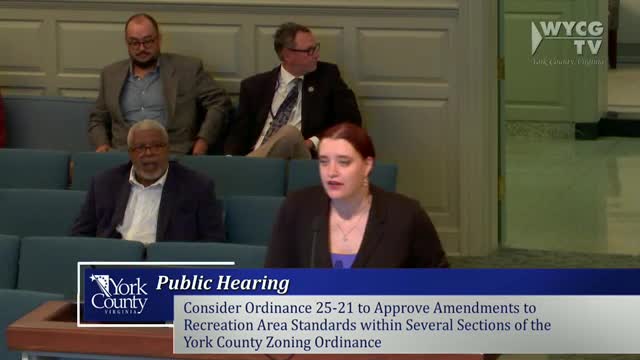
Caitlin (planning staff) summarized the proposal and told the board the change to allow cluster subdivision techniques on parcels of 5 acres or more is rooted in the county comprehensive plan’s environmental element, which recommends techniques to preserve open space as large tracts become less available. Planning staff provided spatial analysis showing many parcels of five acres or more appear ineligible for cluster techniques because of parcel geometry, septic/sewer limits or conservation easements.
Caitlin said cluster developments will still be limited by the underlying zoning density — the amendment does not increase the number of homes that can be built on a parcel, only the option to use clustering as a development technique where the gross acreage meets the revised minimum. She told the board that cluster subdivisions must still set aside at least 40% of gross acreage as common open space and that recreational amenities will be required but the ordinance language was softened to give flexibility for smaller cluster developments.
Public speakers included AT Hamilton, who said his 9.3-acre parcel was just under the former 10-acre threshold and urged approval so his project could proceed. Ron Scribe, a community member, urged caution and asked whether rezoning or a special permit could address individual situations rather than a broad ordinance change.
Supervisor comments noted that utilities (public sewer and water) and parcel geometry are limiting factors in whether clustering is practical and that townhouses and multifamily developments had driven earlier parking-standard updates. Several supervisors praised staff analysis and the planning commission’s recommendation.
Motion: Supervisor Shepherd moved to adopt ordinance 25-21 to approve amendments as presented. The board voted by roll call; Supervisors Holroyd, Drury, Roan, Shepherd and Chair Noll voted yes. Planning commission had recommended approval 4–0 with one abstention.
Caitlin: “Cluster developments, 40% of the gross acreage has to be reserved as common open space at a minimum.”
What changed: minimum gross acreage to employ cluster subdivision technique reduced from 10 to 5 acres; parking standards clarified to prevent counting a garage as the single required off-street space in townhouse/planned developments; recreational-amenity language for clusters made less prescriptive and more flexible.
Next steps: staff to codify the ordinance amendment, and it becomes effective according to the county’s ordinance-adoption schedule.