Get Full Government Meeting Transcripts, Videos, & Alerts Forever!
Get email alerts on the Hog Island Ldr Amendment topic
No spam. Unsubscribe anytime.
Teton County delays decision on Hog Island zoning amendment after hours of testimony
Summary
A proposed amendment to allow contractor yards and limited industrial primary uses in the Hog Island workforce home business zone was continued to Oct. 7 after extensive public comment and commissioner questions about community character, wildlife, water quality and consistency with the comprehensive plan.
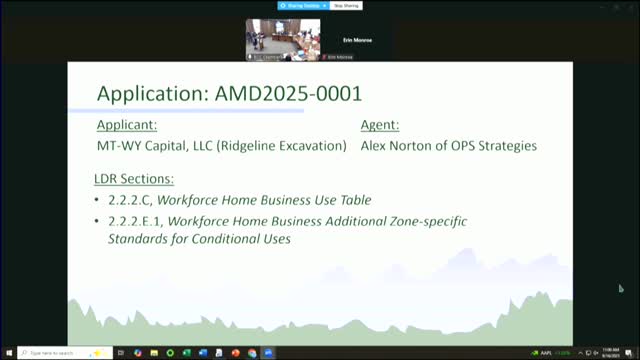
Teton County commissioners on Tuesday continued consideration of an amendment to the workforce home business (WHB) zoning rules — a proposal from Ridgeline Excavation to allow certain contractor and heavy equipment uses as primary uses near Highway 89 in the Hog Island area — to the board’s Oct. 7 meeting after extended public comment and staff and applicant presentations.
The applicant, Ridgeline Excavation owner Kirk Hogan, and his agent Alex Norton (OPS Strategies) said the amendment would create lawful, permitted locations for local contractors who provide snow removal, storm response and other infrastructure services. Norton and Hogan argued the business park zoning district is built out and that Hog Island already contains a cluster of yard‑type operations and nonconforming industrial uses.
Opponents and planning staff said the amendment would conflict with the comprehensive plan’s stated future character for Hog Island (stable, residential with accessory home businesses), would diminish predictability for neighbors who relied on recent regulations, and could threaten wildlife permeability, scenic resources and groundwater‑sensitive areas.
Why it mattered
Erin Monroe, associate long‑range planner, told the board the WHB zone was created in 2022 with standards intended to keep uses residential in character and accessory businesses limited (for example, employee count and material storage restrictions). Monroe said the amendment would introduce a narrow subset of ‘‘light and heavy industry’’ as primary uses limited to contractor businesses, limited to sites of up to 3 acres and only where a portion of the proposed 3‑acre site lies within 200 feet of the WY‑89 right of way.
Public comment
Speakers at the hearing included long‑time Hog Island residents and local nonprofit advocates. Elizabeth Eastman, whose family operates Eastman Excavation and Timber Works and has run an accessory contractor business under CUP for years, opposed the amendment as inequitable to owners who built under the 2012 comp plan and urged the board to preserve predictability. The Jackson Hole Conservation Alliance submitted written comment opposing the proposal and urged denial, citing the area’s scenic overlay, proximity to a 2020 wildlife crossing and groundwater sensitivity.
Applicant rationale and proposed limits
Kirk Hogan said his company operates county snow contracts and emergency responses and has limited local options for legal primary contractor yards. The proposal would restrict allowed industrial activity to building and special trade contractors (paving, excavation, hauling, roofing, etc.), require an operations plan and screening, limit hours of operation (proposed 7 a.m. to 10 p.m.), require at least one primary or accessory residential unit on site, and require WYDOT sign‑off on truck traffic. The applicant proposed a 3‑acre cap on any approved contractor site and said the CUP process would allow the county to add site‑specific conditions to protect water quality, wildlife movement and neighboring residences.
Planning director recommendation and board action
Planning staff and the planning commission recommended denial, citing compromised predictability, inconsistency with the Hog Island sub‑area in the comp plan and the lack of an LDR structure that would clearly implement the change. Commissioners asked detailed questions about screening, how the 3‑acre site would be located on larger parcels, compatibility with wildlife movement and whether the comp plan itself would need amendment to permit this change.
The board voted to continue the matter to the regular meeting on Oct. 7 to allow additional time for analysis and public input. The motion to continue was moved by Commissioner Mac and seconded by Commissioner MacKer and carried unanimously.
Next steps
Staff and the applicant are expected to refine proposed LDR language, clarify how a 3‑acre site must be sited relative to WY‑89, and provide additional analysis on wildlife permeability, water quality protections and screening standards prior to the Oct. 7 continuation.