Get Full Government Meeting Transcripts, Videos, & Alerts Forever!
Get email alerts on the Wireless Code topic
No spam. Unsubscribe anytime.
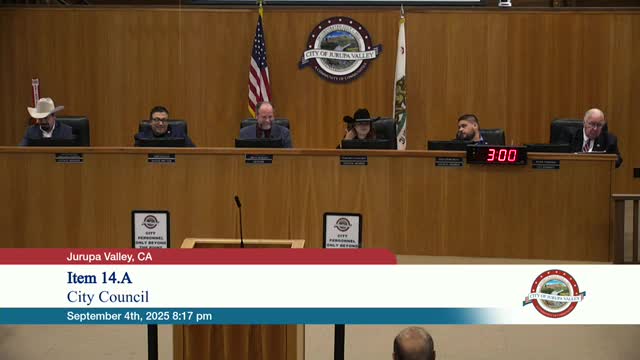
Council hearing on wireless‑facility rules continued after planners expand draft ordinance to limit residential siting
Summary
Staff rewrote the city’s wireless communications code to update it for recent state and federal law, tighten visual‑impact standards and generally prohibit new wireless towers in residential zones; planning commissioners asked for clarifications and council continued the matter so staff can return with zone‑by‑zone guidance.
Jurupa Valley planning staff proposed a rewritten wireless communications ordinance on Sept. 4, aiming to bring local rules into alignment with recent state and federal changes while tightening design and permitting standards to reduce visual impacts.
The draft ordinance would prohibit new wireless communication facilities in residential zones, allow up to 105‑foot towers in limited non‑residential areas, and push providers to co‑locate on existing structures (roofs, utility poles, stealth designs such as palm trees, and building‑integrated installations) rather than build conspicuous new towers. Staff said the new rules also establish a 10‑year permit life with renewal procedures, clearer requirements for abandoned facilities removal, and standards for camouflage, setback buffers and equipment enclosures.
Planning commission feedback and council action
At the public hearing the planning commission recommended changes—requesting that access roads be paved, equipment enclosures be screened with masonry and landscaping rather than chain‑link, and requiring rapid graffiti removal—and asked staff to add additional clarifications on permitted zones. Commissioners also sought limits on illumination and a county‑style approach to stealth designs.
Council members asked staff targeted questions about why some commercial zones were included while others were not and whether the draft would leave gaps near mixed‑use corridors. Planning staff said they had analyzed multiple city zones and would provide more granular justification for the selected zones and for residential exclusions.
Outcome: public hearing continued
Because council members requested additional zone‑by‑zone analysis and clarifications about how the draft aligns with state preemption and ‘‘eligible facilities’’ law, the council continued the hearing so staff can return with the requested details. No ordinance vote occurred.
Why it matters
Wireless providers have broadly used federal and state law to secure siting approvals; local governments must craft objective standards that avoid unlawful prohibitions while protecting community character. Staff said the draft seeks to balance deployment of wireless service and visual/land‑use protections.
Next steps
Staff will produce a written zone‑by‑zone justification for the residential exclusions, provide legal citations on how ‘‘eligible facilities’’ and co‑location requirements apply in residential areas, and return with edits and formal ordinance language for future public hearings.