Get Full Government Meeting Transcripts, Videos, & Alerts Forever!
Get email alerts on the Commission Roles Division topic
No spam. Unsubscribe anytime.
Zoning and Planning commissioners debate dividing site-specific rezoning from broader policy cases
Summary
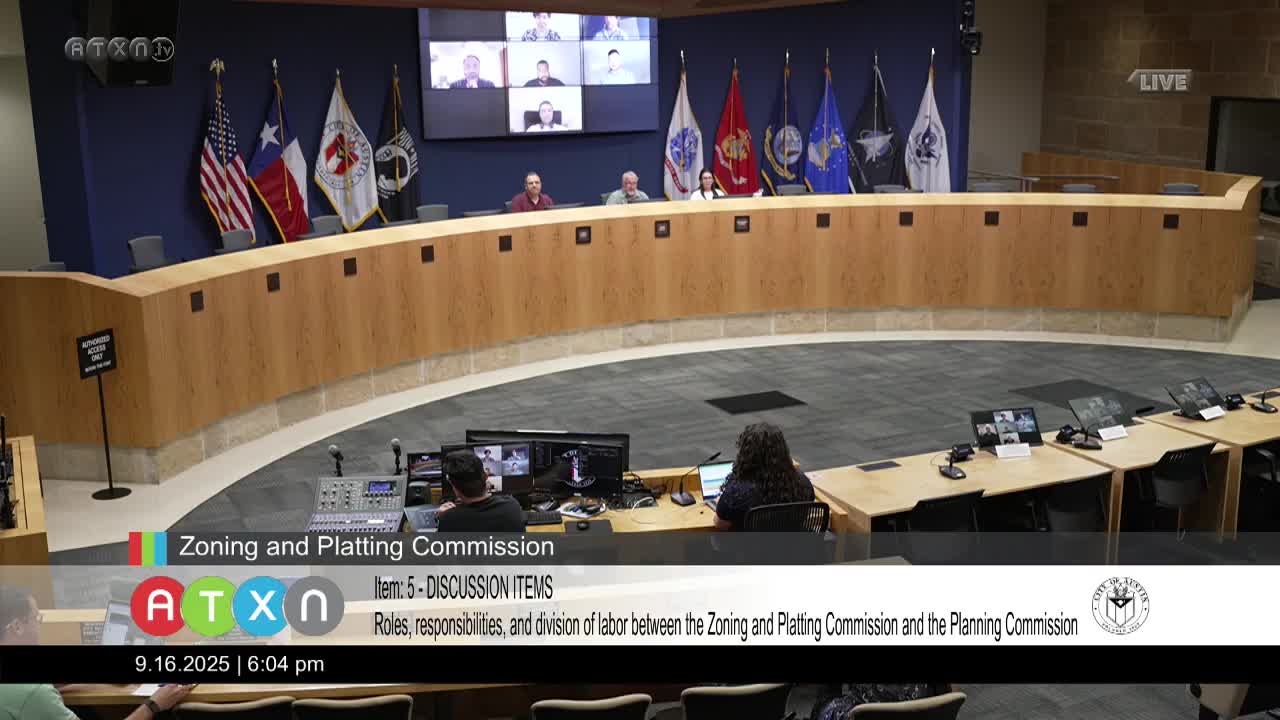
At its Sept. 16 meeting at Austin City Hall, Commissioner Christian Sheppey presented a draft proposal to clarify the division of labor between the Zoning and Planning Commission (ZAP) and the Planning Commission, proposing that ZAP take on more site-specific rezoning cases while Planning Commission retain larger and more complex policy matters.
At its Sept. 16 meeting at Austin City Hall, Commissioner Christian Sheppey presented a draft proposal to clarify the division of labor between the Zoning and Planning Commission (ZAP) and the Planning Commission, proposing that ZAP take on more site-specific rezoning cases while Planning Commission retain larger and more complex policy matters.
Sheppey, who reported outreach to City Council district offices and planning commissioners, said the change would aim to reduce case overload by routing certain kinds of site-level applications — including some neighborhood plan amendments, planned unit developments (PUDs) and planned development areas (PDAs) — to ZAP while keeping downtown density-bonus and other complex cases with the Planning Commission.
The proposal would let city staff establish size and complexity thresholds in an ordinance to determine which cases go to which body. Sheppey also suggested giving the planning and zoning director discretion to assign cases between commissions when one calendar is particularly full and evaluating whether existing joint committees should be restructured or sunsetted.
Why this matters: the commissions currently share many types of cases and joint committees intended to coordinate review. Commissioners said the present setup can create scheduling bottlenecks and unclear review roles; the working-group proposal aims to produce a clearer, more predictable case allocation and reduce overload on either commission.
Commissioners discussed practical limits and coordination mechanisms. Vice Chair Betsy Greenberg said codes and ordinances affect the whole city and that joint committees give ZAP a voice on citywide code changes, noting the committees are structured with more Planning Commission members than ZAP members. “I would say some things, like codes and ordinances, those codes and ordinances affect the whole city,” Greenberg said.
Several commissioners raised quorum and productivity concerns for joint committees. Sheppey said the Small Area Planning joint committee has repeatedly failed to reach quorum; other members said the Codes and Ordinances joint committee usually meets but sometimes receives draft code too late for productive review. One commissioner suggested formally reviewing how Codes and Ordinances work with the Technical Advisory Review (TAR) panel, which is a separate stakeholder group that reviews technical rule changes.
Sheppey described next steps: staff would draft ordinance language that defines thresholds (by site size and case complexity) and return to the commissions for further input; Sheppey also said he is scheduling meetings with individual Planning Commission members and invited working-group participants to join. He said the District 6 council office expressed support for a local, commission-driven solution rather than Council intervention.
No formal vote or ordinance was adopted. Commissioners asked staff to continue gathering input and to bring an ordinance back for consideration, and they discussed possible ex officio participation by a member of each commission to improve coordination.
Members asked staff to ensure any assignment rules account for time-sensitive cases that must meet statutory or procedural deadlines; one commissioner noted schedule timing could determine which commission ultimately hears a case in practice.
Next steps: staff will investigate size-and-complexity thresholds and draft ordinance language for commission review; the working group will continue outreach to Planning Commission members and coordinate on the joint-committee evaluation.