Get Full Government Meeting Transcripts, Videos, & Alerts Forever!
Get email alerts on the Downtown Strategic Initiative topic
No spam. Unsubscribe anytime.
City outlines new Downtown Strategic Office, cites early Sixth Street pilot gains
Summary
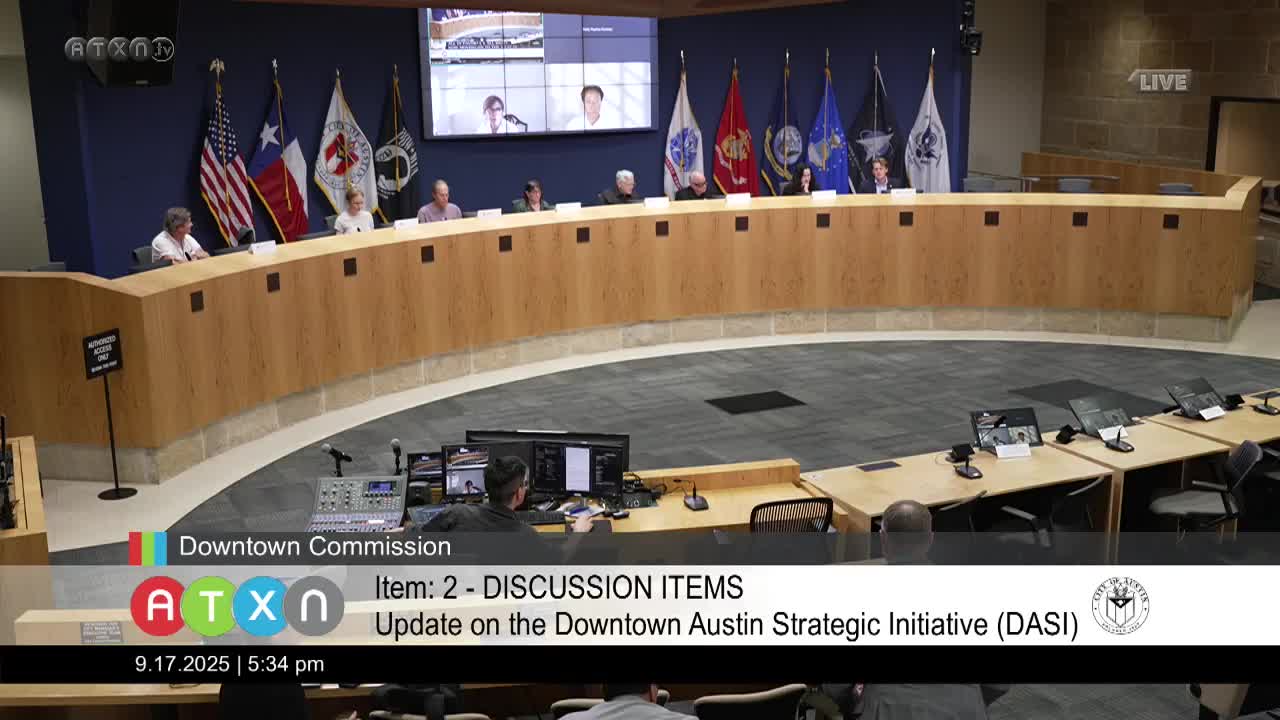
Deputy City Manager John Fortune and policy adviser Rob Trevino briefed the Austin Downtown Commission on Sept. 17 on the Downtown Strategic Initiative, the creation of a two-person Downtown Strategic Office and early public-safety and mobility results from the Sixth Street pilot program.
Deputy City Manager John Fortune told the Austin Downtown Commission on Sept. 17, 2025, that the city is standing up a Downtown Strategic Office to coordinate downtown projects across departments and outside partners and that two initial staff positions — a downtown strategic officer and a community solutions officer — are expected to be filled within about 60 days.
"This initiative really started with a vision from the mayor who has a deep passion for making sure that the downtown is a vibrant, safe, and and, economically vibrant community," Fortune said, describing a council resolution passed earlier in the year that directed the city manager to create the initiative.
The office is intended as a convener, not a direct manager of other departments, Fortune said. He described the initial focus as setting a structure for interdepartmental coordination across areas including mobility, arts and culture, public safety, and parks.
Rob Trevino, a policy adviser to Fortune, summarized near-term work on East Sixth Street launched under a city pilot. He said the city assembled a multidisciplinary task force that includes Austin Police Department, Austin Fire, Austin-Travis County EMS, Development Services, Transportation Public Works, Austin Energy, the Arts, Culture, Music and Entertainment Office, the homeless strategy office, the convention center, the law department and communications staff.
Trevin o (sic) said the pilot pursues three strategies: bolstering law and code enforcement to disrupt criminal networks, changing the physical environment to reduce opportunities for harm, and partnering with community organizations to sustain progress. "Early success in the sixth street pilot program has demonstrated, both the value in in compassion and coordination," Trevino said, citing data trends from January to the present.
City staff described specific measures already in place: installation and beautification of concrete barricades with the Downtown Austin Alliance and the East Sixth Street Public Improvement District to improve crowd and traffic management; replacement of alleyway lighting and ongoing replacement of street lanterns by Austin Energy; expanded convention center garage hours to provide evening parking; rideshare pickup/drop-off zones established on the north curve of the 200, 300, 400 and 500 blocks; and weekly multidisciplinary patrols by Development Services, fire and police focused on property-related enforcement. The law department is reviewing legal instruments to abate nuisance and criminal activity at the source, staff said.
City presenters said their public-safety indicators show fewer use-of-force reports, fewer arrests and fewer officer injuries, while dispatch calls from the public increased (which staff interpret as improved reporting) and officer-initiated dispatches decreased. Staff characterized nonviolent incidents as having shown minor increases while the overall environment on Sixth Street has become more stable.
Commissioners asked about how the Downtown Strategic Office (referred to in the meeting as DOSI) will operate day-to-day, how it will coordinate with Transportation Public Works on a permanent Sixth Street design (including whether portions will remain one-way or revert to two-way), how the office will set performance metrics and how it will incorporate community engagement. Fortune and Trevino said the operational cadence (weekly, monthly or quarterly meetings) and specific performance measures will be developed after the positions are filled; staff said benchmarks and KPIs will be drafted in the office’s early months and welcomed input from the commission on what to measure, including residential and office occupancy and transportation metrics.
Fortune said the office will initially report to the city manager’s office and will be staffed by the two positions with the expectation it could grow. "We hope to have those positions filled within the next 60 days," Fortune said. He said initial funding to begin work is available through the current budget process.
Commissioners and staff also discussed the geographic scope of the office. Planning staff previously recommended expanding the Downtown Austin plan into a larger Center City/Central District plan that would include West Campus (the University North Overlay) to the north and the South Central Waterfront to the south; Fortune said the downtown plan’s boundaries are a reasonable starting point for defining the office’s scope but that the boundary question will be resolved in setup phases.
The presentation closed with staff inviting the commission to provide ideas on KPIs and asking that the new downtown strategic officer be a regular participant in the commission’s meetings once hired. Staff said they will return with additional updates after hires are made and said they expect the office to be "in full swing" by the end of the year.