Get Full Government Meeting Transcripts, Videos, & Alerts Forever!
Get email alerts on the Land Use And Environment topic
No spam. Unsubscribe anytime.
National City planning commission certifies EIR but denies fuel transfer facility at BNSF site
Summary
The National City Planning Commission on Sept. 15 certified a final environmental impact report for a proposed renewable-fuels transloading facility on BNSF property, then voted 5–1 to deny the conditional use permit and coastal development permit that would have allowed construction and operation.
The National City Planning Commission on Sept. 15 certified a final environmental impact report (EIR) for a proposed fuel transfer facility on BNSF Railway property but then voted to deny the conditional use permit and coastal development permit needed to build and operate the site.
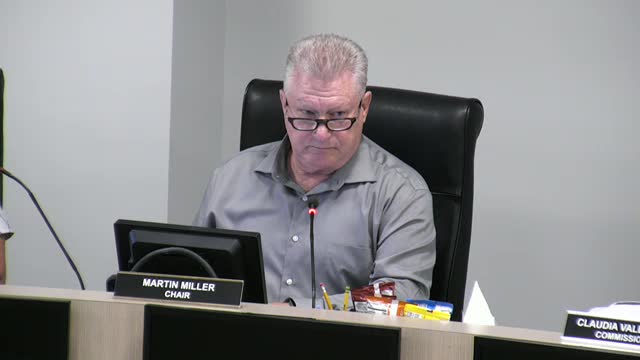
The planning commission certified the EIR by motion and later voted 5–1 to deny the permits for the project proposed by San Diego Clean Fuels (operated by USD Clean Fuels). Vice Chair Cassell made the motions to certify and to deny; Commissioner Armenta seconded the denial. The denial vote was recorded as 5 yes, 1 no, and 1 absent; Chair Miller cast the lone no vote and Commissioner Valenzuela was absent.
The project would have placed a transloading facility for renewable fuels on roughly 7.5 acres of BNSF-owned right-of-way west of Interstate 5, with new track work, truck loading areas and a small office building. Staff said the facility would operate 24 hours a day and estimated up to 72 truck trips per day to or from the site. The applicant offered to pay the city $200,000 annually for the life of the project and to provide a mobile foam firefighting platform for the National City Fire Department.
Why it mattered
Staff presented the EIR and planning analysis, which found that with the project’s proposed mitigation measures potential environmental impacts could be reduced to less-than-significant levels under CEQA. The EIR examined air quality, greenhouse gases, biological and tribal cultural resources, noise, stormwater and other topics, and included mitigation for nesting birds, cultural monitoring during earthwork and operational conditions such as truck routing and spill containment. The California Coastal Commission had asked the city to examine a potential on-site wetland and coastal hazards; staff reported a wetland delineation concluded no jurisdictional wetland exists on the parcel and the staff recommended a 30-year sunset on the coastal development permit tied to sea-level-rise analysis.
What speakers said
David Welch, planner for the City of National City, summarized the analysis and the conditions staff recommended if the commission approved the project. Welch said the site lies between Civic Center Drive and West Nineteenth Street, that part of the parcel had been a DTSC cleanup site and that improvements would include a second rail crossing at Civic Center Drive and concrete pump pads, drains, piping and containment for transloading operations.
Bill Fierking, chief administrative officer for USD Clean Fuels, urged approval and pointed to statewide goals to reduce greenhouse gases, saying the facility would deliver renewable diesel, biodiesel and sustainable aviation fuel and would “eliminate 2,400,000 truck miles a year” currently spent hauling fuel into the San Diego region. Fierking said the EIR identified no significant environmental risks with proper mitigations and highlighted the applicant’s voluntary annual payment to the city and donations of safety equipment.
Hundreds of pages of public comment and nearly 40 speakers addressed the commission in person. Speakers in opposition included teachers, parents, nonprofit leaders and residents who said the West Side is already heavily burdened by diesel pollution and that additional truck and rail activity near Kimball Elementary (about a half-mile away) and nearby residences would worsen air quality and health outcomes. Christina Benson, a fifth-grade teacher at Central School, told the commission: “By moving this plan forward, you would be creating a real-world example for our students to critically ask why. Why would you put something that can cause damage to the water in the nearby ecosystem?”
Environmental and community groups, including the Environmental Health Coalition and Olivewood Gardens, urged denial. Amy Castaneda of the Environmental Health Coalition said the project would “make these air quality statistics even worse” for a Portside community already ranked among the highest statewide for diesel impacts. Naval Base San Diego’s community liaison, Jasmine Ayers, asked for more detail on rail operations and timing, warning that blocked crossings could “translate directly to idling vehicles, increased carbon emissions, and traffic delays” that could affect base access.
Opponents raised also procedural and equity concerns, arguing National City has long borne high industrial burdens. Supporters included labor representatives, contractor and operator representatives, and some construction and operations specialists who emphasized experience building similar terminals and pledged strict operational controls, truck-route adherence and enforcement measures.
Staff recommendations and conditions
Staff recommended certification of the EIR and recommended approval of the conditional use permit and coastal development permit subject to conditions that include: adherence to designated truck routes; a 6-foot solid screen wall adjacent to nearby properties; containment and spill-response measures sized to hold a rail car volume; noise and lighting controls; mitigation and monitoring for biological and tribal resources during construction; and operational limits on the number of truck movements. Staff also recommended a condition implementing the applicant’s voluntary $200,000-per-year economic benefit directed toward local air-quality and community projects. To address Coastal Commission concerns staff added a condition terminating the coastal permit after 30 years unless further sea-level-rise study supports a longer life for the facility.
Commission action and reasoning
The commission first voted to certify the EIR, finding the document had been prepared in compliance with CEQA. Later, after several hours of public testimony and questioning of staff and the applicant, the commission voted to deny the CUP and CDP. Commissioners who voted to deny cited the project’s placement in a community already designated under AB 617/Portside planning as heavily impacted by diesel pollution, proximity to sensitive receptors (including Kimball Elementary), and inconsistency with local health and environmental-justice goals. Chair Miller, the lone no vote on the denial, said she opposed denial because she feared a by-right railroad or industrial use placed on the property later could be more damaging and that those outcomes would receive less public review.
What’s next
The commission’s denial is a recommendation and initial local action; the applicant and any aggrieved party may appeal to the City Council, and after final city action the coastal development permit decision may be appealed to the California Coastal Commission. Staff indicated notice of decision and appeal information would be provided to interested parties.
Ending note
The commission’s split ruling — certifying the EIR but denying the permits — leaves the environmental analysis on the record while blocking the specific transload proposal from moving forward under the conditions presented to the commission. The decision does not preclude other uses of the BNSF parcel or a differently designed project returning for review, but it does reflect the commission’s conclusion that the proposed transloading facility, as framed in the staff report and public record, was not appropriate in that location under current local policy priorities.