Get Full Government Meeting Transcripts, Videos, & Alerts Forever!
Get email alerts on the Riverwalk Project topic
No spam. Unsubscribe anytime.
Riverwalk (Walker) urban renewal project tabled to October after feasibility concerns about rock-blasting costs
Summary
The Urban Renewal Agency of Idaho Falls on Sept. 18 tabled consideration of the Riverwalk (Walker) Urban Renewal Project to the October meeting, requesting more detailed developer cost estimates after feasibility concerns.
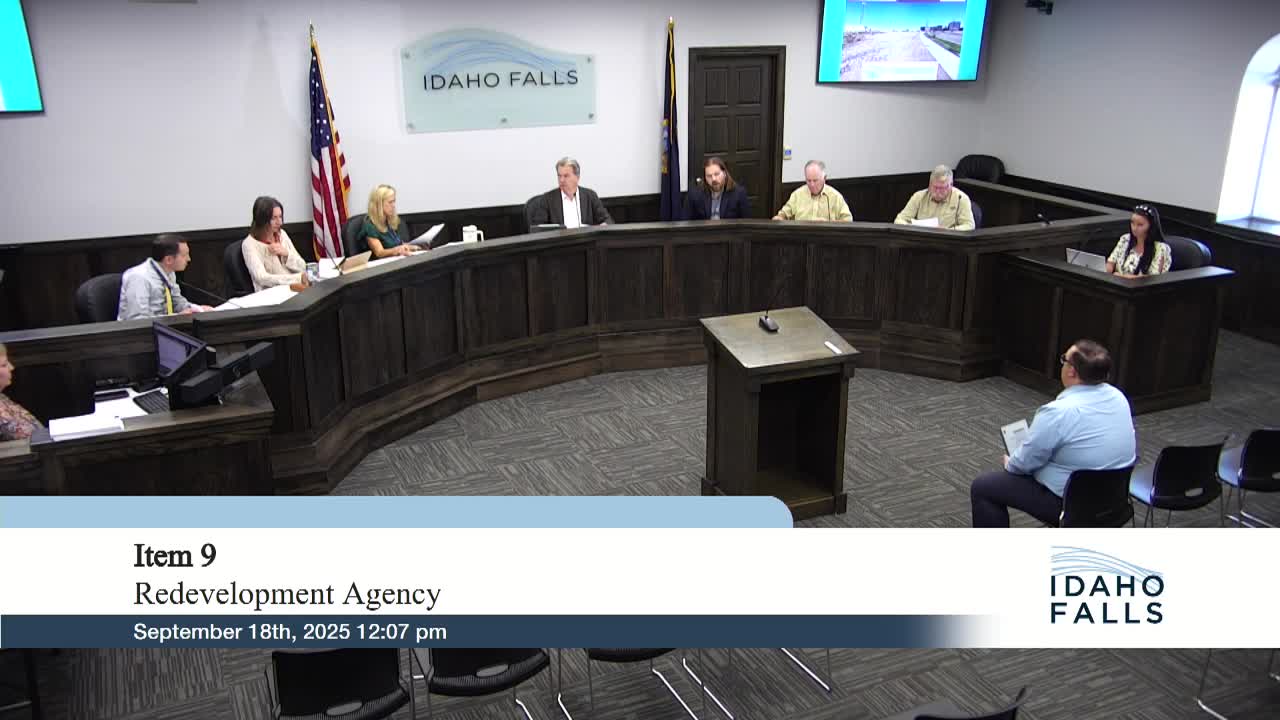
The Urban Renewal Agency of Idaho Falls on Sept. 18 tabled consideration of the Riverwalk (Walker) Urban Renewal Project (referenced as Resolution 2025-15 in meeting discussion) to the October meeting and asked the developer to provide more detailed cost estimates, particularly for rock blasting.
Agency consultant Brad Kramer told the board the proposed Riverwalk district is small — three sites — with total private investment anticipated near $40 million and public-project requests of roughly $4.2 million, primarily to cover rock blasting and related site work. Kramer said that under the standard 75% tax increment payback assumption the project, as modeled, was not financially feasible; his conservative cash-flow projections indicated the OPA payments would not be satisfied before the end of the district’s revenue term unless the share of tax increment returned to the OPA was increased to about 80% (or other adjustments were made).
Commissioners discussed options including (a) holding firm at the agency’s typical 75% payback policy and asking the developer to revise project costs and plans to meet feasibility; (b) allowing a higher payback percentage; or (c) capping a specific line item in the plan. Several commissioners said they preferred to maintain the agency standard of 75% but requested developer-provided blasting and cost estimates so the feasibility model could be updated. Kramer and staff agreed that blasting costs can vary widely by depth and site conditions and that developer-provided estimates would meaningfully improve the analysis.
After discussion the board voted unanimously to table the Riverwalk item to the October meeting and to request that the developer submit more detailed blasting and cost estimates to support a feasibility model consistent with the agency’s usual 75% payback assumption.
What happens next: staff will notify the developer and ask for more detailed cost and blasting estimates; the agency will revisit the Riverwalk plan at the October meeting and may proceed, seek modifications to the OPA structure, or ask the developer to revise their project assumptions.