Get Full Government Meeting Transcripts, Videos, & Alerts Forever!
Get email alerts on the Waste Management topic
No spam. Unsubscribe anytime.
Audit finds Austin Resource Recovery education is aligned with best practices but lacks prioritization and measurable goals
Summary
An auditor's review found Austin Resource Recovery follows many best practices for recycling and compost education but does not prioritize campaigns by impact, has inconsistent messaging across city facilities and private haulers, and lacks consistent measurable goals; department agreed with recommendations.
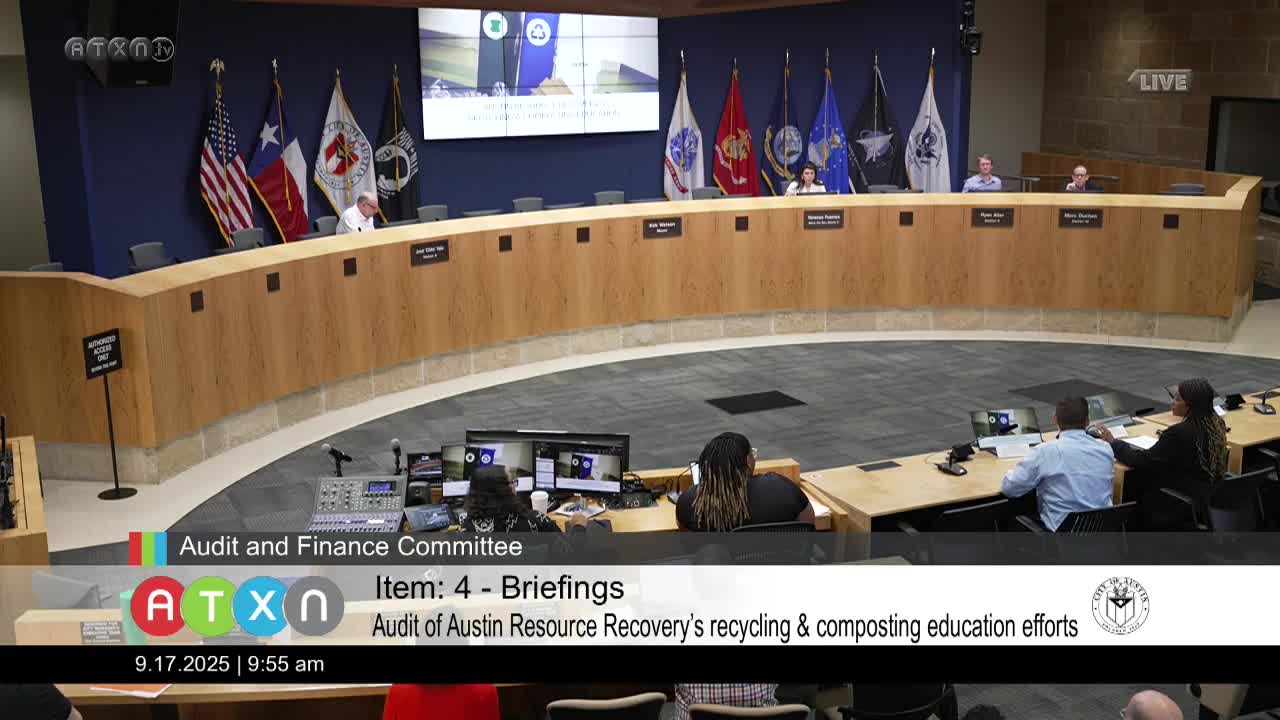
Kathy Harrison, audit lead, presented an audit of Austin Resource Recovery's (ARR) recycling and composting education efforts to the Audit and Finance Committee on Sept. 17 and found that while ARR's outreach generally follows best practices, the department needs clearer prioritization, measurable goals and better coordination with private haulers.
Harrison said ARR is responsible for collecting residential trash, recycling and composting and for meeting the city's 90% "zero waste" diversion goal by 2040, though ARR directly collects roughly 15% of city waste while private haulers account for about 85%. The audit noted Austin Resource Recovery’s community diversion rate has held near 37% for the last decade.
Key findings included: - Lack of prioritization: ARR tracks 90-plus projects and campaigns but does not use its project management tool to rank them by likely impact. The audit said staff lack clear, measurable goals for reach or behavior change tied to campaigns. - Inconsistent messaging and authority: The city’s 0‑waste guidelines lack clear implementation dates and ARR reported it does not have authority to require other city departments or contract partners to adopt uniform signage or labels; field visits showed inconsistent bin colors and signage across city facilities and private facilities. - Contract variation: One recycling processor agreed to pay an education fee to support outreach, while another did not. ARR said the upcoming contract reset is an opportunity to negotiate more consistent education funding. - Data and evaluation gaps: Waste composition studies are done twice a year, but not routinely done before and after campaigns, limiting the ability to evaluate campaign effectiveness. The audit recommended using pre/post studies and setting measurable targets.
Gina McKinley, assistant director of Austin Resource Recovery, told the committee the department agrees with the recommendations and is already working on improvements. ARR reported a fiscal 2025 education budget of about $2,900,000, though funds are coded across divisions and categories. ARR staff said they are conducting a capture‑rate study with pre/post measurement this week and are considering ways to prioritize efforts.
Committee members pressed ARR on several operational points: whether the city can require processors to fund education (ARR said the fee was negotiated during prior contract resets and could be a requirement in future contracts), the department's plan to adopt per‑capita disposal as a more robust metric, and enforcement of the Universal Recycling Ordinance (ARR confirmed a new compliance team — a supervisor plus three inspection officers — enforces commercial/multifamily reporting requirements).
Why it matters: The audit addresses how the city directs education and coordinates with private haulers on recycling and composting—central to reaching community diversion goals and reducing contamination in the recycling stream.
Next steps: Management agreed to two audit recommendations to (1) prioritize educational efforts by likely impact and establish measurable goals, and (2) coordinate messaging with private haulers and other city departments; ARR said it will work with the Law Department to consider contract language that funds education.