Get Full Government Meeting Transcripts, Videos, & Alerts Forever!
Get email alerts on the Evictions topic
No spam. Unsubscribe anytime.
Local eviction filings hit record high in 2024; advocates urge prevention plans and enforcement of existing protections
Summary
Building and Strengthening Tenant Action (BASTA) presented a Travis County eviction dashboard showing 13,210 filings in 2024 and rapid case resolution; the group urged upstream eviction prevention measures and enforcement of protections on subsidized properties.
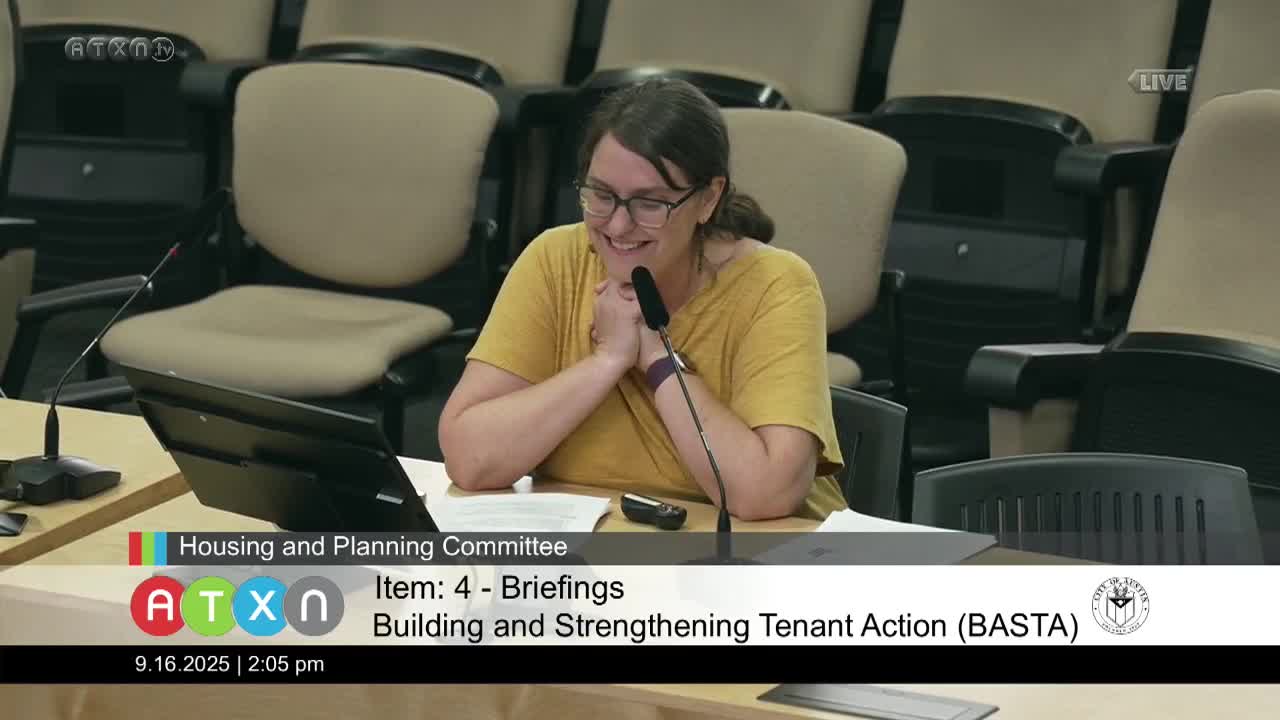
Shoshana Krieger, project director for Building and Strengthening Tenant Action (a project of Texas Rio Grande Legal Aid), briefed the Housing and Planning Committee on Sept. 16 on eviction filing trends in Travis County and policy options to reduce displacement.
Krieger said the group’s 2024 snapshot found 13,210 eviction filings in Travis County in 2024 and that 2025 filings were on pace to meet or exceed 2024 totals. “In 2024, we had the highest filings we’ve ever had with 13,210 eviction filings,” Krieger told the committee. The group’s eviction dashboard, updated weekly, uses court filing records and geocoded addresses to show eviction patterns by tract and council district.
Key findings presented included: a median case duration of about 20 days from filing to judgment in 2024 and 99% of cases disposed within 60 days; the top‑filing properties often file against a large share of households in a given complex (the presentation noted one property with a filing rate around 38%); and tax‑exempt private partnership (TEP) properties—including some that receive public subsidy in exchange for affordability—showed a higher‑than‑average filing rate in the dataset the group examined.
Krieger said the data show eviction filings concentrated historically in the Eastern Crescent but also shifting toward the county edges, where lower‑income households have increasingly moved. She noted limitations: filings are an imperfect measure of displacement because many households receive a notice to vacate and move before a court filing is recorded.
Advocacy recommendations presented to the committee included adopting eviction prevention plans at properties (particularly at properties receiving public subsidy or tax exemption), ensuring enforcement of existing protections attached to publicly funded and RHDA properties, and improving tenant navigation, multilingual notice and case management capacity. Krieger described several tenant stories—seniors at a subsidized property known in the briefing as “Arbors”—to illustrate how operational practices (for example, refusing partial payments) and weak enforcement can accelerate evictions and cause harm even when small arrears might be addressed.
Council members and staff discussed enforcement of protections on properties that receive public subsidy, the role of city‑funded rental assistance and the possibility of requiring eviction prevention measures in incentive programs. Krieger and committee members identified eviction prevention plans and improved tenant navigation as actionable, locally permissible steps that could reduce filings and mitigate harm.
No committee vote was taken on the briefing. Krieger said BASTA’s eviction dashboard and underlying datasets are available to staff and the public to inform further analysis and policy design.