Get Full Government Meeting Transcripts, Videos, & Alerts Forever!
Get email alerts on the School Transportation topic
No spam. Unsubscribe anytime.
Safe Routes to School program reports 603 barriers addressed; $38.9 million spent of combined bond funding
Summary
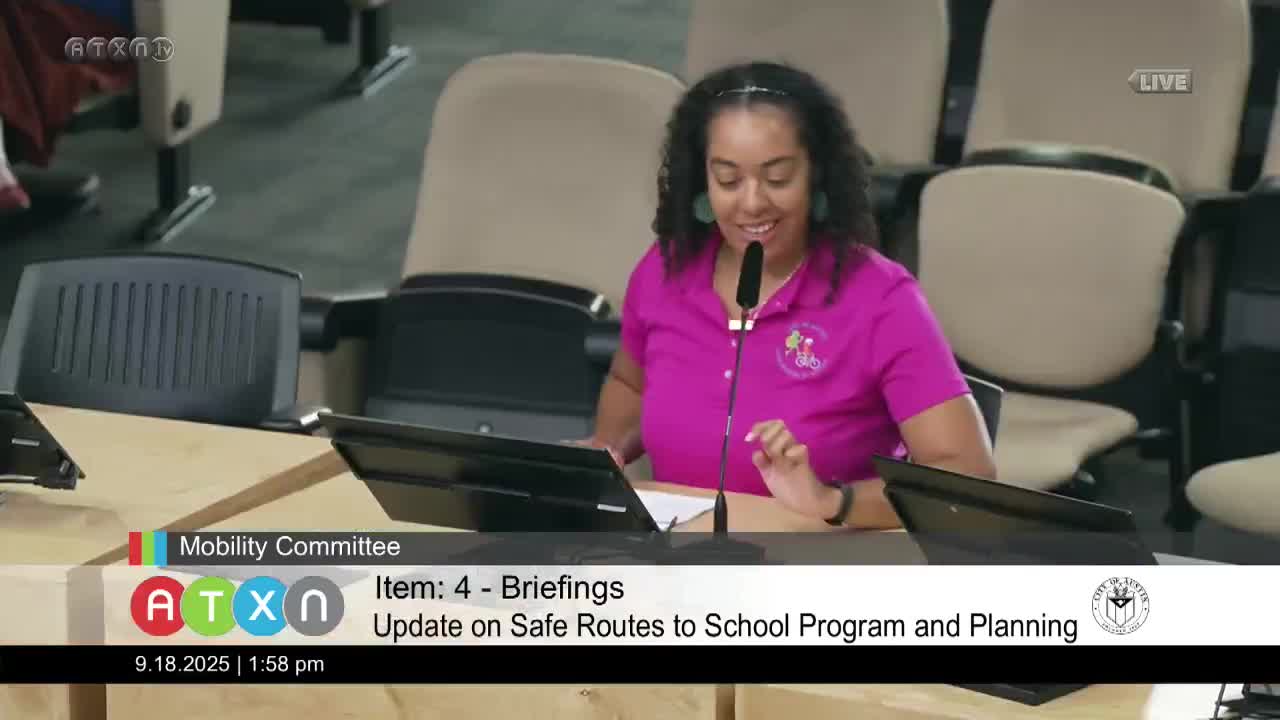
Colleen Gentles, Safe Routes to School infrastructure project manager, told the Mobility Committee that 603 of 4,662 barriers identified in the program's infrastructure report have been addressed and that the program has spent about $38.9 million of combined bond funding to date.
Colleen Gentles, infrastructure project manager for the Safe Routes to School program in the Community Services Division of Transportation and Public Works, updated the committee on program structure, outreach and infrastructure work funded by the 2016 and 2020 mobility bonds.
Gentles described the program as four "arms": a crossing-guard program, an education team, an engagement team, and an infrastructure program. She said the crossing-guard program includes a manager, seven supervisors, 14 assistants and more than 200 crossing guards who serve schools in Austin, Del Valle, Eanes, Leander, Manor, Pflugerville and Round Rock independent school districts, plus three charter schools.
"Last school year, 2024 to 2025, we serviced 90 different schools; 36,000 students were trained," Gentles said, summarizing the education team's outreach. The engagement team oversees campaigns such as walking- and biking-focused events and pilot programs; staff said they will pilot a bike-train this school year.
The infrastructure program emerged from the 2016 mobility bond and received additional funding in 2020. Gentles said the program's infrastructure report cataloged 4,662 barriers and estimated a notional total cost of approximately $825 million to address every identified item; staff subsequently prioritized projects using a GIS-based model that weighed demand, safety, equity and stakeholder input.
As of the presentation, Gentles said combined bond spend and commitments were: - $38,900,000 spent on projects on the ground (combined 2016 and 2020 funding) - $2,600,000 encumbered (projects contracted but not yet built) - $5,900,000 planned but not yet assigned a funding number, leaving the program on track to spend the combined $47.5 million allocated through the bonds.
Project counts reported in staff materials showed 603 barriers addressed to date: 389 intersection improvements, 165 sidewalk improvements, 28 street projects, 7 trails and 14 other improvements (signals, school beacons, pedestrian hybrid beacons).
Gentles said staff will refresh the infrastructure plan in 2026 to include newly built schools, high schools (which were not included in the original 2016 audits), and updated council and school boundaries. She said walk audits will expand to include high schools and newly opened campuses such as Bear Creek Elementary, Blazer Intermediate and Marshall Middle School.
Committee members asked about school-zone policy and maintenance costs. Eric Bullock, managing engineer in the Transportation Engineering division, said a proposed change to school-zone placement would focus school-zone controls at unprotected crossings and at school frontages. Bullock told the committee the evaluation suggests hundreds of new or modified school zones would be required and estimated maintenance and implementation costs at about $5,000,000, of which roughly 90% would be signs and flashers and about 10% would cover additional staffing and maintenance.
Committee members also asked about projects near school sites that fall in county or ETJ areas. Gentles said the program has generally focused bond-funded improvements within city limits because bond funds are city-restricted, but that staff are aware of edge cases and maintain partnerships with other departments and jurisdictions where co-funding or operational arrangements are feasible.
On programming, Amir Mommy, division manager for Community Services, described efforts to pilot a bike-bus program using trained crossing-guard staff as bike-bus leaders and explained that bike-bus groups will require additional volunteers and training compared with walking-school-bus groups.
Gentles said the program continues to leverage internal and external partners (Urban Trails, Neighborhood Partnering Program, Sidewalks and Bridges, Bikeways, Vision Zero, CapMetro and multiple school districts) to stretch dollars and target projects that connect safely to multiple schools and community destinations. The staff presentation noted plans to refresh the Safe Routes infrastructure plan in 2026 and to release a short list of schools for upcoming walk audits.