Get Full Government Meeting Transcripts, Videos, & Alerts Forever!
Get email alerts on the Historic Preservation Accessibility topic
No spam. Unsubscribe anytime.
Friends of the Elizabeth Ney Museum ask committee to support freestanding ADA restroom
Summary
Friends of the Elizabeth Ney Museum asked the Mayor's Committee for People with Disabilities on Sept. 12 to support fundraising and a letter of support for a freestanding ADA-accessible restroom as part of an ongoing renovation funded by earlier bonds and other sources.
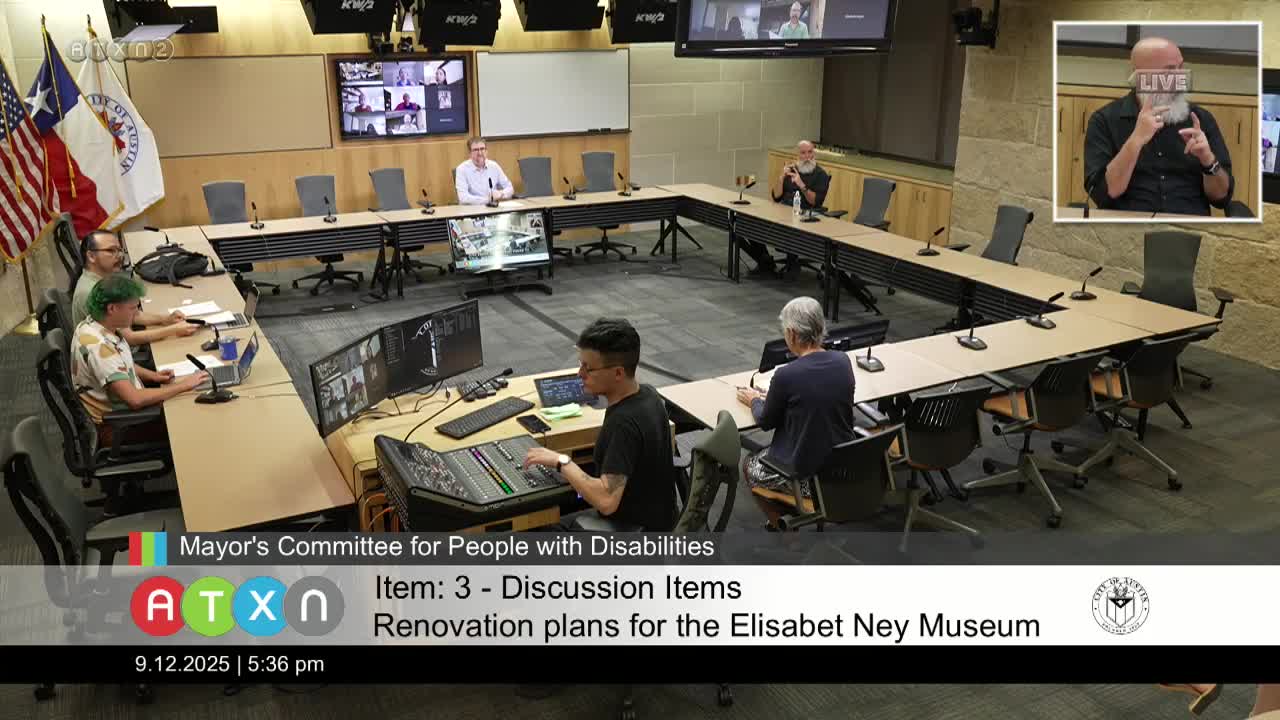
Friends of the Elizabeth Ney Museum presented renovation plans to the Mayor's Committee for People with Disabilities on Sept. 12 and asked the committee for a letter of support and help identifying funding for an ADA-accessible freestanding restroom.
The request matters because the museum, the former studio and home of sculptor Elizabeth Ney, is owned by the City of Austin, listed on the National Register of Historic Places and, according to the presenters, currently lacks an accessible restroom. Friends member Anne Graham told the committee the building's only toilet is in a basement reached by a narrow wooden staircase and “does not meet any bathroom code.”
Graham said the renovations already under way include restoration of doors and windows, a new HVAC system, new security and lighting systems, and an accessible bridge across Waller Creek. Funding for those elements has come from 2012 City of Austin bond funding, the Parkland Dedication Fund and private grants and philanthropy, she said. The specific restroom project is not yet funded.
During a question-and-answer period, commissioners and staff discussed permit and preservation requirements, possible grant sources and physical constraints. Commissioner Chan (first reference: Commissioner [full name not specified in transcript]) suggested the Friends consider Preservation Austin grants and matching programs used by other museums. Staff liaison Ryan Sperling noted the group had met with the mayor's office and that the city's budget and the 2026 bond cycle were the most likely public sources of support.
Graham described preliminary costs and design constraints: she said a current estimate for the accessible restroom is about $800,000, up from an earlier estimate of roughly $400,000, and that because of the museum's historic designation the restroom would need to be a freestanding structure on the site of the former stables and would have to comply with historic-preservation guidelines. She said major utility work would be required, including water and electricity and potential burying of overhead power lines between Fourth and Fifth Streets to improve reliability and sightlines.
Committee members suggested additional outreach to other local arts institutions for technical advice on ADA retrofits and to the city's preservation staff and the Commission on Aging for coalition support. The committee indicated it was willing to provide a letter of support the Friends could use in fundraising, and members encouraged the Friends to bring more detailed plans, cost breakdowns and permitting questions back to the committee when available.
The presentation and discussion were informational; the committee did not take formal action on the restroom funding during the meeting.
The committee and presenters agreed to continue discussions and to coordinate on outreach to potential funders and relevant city offices ahead of future budget and bond processes.