Get Full Government Meeting Transcripts, Videos, & Alerts Forever!
Get email alerts on the Urban Forestry topic
No spam. Unsubscribe anytime.
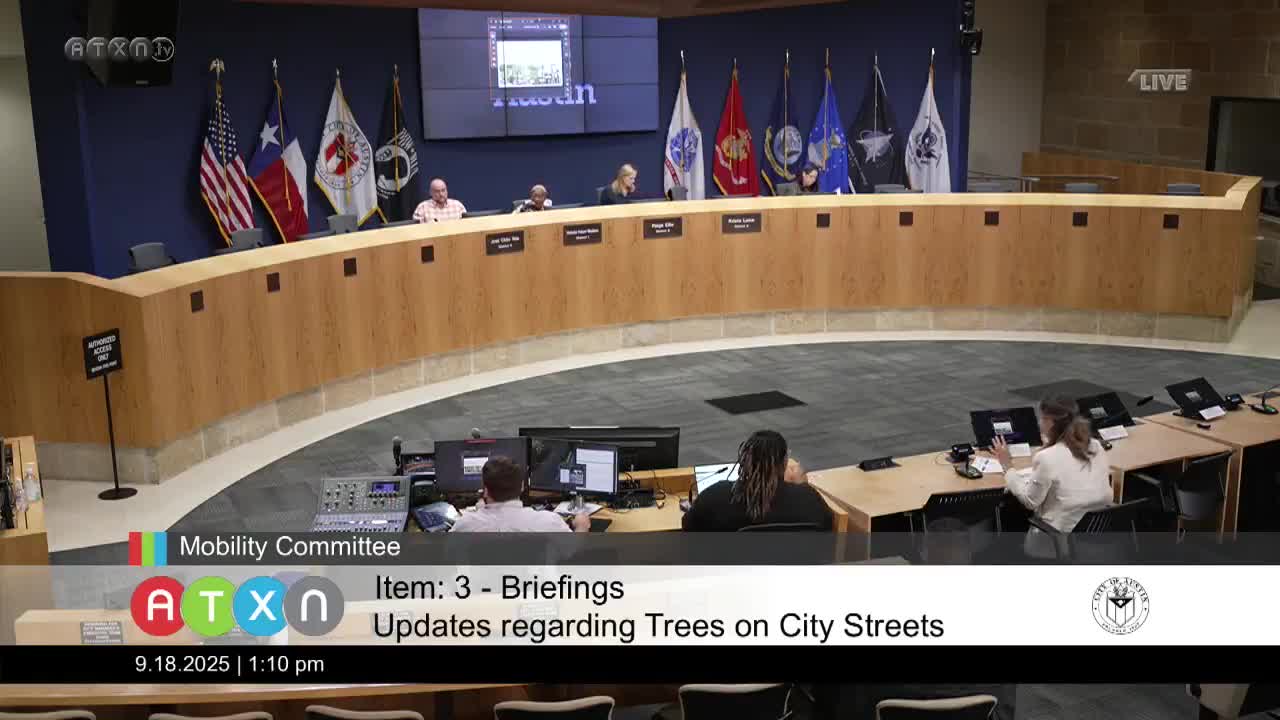
Mobility committee briefed on TARP—indings and 12 recommendations to ease barriers to street trees in Austin
Summary
Michelle Marks, transportation officer with Transportation and Public Works, presented 12 recommendations from a TARP working group intended to remove regulatory, permitting and programmatic barriers to planting and maintaining street trees in Austin rights of way.
Michelle Marks, transportation officer with Transportation and Public Works, told the Mobility Committee that a Technical Advisory Review Panel (TARP) working group spent roughly nine months reviewing barriers to street-tree installation and maintenance and produced 12 recommendations for city leadership.
The recommendations were developed in response to a March 21, 2024, council resolution directing the city manager to "explore right-of-way design and management plan" and identify barriers to green infrastructure in Austin rights of way. Marks said the working groupwhich included interdepartmental representatives and private-development designersfocused its first phase on clearing regulatory obstacles in administrative manuals and criteria documents.
"Trees really are vital in public infrastructure when it comes to heat mitigation, when it comes to climate resilience," Marks said. She told the committee the group prioritized changes to the Transportation Criteria Manual (TCM) so the TCM would clearly treat street-tree design as part of the sidewalk corridor rather than forcing designers to map scattered provisions across multiple manuals.
Key regulatory and process recommendations presented by staff include: - Revise the Transportation Criteria Manual to provide clear, holistic right-of-way design guidance for street trees and sidewalk corridors, including how trees must relate to below- and above-grade utilities. - Update standard specifications and provide preapproved product lists (for irrigation, structural soil cells, root barriers) and clear soil-volume and trench-size requirements. - Conduct a joint review of the Utility Criteria Manual with utility departments to identify opportunities for more space-efficient practices around underground infrastructure while protecting critical assets. - Update the city—s approved street-tree list to emphasize climate-resilient, context-appropriate species and provide guidance for constrained planting conditions. - Consider, at a later stage, whether code changes are warranted to require street trees in frontage or sidewalk improvements; the working group said many barriers could be resolved through administrative updates first. - Simplify or eliminate the current private license-agreement process for street trees and irrigation, which Marks said acts as a nearly second site-plan review and deters applicants. - Explore options for city-led maintenance of street trees as an alternative to case-by-case private maintenance obligations, and develop an inventory of existing right-of-way trees and conditions to inform priorities and funding needs. - Incorporate street trees into baseline scopes and budgets for capital projects where feasible and prepare a green infrastructure investment plan once foundational regulatory and process changes are in place.
Marks said staff will consolidate a formal response to the TARP recommendations and deliver a memo to mayor and council in October describing how departments might fold the recommendations into work plans.
Assistant City Manager Rogers, who has worked on similar programs in other cities, urged the committee to consider creative maintenance and workforce approaches. "We have to be very creative," Rogers said, describing publicprivate partnerships and nonprofit-led workforce programs that have trained young people in vegetation management and produced local contracting capacity.
Curtis Beatty, who oversees development review in Transportation, said the department will seek to start interdepartmental coordination earlier in the development-review cycle so utility, sidewalk and tree requirements are hashed out up front. "This would not add any time to the process," Beatty said, explaining the intention to keep any additional waivers or administrative steps from lengthening average review cycles.
Several council members asked whether medians and other ground-level vegetation would be considered; Marks said medians and pedestrian islands would be on the table as part of the TCM updates. Committee members also pressed staff on how quickly low-hanging fruit could be addressed where utilities are not present. Marks said the working group recommended phasing work to focus first on regulatory foundations, then process improvements and operations, and finally capital-program integration.
Marks and staff said they have begun sharing the recommendations with utility leadership at Austin Water and Austin Energy; those departments are reviewing the materials and staff will seek collaborative solutions to limit risk to utility infrastructure while making more space for trees.
"If we can provide confirmation from the city arborist that a tree can be removed to maintain water infrastructure that might be under the tree, does that provide some kind of assurance to our utility partners about changing our practices to allow that kind of stacking?" Marks asked, summarizing the type of interdepartmental trade-offs the working group wants to explore.
The briefing concluded with staff saying they will return with additional details after leadership reviews and after they draft the October memo to mayor and council.