Get Full Government Meeting Transcripts, Videos, & Alerts Forever!
Get email alerts on the Civilian Review Board Procedures topic
No spam. Unsubscribe anytime.
Saratoga Springs Civilian Review Board reviews revised complaint procedures, holds executive session on personnel complaints
Summary
The Civilian Review Board reviewed proposed revisions that make the police department the formal entry point for complaints, add a checkbox to request board review, clarify timelines and recusal language, and preserve mediation options; the board also held an executive session to discuss personnel complaint examples.
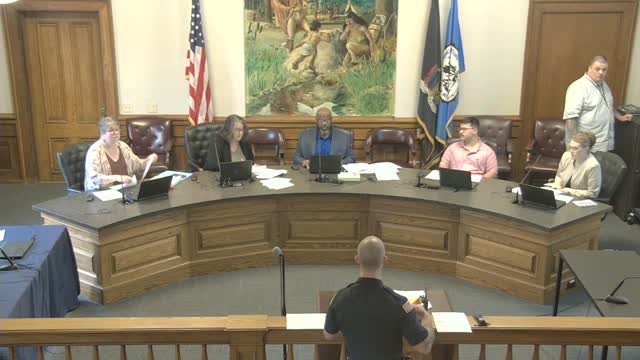
The Saratoga Springs Civilian Review Board on Sept. 17 reviewed proposed revisions to its complaint-handling procedures that make the Saratoga Springs Police Department the formal point of entry for complaints and add a checkbox allowing complainants to request later review by the board. The board also moved into executive session to discuss personnel-complaint examples; no case details were disclosed.
The proposed revisions, presented by Assistant Chief Frederick Warfield and Lieutenant Angela McGovern of the Saratoga Springs Police Department, redraw sections 4 and 5 of the board's procedures to eliminate what presenters described as “parallel” complaint paths. Under the draft, every complaint would be submitted to the police department first; if a complainant checks a box on the complaint form, the department will forward the completed investigation to the board for review after the police process is finished.
The draft includes a timeline requiring the board, upon receipt of a forwarded complaint, to make “diligent effort” to contact the complainant within two weeks to ask whether the complaint has been resolved. The document also adds an explicit provision that the board may, “in a proper case,” offer mediation between the complainant and department personnel. Board members noted they recently completed a 40-hour mediation training program; the training was added to the draft as explanatory text.
Assistant Chief Warfield summarized preferred practice, saying the department “would always love for somebody to come in in person to fill out a personnel complaint,” and explained why the department asks for signatures, photographs or sworn statements in cases alleging physical injury or when physical evidence exists. Warfield and McGovern outlined current disposition categories — sustained, not sustained, exonerated and unfounded — and walked through three years of complaint data: 8 external complaints in 2022, 10 in 2023, 12 in 2024 and 14 so far in 2025. Warfield placed those complaint counts alongside calls-for-service and arrest totals the department provided to the board: just over 26,000 calls and 839 arrests in 2022; about 27,000 calls and 851 arrests in 2023; 26,600 calls and 885 arrests in 2024; and roughly 20,000 calls and 691 arrests so far in 2025.
Presenters reminded the board about Executive Law 75 and the Law Enforcement Misconduct Investigations Office (often referred to as LEMIO), which requires referral to the state when an officer receives at least five complaints from five different individuals alleging five separate incidents within two years. Warfield said he has made one such referral during his tenure; the Attorney General's Office reviewed the department's investigation and later indicated it was satisfied with the department's process. Board members discussed the officer decertification index the department checks during background investigations when an officer resigns or is removed.
Specific proposed edits the board discussed included: changing the form heading to list both the Civilian Review Board and the Saratoga Springs Police Department; requiring the complainant to check a box on the form to request board review (the chair agreed the draft should be amended to clarify that a complainant may check the box at any time, including after the police investigation); renumbering sections; narrowing ex parte contacts by directing members to refer complainant questions to staff; and adjusting recusal language so that a member who becomes aware of a personal or business relationship relevant to a complaint must promptly recuse themselves.
Board members agreed to form subcommittees of fewer than a quorum to review complaint files and documents and to seek copies of the latest draft for further edits. Staff said updated complaint forms were posted in the police lobby and the department's offices and that the draft form and procedures would be circulated again after the chair incorporates suggested wording changes.
The board approved a motion to accept the minutes of the June 18 meeting; the motion was made by Steve Boxley and seconded by Diana Goodwin and was approved by the board. Later the board voted to move into executive session under section 105(f) of the Open Meetings Law to discuss the medical, financial, credit or employment history of a particular person and matters leading to discipline, suspension or removal of a particular person. The executive session occurred and the board's minutes read into the public record summarized that Lieutenant McGovern and Assistant Chief Warfield reviewed several case examples and that the board discussed officers' experiences and the department's responses; no confidential details were released in open session.
Next steps identified at the meeting included staff incorporation of a proposed edit allowing complainants to request board review after the police investigation, circulation of the revised draft to board members for a future vote, and creation of small subcommittees and website volunteers to help with public materials. The board opened the floor for public comment and then adjourned.