Get Full Government Meeting Transcripts, Videos, & Alerts Forever!
Get email alerts on the Budget And Tax Rate topic
No spam. Unsubscribe anytime.
Conroe council keeps tax rate unchanged, approves 6% COLA after debate over 10% police pay plan
Summary
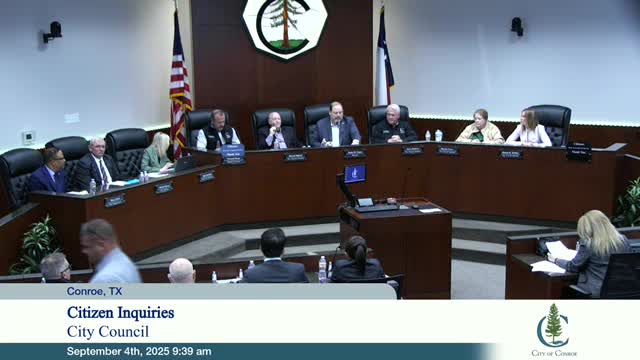
On Sept. 4 the Conroe City Council voted to keep the city's tax rate at 0.4272 and approved a 6% cost-of-living raise across city employees after hours of public comment and discussion over whether to front-load a four-year, 40% pay plan for police to match Montgomery County.
At a special meeting Sept. 4 at Conroe City Hall, the Conroe City Council voted to keep the city's 2025 tax rate unchanged at 0.4272 and approved a 6% cost-of-living adjustment (COLA) for all city employees after a lengthy debate over a mayoral proposal to give police officers a larger, immediate raise to reach pay parity with Montgomery County.
The council's decisions follow public remarks from pastors, residents and the Conroe Police Officers Association urging higher police pay, and a staff presentation laying out the fiscal impact of several tax-rate scenarios and pay models. The council voted 3-2 to maintain the current tax rate, and later approved a 6% COLA across the board by roll call vote (three in favor, two opposed).
Why it matters: Council members and city staff said Conroe faces competing short- and long-term fiscal pressures'including a multiyear need for new water wells, rising capital costs, debt related to recent downtown projects, and recruiting and retaining public-safety personnel. Supporters of a larger police raise said Conroe could lose experienced officers to higher-paying jurisdictions; opponents warned that raising the tax rate now would commit the city to higher ongoing costs without voter approval.
Council action and votes
Councilwoman Porter moved to keep the tax rate at 0.4272 (the city's current rate). Mayor Pro Tem Wood seconded; the motion carried on a 3-2 vote with Porter, Mayor Pro Tem Wood and Councilwoman Arthur recorded as voting in favor and Councilman Harrell and Councilman Hardman recorded as voting against. Councilmembers discussed that final adoption of any tax rate on Sept. 11 will require four votes (a supermajority) to adopt a rate above the voter-approval threshold, so today's direction will feed staff budget work ahead of that meeting.
Later in the meeting the council approved a 6% COLA for all employees by roll call (Mayor Pro Tem Wood and Councilman Harrell voted no; Councilwoman Porter, Councilman Hardman and Councilwoman Arthur voted yes). Staff and councilmembers said the 6% across-the-board raise fits within the budget work the city has already presented to council and will be included in the operating budget preparation.
What staff presented and the budget trade-offs
City finance staffed three primary tax-rate scenarios for council: the current 0.4272 rate; a mid option of 0.4488 (projected to raise about $3.2 million); and the voter-approval ceiling of 0.4613 (projected to raise about $5.0 million). Finance told the council that a 0.4613 rate would increase the annual tax bill for the average taxable home (valued in staff material at $277,000) by about $94.46 a year.
Staff also modeled the cost to front-load Montgomery County's four-year deputy pay plan. Based on headcount and benefits, front-loading the county's proposed FY29 pay scale in FY26 would cost about $4.6 million in salaries and roughly $1.2 million in benefits and taxes, for a combined $5.9 million additional recurring cost if implemented immediately.
Mayor (name not specified) proposed an alternative that Councilmembers discussed at length: a 10% COLA for police in year one with roughly a 3% COLA for other city employees in year one, and a written meet-and-confer agreement guaranteeing 10% COLAs for police in years 2-4 (a four-year path that would total about 40% by compounding). The mayor said the year-one 10% could be achieved without raising the tax rate by using funds already allocated for a previously discussed 6% citywide COLA.
Police recruitment and retention concerns
Representatives of the Conroe Police Officers Association and public commenters argued that neighboring jurisdictions, including Montgomery County and larger agencies, are offering substantially higher starting pay and are actively recruiting officers. Greg Tullis, president of the Conroe Police Officers Association, told the council: "We're asking for a sustainable path forward that ensures our city can retain the qualified community-oriented professionals we need to keep the city safe." Police leaders told council an internal poll indicated roughly half of officers would consider leaving without pay parity.
Several councilmembers and the police chief warned that losing multiple officers would raise training and replacement costs and reduce institutional knowledge. The police chief said: "If we lose 10 people, that's millions of dollars to replace them," and argued a near-term pay adjustment would be less costly than an exodus.
Public questions about water funds and other liabilities
Residents also raised fiscal and transparency questions. John Sellers asked about roughly $11 million in escrowed funds collected from Conroe water customers during litigation with the San Jacinto River Authority (referred to in the meeting as the SJRA/SGRA matter), asking: "What will that $11,000,000 be refunded to the people that it was collected from, or will it just disappear into the city's revenue stream?"
City leaders and staff replied that water system needs remain large: council and staff referenced a multiyear program to drill new wells and expand water capacity. One councilmember said the city will need to drill "minimally 11 to 13 wells in the next 12 years," and warned a single well's cost has grown substantially compared with prior years. Staff advised that the SJRA settlement funds are being considered for capital projects but emphasized higher capital and operating needs remain.
Council discussion also cited other fiscal pressures: operating and debt service on the Oscar Johnson Center, lower-than-expected sales tax and permit revenues following a moratorium, and the city's capital and debt load. Multiple councilmembers urged using the council's remaining time before the Sept. 11 budget meeting to prepare clear options and, if needed, seek voter approval in a later election so residents could decide larger, ongoing tax increases.
Implementation steps and next meetings
City staff said today's direction gives them time to prepare the formal budget and proposed tax rate for the Sept. 11 agenda and public hearing. Staff reminded the council that to adopt a tax rate above the voter-approval rate by ordinance on Sept. 11 they will need four votes; several councilmembers said they intend to bring a voter referendum option to a May election if council opts to seek public approval for larger revenue increases.
Closing notes
After the 6% COLA vote, the council adjourned. Councilmembers said they will continue refining pay scenarios and budget projections, and staff will return with the detailed operating budget, multi-year projections and specific scenarios showing the effect of different COLA mixes and tax rates.