Get Full Government Meeting Transcripts, Videos, & Alerts Forever!
Get email alerts on the Land Use Rezoning topic
No spam. Unsubscribe anytime.
Derby council sends 39.8‑acre rezoning back to planning commission after neighbors raise flooding and density concerns
Summary
The council voted 7‑0 to return a proposed rezoning of roughly 39.8 acres south of 50 Fifth Street and west of Woodlawn Boulevard to the planning commission for revisions after widespread neighborhood protest and discussion about buffering and floodplain management.
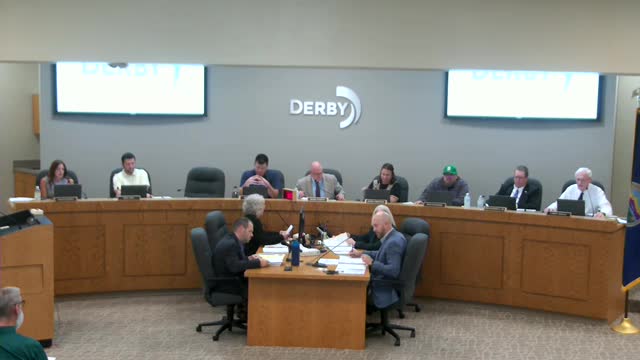
The Derby City Council voted 7‑0 on Sept. 9 to return a proposed rezoning for land south of 50 Fifth Street and west of Woodlawn Boulevard to the planning commission so staff and the developer can explore a reduced R2 area and single‑family buffer.
City planner Scott Knaebel said the subject site covers 39.8 acres within a 50.8‑acre parent tract and that the applicant seeks to change zoning from R1A (urban density single‑family) to R2 (two‑family). “The, subject site is, 39.8 acres,” Knaebel said, describing a plan that would place two‑family units in the center of the tract while leaving the eastern portion inside the floodplain in R1A for detention and open space.
The rezoning was recommended for approval 9‑0 by the planning commission subject to platting within one year, Knaebel said; that process would require a licensed engineer to prepare a drainage plan and meet subdivision rules that keep post‑development runoff from exceeding pre‑development discharge at the 100‑year storm. The planner also showed historical FEMA/floodplain overlays and said the area has contained floodplain and floodway designations dating back decades.
The application generated strong neighborhood opposition in the planning hearing and afterward. Phil Meyer, agent for the applicant, summarized questions neighbors raised at planning — Corps of Engineers coordination, wetlands, detention ponds and whether units would be Section 8 — and said, “the answer to that is no,” when asked about subsidized housing. Meyer told the council the developer intentionally excluded the eastern floodplain from the rezoning request and plans to preserve it as a reserve.
Several council members said residents’ flood concerns were substantial, but Knaebel and other staff emphasized that drainage and flood mitigation are addressed during platting and site‑planning rather than in the zoning decision. Council member Tripp and others said the process of consent annexation and subsequent zoning has sometimes lacked transparency for neighbors and asked staff to consider earlier public notice for future annexations.
Council members debated scale, precedent and neighborhood fit. Some members, noting the area’s existing single‑family character and homeowner objections, said they would prefer a compromise that preserved single‑family lots adjacent to existing neighborhoods while allowing duplexes in the interior. Other members pointed to market need for “attainable” housing and said a mix of housing types can be compatible if transition buffers are required.
Council member Jackie Coleman made a motion — seconded by another member — to return the item to the planning commission with direction to explore a reduced R2 area and establishment of single‑family buffers along the edges. The motion passed 7‑0. Under state law and Derby’s zoning rules, the council had the option to approve the planning commission recommendation (which would have required a supermajority because of the protest level) or to deny or modify it; sending it back requires a simple majority.
What happens next: the planning commission will consider the developer’s proposed modifications (for example, reserving a 150‑foot single‑family buffer along certain edges) and return a revised recommendation to the council. Any final zone change that is opposed by the notified property owners will require the supermajority vote specified by statute and local code.
Clarifying context: planning staff said the notification area produced protest petitions from nearly two‑thirds of notified properties — above the 20% protest threshold that triggers a supermajority requirement — and emphasized that flood mitigation (on‑site detention) will be required during the platting and engineering review to keep post‑development runoff equal to or below the pre‑development 100‑year runoff rate.