Get Full Government Meeting Transcripts, Videos, & Alerts Forever!
Planning board hears hours of neighborhood concern over proposed 71‑unit supportive housing at 26 Findlay Street
Summary
RISE and its development partners presented revisions to a proposed 71‑unit affordable/supportive apartment building at 26 Findlay Street; neighbors raised safety, traffic and tree‑loss concerns. The board did not vote and asked staff and the applicant for more data before advancing SEQRA review.
The Saratoga Springs Planning Board on a busy night heard detailed presentations from developer representatives for a proposed 71‑unit affordable and supportive housing project at 26 Findlay Street and more than a dozen neighbors who said the site and nearby blocks are already “oversaturated” with social‑service facilities.
The applicant, nonprofit RISE, represented by attorney Matt Jones and executive director Sybil Newell and supported by engineer Jason Dell (Lansing Engineering) and consultant Mike Newman (CST Housing), presented an updated site plan intended to respond to board and neighbor comments. RISE said the project would combine workforce housing (units for households up to roughly 60 percent of Saratoga County area median income) with supportive apartments reserved for people diagnosed with psychiatric disabilities and that supportive services would be provided on a scheduled basis.
Why it matters: Neighbors said the block that includes Findlay and Adelphi streets is already a concentrating point for short‑term shelters, drop‑in services and other facilities; they warned that building more permanent units at this site could exacerbate traffic, pedestrian safety and neighborhood character concerns unless the board requires mitigation. The board paused a decision so it could gather more objective data needed for its SEQRA (State Environmental Quality Review Act) review.
What the applicant told the board
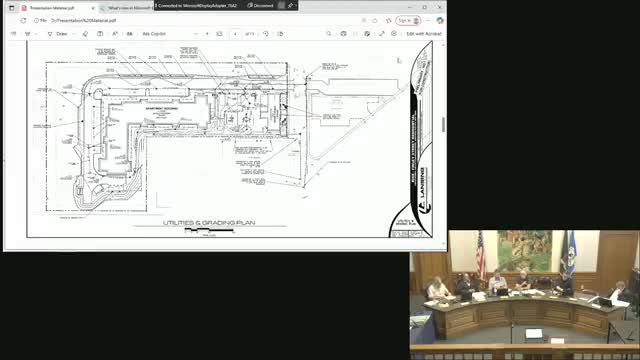
Matt Jones, attorney for the applicant, reviewed procedural steps already taken and noted a council resolution supporting a payment‑in‑lieu‑of‑taxes (PILOT) device that the city council adopted recently, an element the developer says strengthens project feasibility. Engineer Jason Dell described plan edits since the last appearance: the water main extension was upsized from 6 to 8 inches and an additional hydrant location added; access drive widths were reduced to the city standard (22 feet with 5‑foot radii); additional right‑of‑way street trees and a sidewalk connecting to the building were added; and the applicant reconfigured “banked” (future) parking so the vegetative buffer on the site perimeter would be less impacted. Dell said the applicant committed to additional evergreen plantings in the wooded buffer and that two subsurface stormwater treatment systems will detain large storm events.
Sybil Newell, RISE executive director, described the resident profile RISE expects: about half the units as workforce housing for households at or below 50–60 percent of area median income and half set aside as “supportive housing” for people diagnosed with psychiatric disabilities. Newell said supportive housing is permanent housing with wraparound services and “is not transitional” and added, “the requirements for supportive housing are that we see the individual once every three months; depending on need we will see them up to every day.”…
Already have an account? Log in
Subscribe to keep reading
Unlock the rest of this article — and every article on Citizen Portal.
- Unlimited articles
- AI-powered breakdowns of topics, speakers, decisions, and budgets
- Instant alerts when your location has a new meeting
- Follow topics and more locations
- 1,000 AI Insights / month, plus AI Chat