Get Full Government Meeting Transcripts, Videos, & Alerts Forever!
Get email alerts on the Capital Improvements topic
No spam. Unsubscribe anytime.
Calvert schools present $172.4 million six‑year capital plan; Northern Middle construction remains top priority
Summary
Calvert County Public Schools presented a FY 2027–2032 Capital Improvement Program that focuses on systemic renovations, continued construction at Northern Middle School, and combined planning for Calvert Elementary and Calvert Country. The district outlined $172.4 million in estimated project costs and described shifting state/local cost shares.
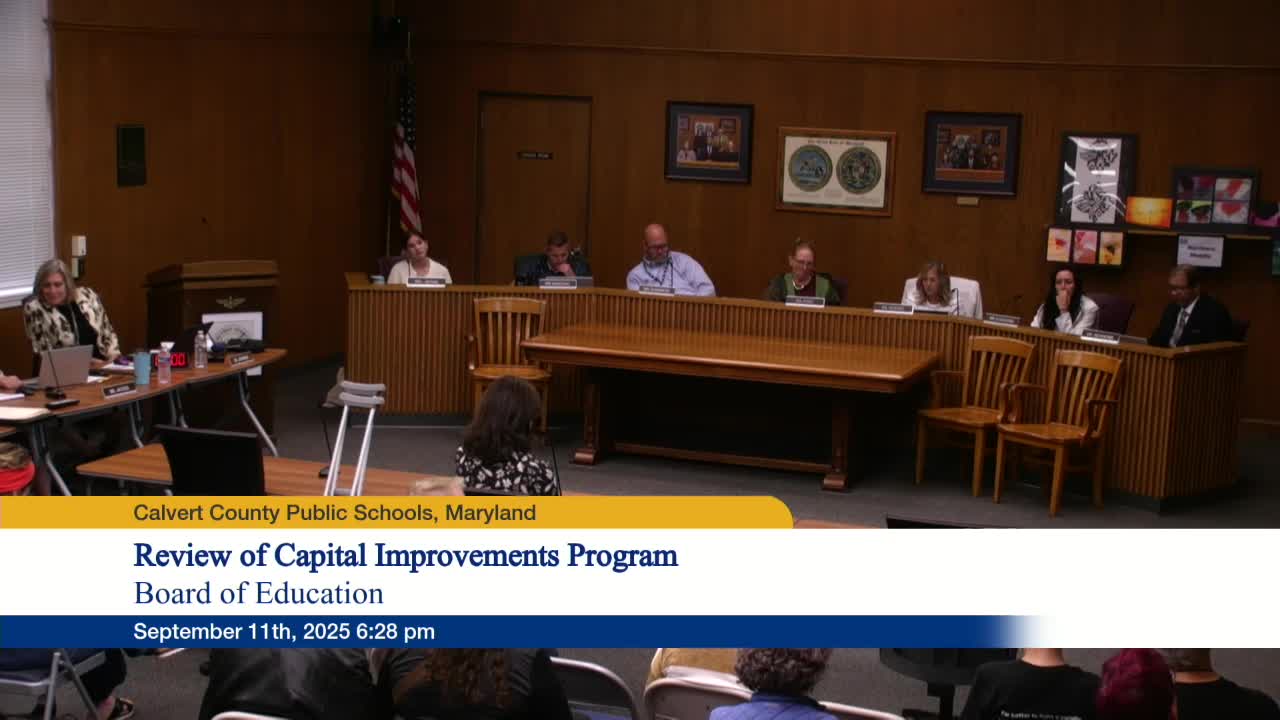
Calvert County Public Schools presented its FY 2027–2032 Capital Improvement Program on Sept. 11, outlining $172.4 million in estimated project costs and identifying continued construction at Northern Middle School and combined planning for Calvert Elementary and the Calvert Country School as top priorities.
The CIP presentation, delivered by Shichida Warner, director of planning and construction, said the six‑year plan is dominated by systemic renovation projects — roofs, HVAC, windows and related work — at multiple schools. Warner told the board that the total estimated cost for the six‑year cycle is $172,400,000, with an estimated state share of $61,800,000 and a local share of $110,600,000.
Warner said state funding shares for Calvert County will decline modestly in the near term because of the county's revised wealth calculation. For FY 2027 the presentation showed a state share of about 54 percent and a projected reduction to about 51 percent in FY 2028. Warner noted the State will continue to cap design costs at a maximum of 10 percent of construction and furniture/fixtures/equipment (FFE) participation at up to 5 percent on eligible projects.
Why it matters: the CIP funds both state‑eligible projects (with a shared state/local match) and projects paid entirely by the county. The local share increases the county's budget exposure, including responsibility for project contingencies and change orders.
Key projects and schedule details cited in the presentation: • Northern Middle School: continued construction in FY 2027 and FY 2028; Warner said rain earlier in the summer caused about a month of delay but project managers had made up roughly two weeks and, at the time of the meeting, were still projecting occupancy by next summer for Phase 1.
• Calvert Elementary and Calvert Country School: presented as a combined project (co‑located) with educational specifications and design in FY 2027–2028 and construction planned for FY 2029–2031.
• Mount Harmony Elementary School: feasibility work and planning included in the long range schedule, with design and construction slated later in the program timeline; Warner noted the existing Calvert Elementary building is shown as potential swing space and scheduled for limited renovations to permit temporary occupancy when Mount Harmony construction begins.
• Plum Point curtain wall and skylight replacement: listed again for funding; Warner said the project has been requested from the State for multiple years and the district is also pursuing a Maryland Energy Administration (MEA) grant to cover the work.
Warner explained how projects are identified for the CIP: internal condition and maintenance assessments, work‑order history, energy benchmarking and statewide facility assessments (the FCI). She also said stakeholder engagement occurs for specific projects, for example playgrounds.
Board Q&A and clarifications Board members pressed for detail on specific items. Warner said the Plum Point roof leak is being pursued with the roofing manufacturer under warranty; dye testing was planned to locate leaks in the area that had been replaced about 14–15 years ago. On whether the Calvert Country/Elementary project is inside the town center priority funding area, Warner said the application is pending county reviews: it had been delayed before the Board of County Commissioners hearing and would next go to the Planning Commission.
On contingency and risk, Warner said large projects typically use a construction manager at risk and a guaranteed maximum price that includes a defined contingency; systemic projects often lack that stop‑loss protection, so contingency levels vary by project and by anticipated unknowns (for example, potential abatement when opening walls).
The board did not take a formal vote on the CIP at the Sept. 11 meeting; Warner said the document will be posted for a 30‑day public comment period and staff will return with questions and next steps.
Ending: Warner closed by summarizing priorities and asking the board for questions; the district will post the full CIP for public review and accept comments during the 30‑day posting period.