Get Full Government Meeting Transcripts, Videos, & Alerts Forever!
Get email alerts on the Budget topic
No spam. Unsubscribe anytime.
Stafford mayor submits balanced FY2025–26 budget; council and police urge more funding for officers
Summary
Mayor Ken Matthew presented a balanced FY2025–26 budget that includes a $39.7 million general fund. Police and several council members warned the cuts could harm public safety and urged the council to consider restoring funds or new revenue options.
Mayor Ken Matthew submitted a balanced fiscal 2025–26 budget to the Stafford City Council on Wednesday, proposing a $39,737,781 general fund with $25,350,791 for salaries and benefits, $6,823,865 for operating expenses and $4,388,210 for capital items.
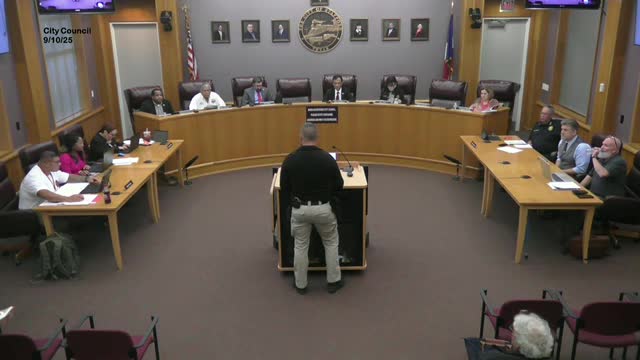
The presentation opened with public comment from Detective Reising, vice president of the Stafford Police Officers Association, who urged the council to fund ‘‘competitive pay for the Stafford Police Department,’’ saying neighboring agencies have recently awarded raises of ‘‘10 to 20%’’ and that the city risks losing officers after the city invests in training and equipment. ‘‘We ask that you invest in the men and women who protect the city every day, just as they have invested themselves in serving the city of Stafford,’’ Reising said.
Why it matters: Several council members said the paperwork shows a balanced budget but does not guarantee the city can meet contractual obligations, retain staff or maintain services without drawing on the fund balance or finding new revenue. Council members repeatedly cautioned against using one-time reserves for ongoing expenses and flagged potential contract and subscription obligations that could trigger litigation if underfunded.
Council debate and concerns Council members praised the mayor’s effort to present a balanced budget but said the document relies on cuts that may be ‘‘insufficient’’ to cover recurring costs. One councilmember observed the mayor ‘‘did his duty’’ in balancing the numbers but called the result ‘‘not a workable budget’’ because it reduces some contract and operating lines that staff said are legally binding. The council discussed three options: restore cuts, borrow from fund balance (with an acknowledged outstanding capital drawdown), or pursue new recurring revenue such as property taxes.
Several council members pressed for clear, department-level detail. Councilmembers said earlier pre-budget workshops produced a different set of departmental requests and that some positions or line items reappeared in the mayor’s edited worksheet after department-level workshops had rejected them. The council asked the finance director to supply a reconciled, line-by-line worksheet showing the mayor’s handwritten edits and the department-level totals.
Police staffing and public safety Detective Reising told the council that, since the start of the year, the department had responded to more than 60 violent crimes including three homicides and a recent multi-hour standoff in which officers endured sustained gunfire. He said Stafford has become a ‘‘stepping stone’’ agency and that many officers leave after two to five years despite the city’s investment; he cited an estimated $125,000 cost in training and equipment per recruit.
Mayor Matthew and the finance director responded that the police department’s proposed budget line for the coming year is higher than prior-year actual spending in several categories and said the mayor did not cut sworn staffing in his worksheet; the mayor noted the budget includes funding to unfreeze several police positions. Council members nevertheless said they want to examine specific pay, retention and competitiveness data before final votes.
Next steps The council did not take a final vote on the budget at Wednesday’s meeting. Members agreed to continue the discussion in the upcoming budget workshop and to have the finance director circulate the mayor’s edited worksheet and a reconciled line-by-line summary so council members can identify which cuts affect legally binding contracts or essential services. Multiple council members suggested putting property tax or other revenue options on the table before final adoption.
Ending note: In public comment and during the debate council members repeatedly framed the issue as a choice between protecting services (including police and fire), maintaining fiscal discipline, and facing the political difficulty of discussing a return to property taxation. No formal funding decisions were adopted at the meeting.