Get Full Government Meeting Transcripts, Videos, & Alerts Forever!
Get email alerts on the Administrative Services topic
No spam. Unsubscribe anytime.
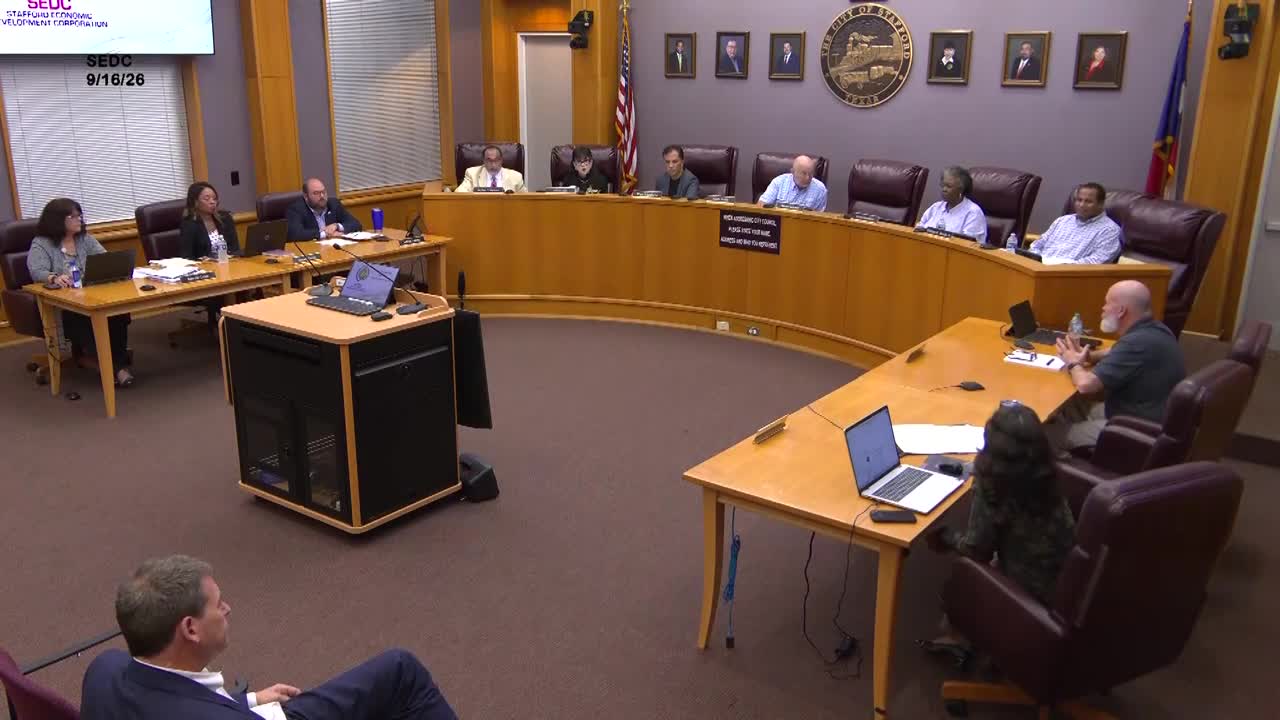
Stafford EDC approves $2.05 million administrative services agreement amid board concern over allocation and voter intent
Summary
The Stafford EDC board approved a $2,054,773 administrative services agreement and ratified fees paid to the city for FY2025–26 after an extended debate about whether the contract diverts EDC funds away from voter-directed economic-development uses.
The Stafford Economic Development Corporation voted to approve an administrative services agreement that sets administrative fees to be paid to the City of Stafford totaling $2,054,773 for fiscal year 2025–26.
The approval followed substantial debate. Board member Ken Matthew said the board must guard against a trend of “absorbing” EDC funds into the city general fund and urged documentation showing the EDC receives direct, measurable benefits. “I think this is against the wishes of the voters who voted for the formation of SEDC back in 1999,” he said, arguing the board needs an allocation method showing hours or measurable return tied to EDC duties. Matthew also cited an Attorney General opinion (referred to in the meeting as “GAO 610”) urging caution about using type A or B economic-development funds as a general revenue subsidy for municipalities.
Other board members explained the administrative allocation is a percentage-based sharing of departmental costs and said the amounts align with state law and historical practice. One board member clarified the methodology: the listed percentages reflect the share of certain city-department expenses (salaries, utilities and related costs) tied to work that benefits the EDC, not a flat transfer of EDC receipts. Several directors said the increase reflects expanded departmental workloads and more staff involvement in economic-development tasks.
Board members who spoke in favor said they want to ensure transparency and suggested future tracking or a joint meeting with city council to clarify duties, hours and measurable deliverables behind the fee. The record shows the city has previously used a percentage allocation and that the dollar amount has grown as revenues and department involvement increased.
A motion to approve the administrative services agreement as presented was made, seconded and approved by the board. The minutes record the vote as passed; the motion included ratification of administrative fees paid to the city for FY2025–26.
Board direction: members requested additional documentation showing the departmental time or deliverables tied to the administrative fee and suggested a joint council/EDC review to evaluate the allocation method.