Get Full Government Meeting Transcripts, Videos, & Alerts Forever!
Get email alerts on the Annual Maintenance Program 2026 topic
No spam. Unsubscribe anytime.
Public Works committee recommends $38 million 2026 maintenance program covering streets, sidewalks, signals and stormwater
Summary
The committee recommended City Council approve the 2026 Annual Maintenance Program, a roughly $38 million package that staffs said will fund street preservation and rehabilitation, sidewalks, stormwater repairs including a Wycliffe neighborhood project, signals and bridge maintenance.
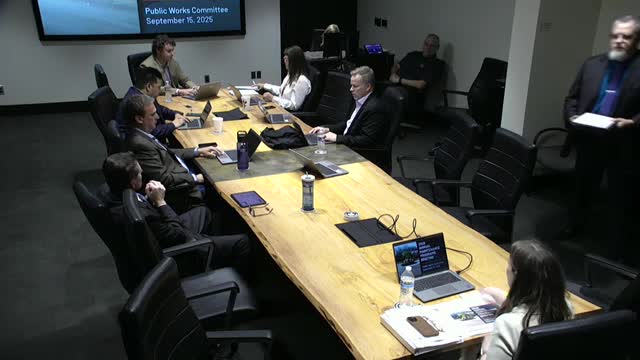
The Overland Park Public Works Committee on Sept. 15 recommended City Council approve the city’s 2026 Annual Maintenance Program, a planned expenditure package staff described as roughly $38,000,000 and including street preservation and rehabilitation, sidewalk work, stormwater repairs and traffic signal upgrades.
Public Works Director Lorraine Posalo and deputy city engineer Kyle Dickman presented the program overview. Posalo said the program focuses on preserving pavement condition and extending asset life, and noted the city budgets maintenance as part of a five-year capital and maintenance plan. “Our goals ... are we want to keep our infrastructure in good condition. We are also looking to extend that useful life and stay ahead of those failures,” Posalo said.
Staff recapped 2025 accomplishments: roughly 200 lane miles treated primarily through preservation (chip seal and UBAS), 45 lane miles rehabilitated with mill-and-overlay, nearly 40 miles of curb work, extensive sidewalk investments and eight bridges maintained. For 2025 staff reported total program expenditures including outside funds of about $51,880,000 and said they leveraged about $6,200,000 in non‑city funding.
For 2026 staff described a program funded chiefly by the OP Moves infrastructure sales tax and PAYGO, supplemented by special-street funds, stormwater utility funds and intergovernmental dollars. Staff said the 2026 program includes roughly $2,200,000 in non‑city funding. Key elements listed by staff included 36 lane miles of residential rehabilitation, thoroughfare preservation on Antioch and Metcalf, several bridge projects, and ongoing crack sealing, prep work and automated pavement condition surveys. The stormwater program identified a major repair in the Wycliffe neighborhood (103rd & Antioch) that staff said will replace about 6,700 linear feet of pipe and 67 inlets and will be phased to align with neighborhood reconstruction; staff said they expect the Wycliffe work to be a two‑year project and that they secured $2,200,000 in county funds for that work.
Staff also described the sidewalk program as substantially increased compared with past years, with an annual standalone sidewalk program of about $1,500,000 plus on‑demand contracts; they plan to add an in‑house crew to handle spot panel replacements and reduce reliance on temporary asphalt repairs. Staff said they continue to monitor contractor market capacity and rising construction costs.
The committee discussed preservation choices, including UBAS and chip seal, and staff explained their approach: UBAS is used when curb and sidewalk conditions are suitable and is generally applied earlier in a street’s lifecycle or after rehabilitation, while chip seal is a lower‑cost preservation method applied more widely. Staff emphasized PCI (pavement condition index) and professional judgment drive project selection. Council members asked about emergency‑response detours, contractor availability and neighborhood selection criteria; staff responded that they prioritize using data and professional judgment and will coordinate public notice to reduce construction fatigue.
Council member Chad moved to recommend City Council approval; the motion passed unanimously.