Get Full Government Meeting Transcripts, Videos, & Alerts Forever!
Get email alerts on the Policing Technology topic
No spam. Unsubscribe anytime.
Overland Park committee approves 10-year, $22.4 million Axon agreement for connected policing technology
Summary
The Overland Park Public Safety Committee on Sept. 10 recommended city council approval of a sole‑source, 10‑year purchase and services agreement with Axon Technologies Inc. for an officer-safety ecosystem costing up to $22,366,743.84.
The Overland Park Public Safety Committee on Sept. 10 recommended that the City Council approve a sole-source purchase and agreement with Axon Technologies Inc. to adopt the vendor’s connected public-safety ecosystem over a 10-year term for an amount not to exceed $22,366,743.84.
The agreement covers Axon body-worn cameras and in-car systems, a digital evidence management system (evidence.com), records management migration, drone-for-first-responder capability, AI-enabled review tools and a package of services and hardware refreshes that staff said will be delivered across the term. Major Richard Brashears, who led the presentation for the police department, told the committee the system would connect body cameras, in-car video, drones and other devices into a single platform so evidence and records do not need to be pulled from multiple siloed systems.
“This allows you to open up the app, take a photo, and it drops it directly into the record system,” Major Richard Brashears said of Axon’s digital evidence features. He described an integrated workflow in which a body camera’s LTE connection can provide location and live-streaming, trigger recording when a weapon is drawn and launch a drone to an officer’s GPS location.
Why it matters: Staff said the purchase would centralize multiple functions now handled across disparate systems, increase operational efficiency, expand supervisor review capability and create new transparency and community-facing options such as a camera registry and automated community notifications. The packet presented to the committee projected that continuing current, separate systems over the next 10 years would cost roughly $20 million; with Axon’s negotiated discount staff estimated a net increase of about $2–2.5 million across the decade for expanded capabilities.
Committee discussion focused on civil-liberties safeguards, AI oversight, costs and contract protections. Committee members asked about public access to footage after critical incidents, whether federal agencies would have direct access to data, and what termination and insurance protections exist. Major Brashears and city staff said policies for post‑critical-incident release and drone transparency are under review and that the city’s legal and finance teams negotiated contract language including appropriation-based termination and vendor delivery remedies. On insurance, staff said Axon agreed to liability and cybersecurity coverage and the city required evidence of SOC 2/ISO-type audits; staff reported a $25 million per‑loss cyber coverage provision secured in the contract.
Major Brashears described the drone offering as a proof-of-concept on a five-year cadence within the larger 10‑year agreement. He said the drone capability (DFR, drones-for-responders) includes radar-based support to allow extended flight altitudes and safer operations near controlled airspace. He said the DFR component is limited to a five-year term to allow reassessment as the technology and regulation evolve.
On AI features, staff said Axon’s “AI leader plan” allows the city to opt into future Axon-developed capabilities during the contract term but emphasized that all AI outputs would require human review before being relied on in administrative or legal processes. Major Brashears said the department currently uses limited automated tools and intends to build policy language that will identify AI-assisted drafts and preserve human oversight.
The committee also discussed fiscal structure. Staff said the agreement includes hardware refreshes and that many legacy contracts and licenses would be retired; finance staff had reviewed the projections and recommended the payment structure. Major Brashears said annual invoices would be paid in arrears after deliverables, and staff stressed there is an appropriation clause allowing the city to terminate if funding is not available.
On questions about sharing data with federal immigration authorities or other agencies for non‑criminal purposes, staff said the department would not share data absent a criminal nexus and that policy and technical safeguards are intended to limit noncriminal access. On community engagement, staff said they have been discussing technology and transparency with local groups and plan broader policy and community review, including bringing updated body-camera policies back to the committee.
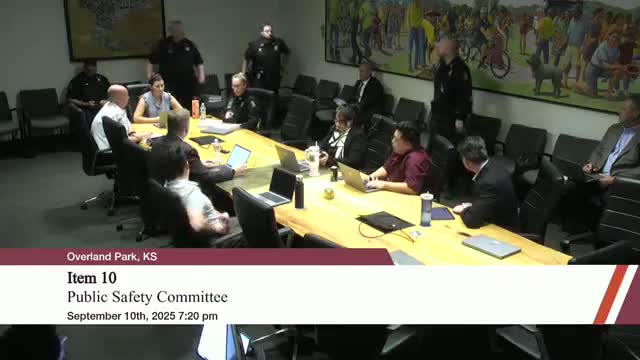
Committee action: A committee member moved to recommend a waiver of competitive bidding as a sole-source purchase and to approve the Axon agreement; the motion was seconded and passed unanimously. Staff said the agreement would next go to the City Council for final approval.
What’s next: Staff expects to return with specific body-worn camera and drone policies and estimated timelines for implementation. Major Brashears said he hoped policy work on post-critical-incident footage would be completed by early next year.