Get Full Government Meeting Transcripts, Videos, & Alerts Forever!
Get email alerts on the City Budget Millage Assessments topic
No spam. Unsubscribe anytime.
Parkland commission sets FY2026 millage at 4.2979 mills, adopts preliminary assessments and first-reading budget
Summary
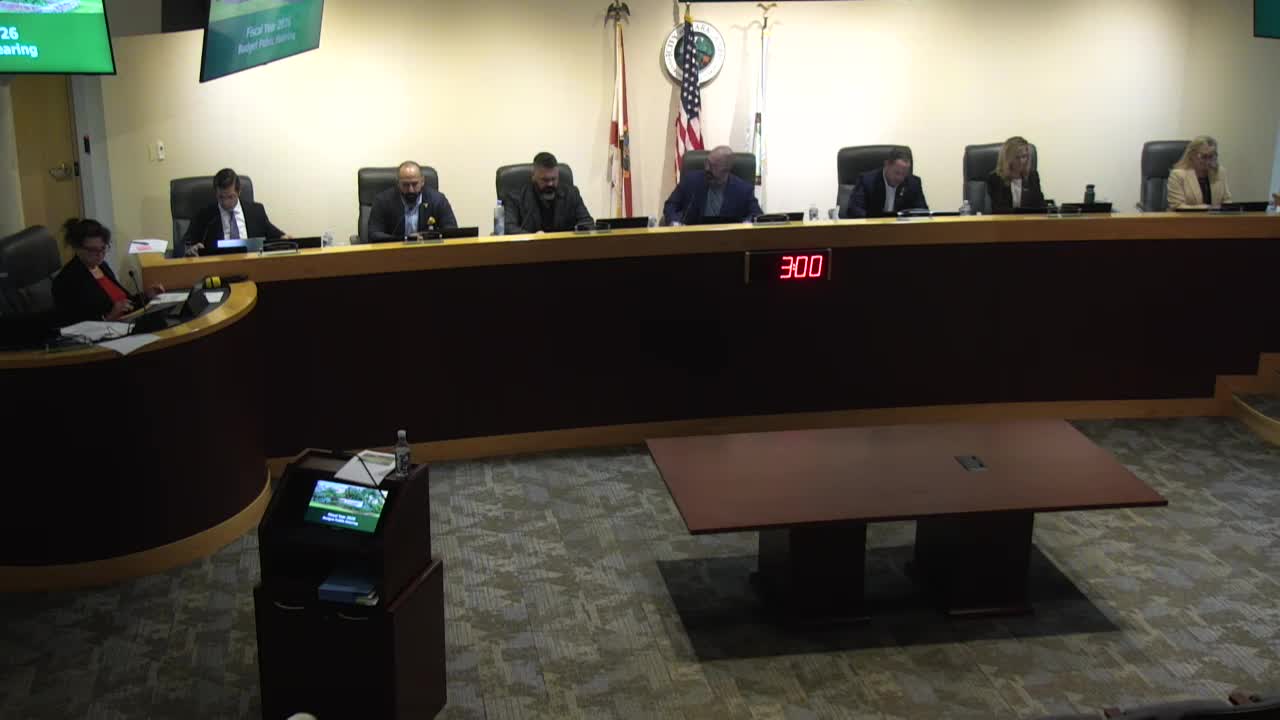
The City of Parkland City Commission voted unanimously Sept. 12 to confirm preliminary assessments for fire, solid waste and stormwater services and to approve first readings of the fiscal year 2026 millage rate and budget, setting the proposed operating millage at 4.2979 mills for the year beginning Oct. 1, 2025.
The City of Parkland City Commission voted unanimously Sept. 12 to confirm preliminary assessments for fire, solid waste and stormwater services and to approve first readings of the fiscal year 2026 millage rate and budget, setting the proposed operating millage at 4.2979 mills for the year beginning Oct. 1, 2025.
Finance Director Kelly Schwartz told the commission the proposed millage equals 4.2979 mills — an increase of 5.81% over the rollback rate of 4.0618 mills calculated under Florida law — and that the city is not proposing any voted debt-service millage. Schwartz said the proposed rate is unchanged from the previous five fiscal years and that the millage and assessments together are projected to generate about $2.15 million in additional ad valorem revenue for FY2026.
The budget measures presented together as agenda items 4a–4e include: reimposition of the fire-rescue assessment (Resolution 2025-062), the solid-waste assessment (Resolution 2025-063), the stormwater management assessment (Resolution 2025-064), first reading of the FY2026 millage ordinance (Ordinance 2025-009), and first reading of the FY2026 budget ordinance (Ordinance 2025-01/2026). The commission held separate votes on each item; all passed unanimously on roll call.
Why it matters: Schwartz emphasized that property taxes supply a large share of city revenue. She told commissioners that property taxes account for about 61% of the city’s revenues and that the city receives roughly 23% of a typical homeowner’s total tax bill (most of the rest goes to Broward County and the school board). The proposed FY2026 total budget presented by staff was about $75.5 million, with the general fund approximately $58.8 million and capital projects roughly $4.9 million.
Key details from staff presentation: Schwartz attributed the increase in ad valorem revenues to higher taxable values and to planned expenditure increases, including the Broward Sheriff’s Office (BSO) contract changes, employee compensation adjustments, benefit cost increases, and capital projects. She said average existing-property value increases were constrained by homestead caps, producing a net taxable-value increase of 5.81% and new taxable value of roughly $73 million. The budget includes a 3% cost-of-living adjustment for staff, a merit pool, an 11% retirement contribution for full-time employees with an optional 4% match, and health-insurance premium increases estimated at 4.75%. Property/general insurance increases were presented at 7.24%.
On assessments: Schwartz presented the proposed residential fire assessment increase (preliminary 5.17%), which would raise the residential fire assessment by about $16.08 annually to a new residential assessment of $327; she also noted an outside study that showed a potential maximum residential fire rate of $476. Solid-waste assessment increases were tied to a trash-specific CPI (4.3% this year), producing a new residential solid-waste assessment of $472.68 (a $19.44 increase). Stormwater assessments were adjusted by the general CPI (2.2%), with per-district changes between $0.87 and $3.96, depending on district.
Budget composition and capital highlights: Schwartz said the FY2026 budget fully funds the city’s capital program at about $4.9 million and carries a stabilization/reserve balance of about $13.4 million and an infrastructure reserve of $750,000 for storm/deductible events. Large capital replacement items include an estimated $925,000 condenser replacement at the recreation center and restroom/concession improvements at Pine Trails Park (about $500,000). The Ranches Roads Fund was budgeted at $4 million for milling and repaving work; Pine Tree Roads Fund was budgeted at $7 million (including $5 million in projected loan proceeds and $2 million of the city’s use of fund balance tied to a settlement agreement).
Public comment and commission discussion: Public comment on the fire assessment urged staff to review alternative (tiered) methodologies in light of potential state-level property-tax changes; commissioners acknowledged the point and suggested adding assessment methodology review to strategic planning. Commissioners praised staff for maintaining the millage rate for multiple years while funding projects and highlighted fiscal conservatism, full funding of capital projects and continued investment in parks and infrastructure.
Next steps: State law requires two public hearings for millage and budget adoption. The commission completed first readings and set a second public hearing for Sept. 24 at 6 p.m. for final adoption. As required, the city will publish the statutorily mandated budget notices in the local paper before the final hearing.
Votes at a glance: The commission conducted separate roll-call votes and approved all five FY2026 items (Res. 2025-062 fire assessment; Res. 2025-063 solid waste assessment; Res. 2025-064 stormwater assessment; Ord. 2025-009 millage first reading; Ord. 2025-01/2026 budget first reading). Each measure passed unanimously with the following roll-call pattern recorded: Commissioner Bridal — yes; Commissioner Kantriman — yes; Commissioner Murphy Salimoni — yes; Vice Mayor Israel — yes; Mayor Walker — yes.
Ending: Staff and commissioners said they will continue to refine budget numbers before the second hearing; the commission requested strategic-planning review of contingency options if state-level property-tax reforms occur.