Get Full Government Meeting Transcripts, Videos, & Alerts Forever!
Get email alerts on the Open Meeting Law topic
No spam. Unsubscribe anytime.
City attorney gives board refresher on Nevada open meeting law
Summary
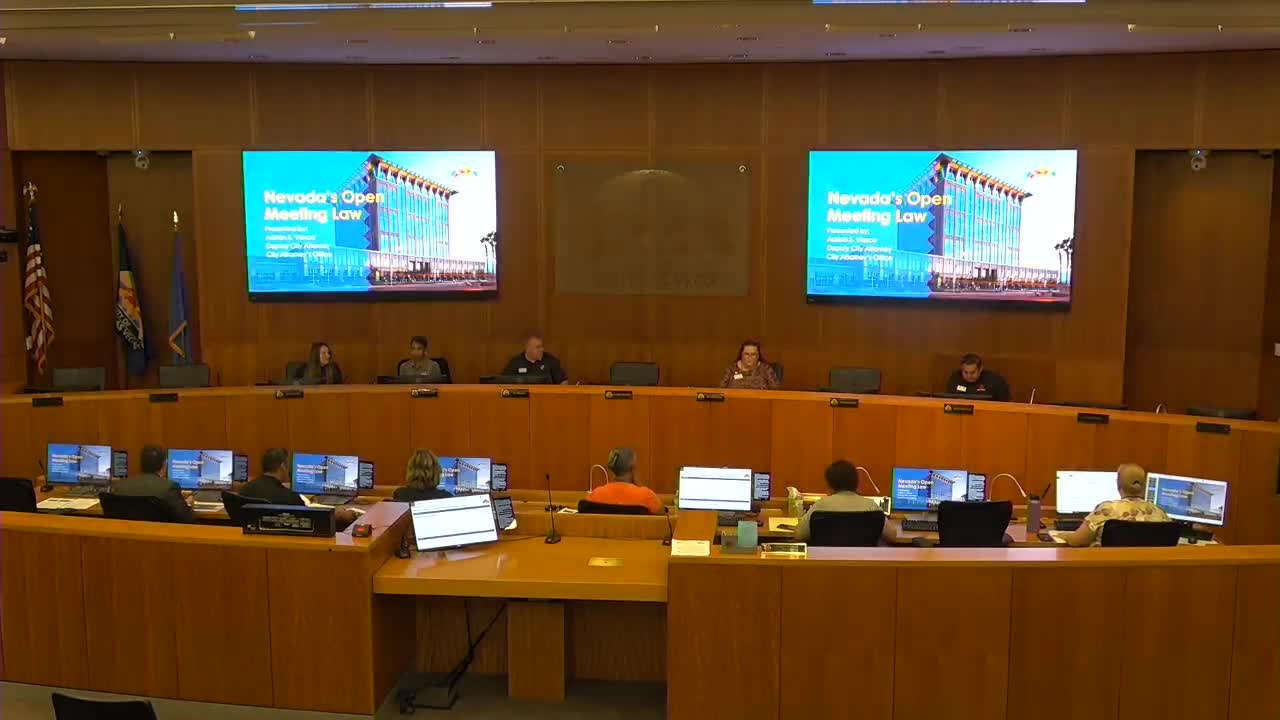
Deputy City Attorney Adrian Villesca reviewed Nevada's open meeting law, explaining quorum rules, serial-communication risks, public-comment requirements and penalties at the Sept. 9 North Las Vegas Parks, Arts, Recreation, and Culture Advisory Board meeting.
Adrian Villesca, a deputy city attorney for North Las Vegas, gave the Parks, Arts, Recreation, and Culture Advisory Board a refresher on Nevada's open meeting law at its Sept. 9 meeting, covering what triggers the law, how to avoid inadvertent violations and the penalties for noncompliance.
Villesca told board members the statute is grounded in transparency and that “the keyword is open,” urging members to keep deliberations in public meetings rather than in emails or serial communications that can create a constructive quorum.
The training reviewed when the law applies: whenever a quorum of a public body — for this board, four members — is present and members deliberate toward a decision about matters within the board’s jurisdiction. Villesca warned that a series of separate gatherings or electronic messages that, taken together, include a quorum and evidence deliberation can amount to a constructive quorum and violate the law.
Villesca used published court decisions to illustrate the boundaries. He summarized Del Papa v. Board of Regents (a Nevada Supreme Court case) in which private circulation of a draft advisory and solicitation of board feedback by the majority was found to be an official action taken outside a public meeting. He contrasted that with a Reno redevelopment case, where back-to-back briefings attended by fewer than a quorum were not found to violate the law because there was no evidence of serial communications that produced collective deliberation.
The deputy city attorney also outlined public-comment rules: a public body must provide comment opportunities both at the start of a meeting for agenda items and later for non-agenda matters; the city’s practice is to limit speakers to two minutes, and the chair may refer speakers to staff for follow-up rather than engage in debate during the public-comment period. Villesca noted minutes must record the substance of public comments if a speaker requests that their remarks be included.
He described criminal and administrative penalties for knowing participation in an open meeting-law violation and for wrongfully excluding someone from a meeting: misdemeanors and administrative fines that can range from $500 (first offense) to $2,500 (third or subsequent). He also said there is no criminal or administrative penalty if a member reasonably relied on legal advice provided by the public body’s attorney.
Board members asked practical questions about the law during the presentation. Member Brown said the training was his first and thanked Villesca: “I learned things.” Members asked about the differences between a comment and an impermissible deliberation during board- or staff-comment agenda slots; Villesca advised that brief comments and requests to place an item on a future agenda are acceptable, but back-and-forth exchanges that resemble collective weighing of options should be avoided and instead scheduled for a noticed agenda item.
Villesca closed by urging members to avoid “reply all” email chains, serial texts or coordinated phone calls that could create an unintentional quorum and to work through staff or the city attorney’s office when in doubt.