Get Full Government Meeting Transcripts, Videos, & Alerts Forever!
Get email alerts on the Minimum Property Standards topic
No spam. Unsubscribe anytime.
Decatur Building Standards Commission unanimously backs adding minimum service requirements to property-standards ordinance
Summary
The commission voted to recommend that city council adopt an amendment to Section 10-111 that adds minimum service requirements—such as functioning plumbing, heating and electricity—for occupied dwellings; commissioners discussed enforcement timelines and exceptions for vacant, secured properties.
The Decatur Building Standards Commission voted unanimously to recommend that City Council adopt a revision to Section 10-111 of the city’s minimum property standards ordinance that would add minimum service requirements for occupied dwellings, commissioners said.
Commissioners said the proposed new subsection would require residential units to have basic, functioning services — including a kitchen sink, lavatory, tub or shower, water closet, hot and cold running water, water heating, heating facilities and basic electrical fixtures — and that those fixtures be connected to potable water and wastewater systems and maintained in good and sanitary working condition.
Commissioner Sean moved to approve the recommendation and Commissioner Danny seconded; the motion passed unanimously. The commission’s action was limited to a recommendation to city council; no ordinance change is final until council consideration.
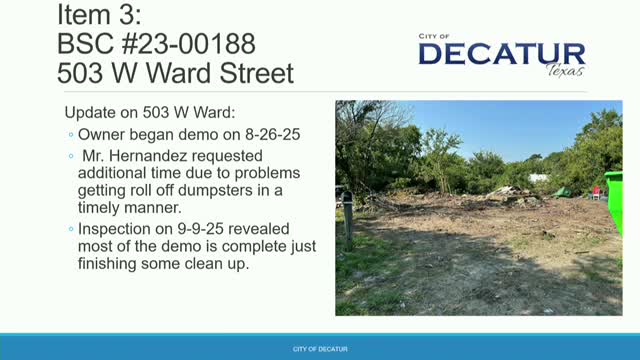
Code enforcement staff described the revision as responding to on‑going enforcement cases in which properties lacked basic services while still being occupied. Rick Denny, the commission’s code enforcement officer, said one property owner, Cristobal Hernandez, chose to demolish a structure at 503 West Ward Street and “he’s down to probably 1 more roll off dumpster full of stuff, and he’ll be complete with that. So it looks a lot better.” Denny also walked the commission through the proposed language and how it would sit alongside existing building codes.
Commissioners asked how the revision would be enforced and whether the clauses require all items to be missing to deem a building substandard. Denny said the proposed clause is written so any single listed deficiency would render a dwelling noncompliant: “it is which does not comply with the following requirements,” meaning the items are standalone standards. Commissioners pressed for clarity on whether a temporarily vacant but secured property with utilities shut off would be treated as substandard; staff said the rule applies to occupied dwellings. “You can have a vacant property with the utility shut off, but nobody living in it. . . And then that’s okay. But as soon as they move in, then they have to follow-up,” Denny said.
Commissioner Sammer asked whether terms such as “good working condition” are defined; staff responded that the adopted building codes and state law provide the technical standards and safety rules that would apply. In more detail, staff said building‑code requirements and state law govern installation and safety features for water heaters, heating appliances and related equipment, and enforcement would reference those codes.
Staff and commissioners discussed typical enforcement timelines. Denny said enforcement often involves initial notice and a corrective timeframe that can range from about 10 days to a month depending on circumstances; longer schedules can be granted through the Building Standards Commission or other civil processes if a property owner presents a remediation plan. Wayne (staff member) explained the distinction between criminal citations and the commission’s civil, quasi‑judicial proceedings: citations may be issued immediately when an occupied dwelling lacks minimum habitability standards, while the commission can grant 30‑, 60‑ or 90‑day timelines under its authority when appropriate.
Commissioners said they will forward staff’s notes and the revisions to City Council with the commission’s unanimous recommendation and asked staff to incorporate clarifications discussed at the meeting before council review.