Get Full Government Meeting Transcripts, Videos, & Alerts Forever!
Get email alerts on the Climate Policy topic
No spam. Unsubscribe anytime.
Kennewick officials review regional climate element required by House Bill 1181
Summary
City staff and consultants presented a regional climate element draft developed under House Bill 1181 requirements, outlining resilience and greenhouse-gas reduction subelements, data sources, public engagement and next steps toward adoption into Kennewick's comprehensive plan.
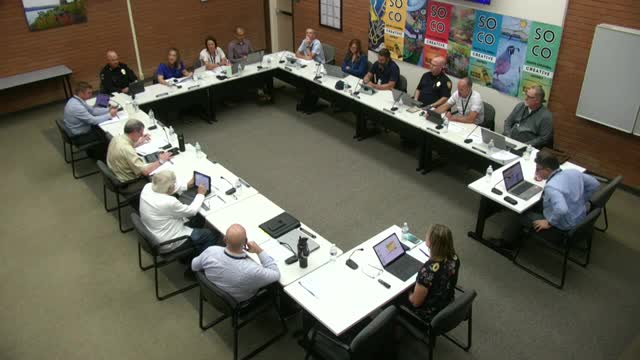
Kennewick City Council members on Tuesday reviewed a regional draft “climate element” developed to meet House Bill 1181 requirements and to be incorporated into the city’s comprehensive plan.
Consultants from Cascadia Consulting Group walked the council through the plan’s two required subelements — a resilience subelement and a greenhouse-gas emissions reduction subelement — and described the regional approach that pooled state funding and technical work across several Tri-Cities jurisdictions.
Gretchen Mueller, director at Cascadia Consulting Group and the project manager for the climate-element effort, told the council: “The House Bill 1181 is a requirement, and it requires jurisdictions to integrate a climate element into its comprehensive plan.” Mueller said the draft posted for public comment includes both resilience policies (for heat, wildfire, flood and smoke) and the emissions/reduction work required for the city because Benton County is among the counties identified in the law.
The draft document, Mueller said, also includes a greenhouse-gas inventory, a vehicle-miles-traveled (VMT) analysis, a vulnerability assessment and a policy audit of existing city plans. Anthony (city staff), who introduced the panel, described the regional approach as a cost-saving measure: combining funds and shared analysis across Kennewick and neighboring jurisdictions reduced expense for each city while creating a consistent, countywide dataset.
Council members pressed for detail on the datasets and methods used to calculate emissions and to allocate sources. “Where did you gather that information?” asked Council member Millar, noting local freight, rail and river traffic may add significant emissions. Mueller said the inventory used standardized datasets applied across jurisdictions and promised the inventory methodology and source list is in the draft climate element’s methodology section and that staff would circulate the underlying datasets on request.
Mueller and Anthony also explained a “wedge analysis,” the method used to compare current emissions, the reductions expected from state and local policies, and the remaining gap toward Washington’s 2050 net-zero goal. “What we’re trying to capture through the goals and policies … is to make up for kind of what isn’t being covered in the current local policies as well as the state policies,” Mueller said.
Public-engagement findings summarized in the presentation noted residents’ experience of extreme weather events and concerns about wildfire smoke, heat, drought and wind. Engagement respondents included priorities such as increasing tree shade and preserving natural areas for flood mitigation though council members cautioned the Tri-Cities drought and fire risk requires careful plant and irrigation choices.
The draft policies are organized by priority sectors recommended by the state Department of Commerce guidance and by topic (for example, transportation/VMT reduction; buildings and energy; ecosystems and water resources; economic development; agriculture and food systems; and waste management). The consultants said the regional element is intended to produce both region-wide policies and jurisdiction-specific strategies that the city will tailor as part of its comprehensive plan update.
Council members raised implementation questions — costs, trade-offs and measurement. Several asked that the city provide clearer, local cost and feasibility context for the draft policies, and one council member suggested a companion implementation or trade-off analysis so the public can understand likely consequences and costs of specific approaches. Mueller and Anthony said more detailed implementation and costing would be part of later steps when cities pick and prioritize policies during the comprehensive plan update.
Next steps explained by the consulting team include finalizing the regional draft in October, handing it to the Kennewick comprehensive-plan project team for local customization, and completing the formal comprehensive-plan adoption process next year. The consultants offered to return with a greenhouse-gas inventory expert if council members wanted a deeper technical briefing. Staff agreed to circulate the inventory methodology and source datasets to the council through the city manager’s office.
Mueller and the team asked council members to review the draft goals and policies posted with the meeting packet and to submit questions. The consultants emphasized that the regional element is intended to be data-informed, to show how draft policies meet the statutory checklist for House Bill 1181, and to provide a path toward implementation once the city tailors and adopts the policies into the comprehensive plan.
The council did not take a formal vote during the workshop; staff and consultants will continue the public-comment period and return draft materials as part of the city’s comprehensive-plan adoption schedule.