Get Full Government Meeting Transcripts, Videos, & Alerts Forever!
Get email alerts on the Budget And Finance topic
No spam. Unsubscribe anytime.
Council leans to 0.42 tax rate as staff refines utility, capital and financing plans
Summary
Council members told staff they are comfortable targeting a 0.42 ad valorem rate for FY26 operations while directing staff to sharpen utility fund expense projections, examine financing for a vac truck, and refine the CIP funding mix between reserves, impact fees and previous bond proceeds.
Lago Vista council members signaled support for a 0.42 ad valorem tax rate for the coming fiscal year while asking staff to tighten expense estimates and identify funding sources for major utility and capital projects.
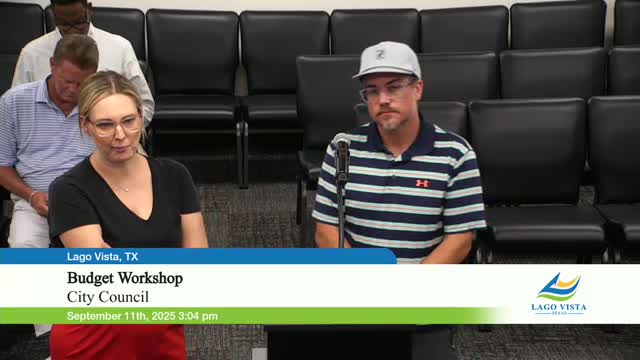
At a budget workshop, finance staff presented a revised “operational” budget that removed one‑time capital purchases to make recurring revenues and expenses clearer. Council members said the 0.42 rate appears sufficient to cover general‑fund operations when large asset purchases are treated separately in the CIP. Several council members and staff emphasized, however, that the city faces larger long‑term needs in the utility fund (water and wastewater) and that those projects — some running into millions of dollars — require careful funding choices, including impact fees, bond proceeds and targeted financing.
Key budget and capital items discussed - Tax rate guidance: After review, several council members said they were comfortable planning around a 0.42 tax rate for FY26 as the operating level. The mayor summarized council comfort with 0.42 while staff makes additional refinements before final adoption. - Utility fund pressure: Staff said the utility fund shows a shortfall when it must cover debt/transfers and one‑time capital. Council asked staff to sharpen the utility operations numbers and identify which large purchases can be financed or paid from impact fees and previous bond proceeds rather than current reserves. - Vac truck financing: Public works noted the city’s need for a vacuum/truck (vac truck). Staff proposed leasing/financing the vehicle (a multi‑year lease similar to the city’s vehicle leasing approach) to avoid a large one‑time draw on utility reserves. Council directed staff to present financing options (term, annual payment, interest) so the purchase does not force a utility‑rate spike. - Golf course fund: The golf course fund showed a projected deficit in some iterations. Council asked the golf course manager to reduce personnel/operating costs where feasible and to supply a realistic revenue forecast tied to the new irrigation system; council members suggested marketing the “rebirth” once the irrigation project is online. - Wastewater treatment plant estimates: Staff and engineering consultants provided a new, higher estimate for wastewater plant replacement/upgrade than earlier planning figures. Council asked for engineer briefings and recommended staff pursue external financing, including a potential Texas Water Development Board application and other grants.
Why it matters: The council’s tax‑rate guidance narrows the focus for public hearings and the final budget adoption. Detecting pressure in the utility fund and large CIP items early allows the city to craft financing strategies and avoid surprise rate spikes for utility customers.
Next steps: Staff will (1) update the budget with the refinements discussed, (2) provide a financing proposal for the vac truck (lease vs. purchase) and (3) refine the CIP with clear notes on which projects are funded by prior bond proceeds, impact fees, grants or reserves. Staff will also ask the engineers for a clearer, line‑itemed cost estimate and schedule for the wastewater plant and related effluent/disposal options.
Ending: The council left the workshop with a practical tax‑rate target and a list of actions staff must take before the next council budget hearings.