Get Full Government Meeting Transcripts, Videos, & Alerts Forever!
Get email alerts on the Emergency Preparedness topic
No spam. Unsubscribe anytime.
Dallas emergency-management staff urge seniors to register for STEER and Dallas Alert; describe CERT and outreach efforts
Summary
Cassandra Wallace of Dallas' Office of Emergency Management briefed the commission on STEER, Dallas Alert, AHAS and CERT, and said STEER registration does not guarantee assistance; staff reported about 4,400 Dallas Alert registrations and offered to provide local STEER counts on request.
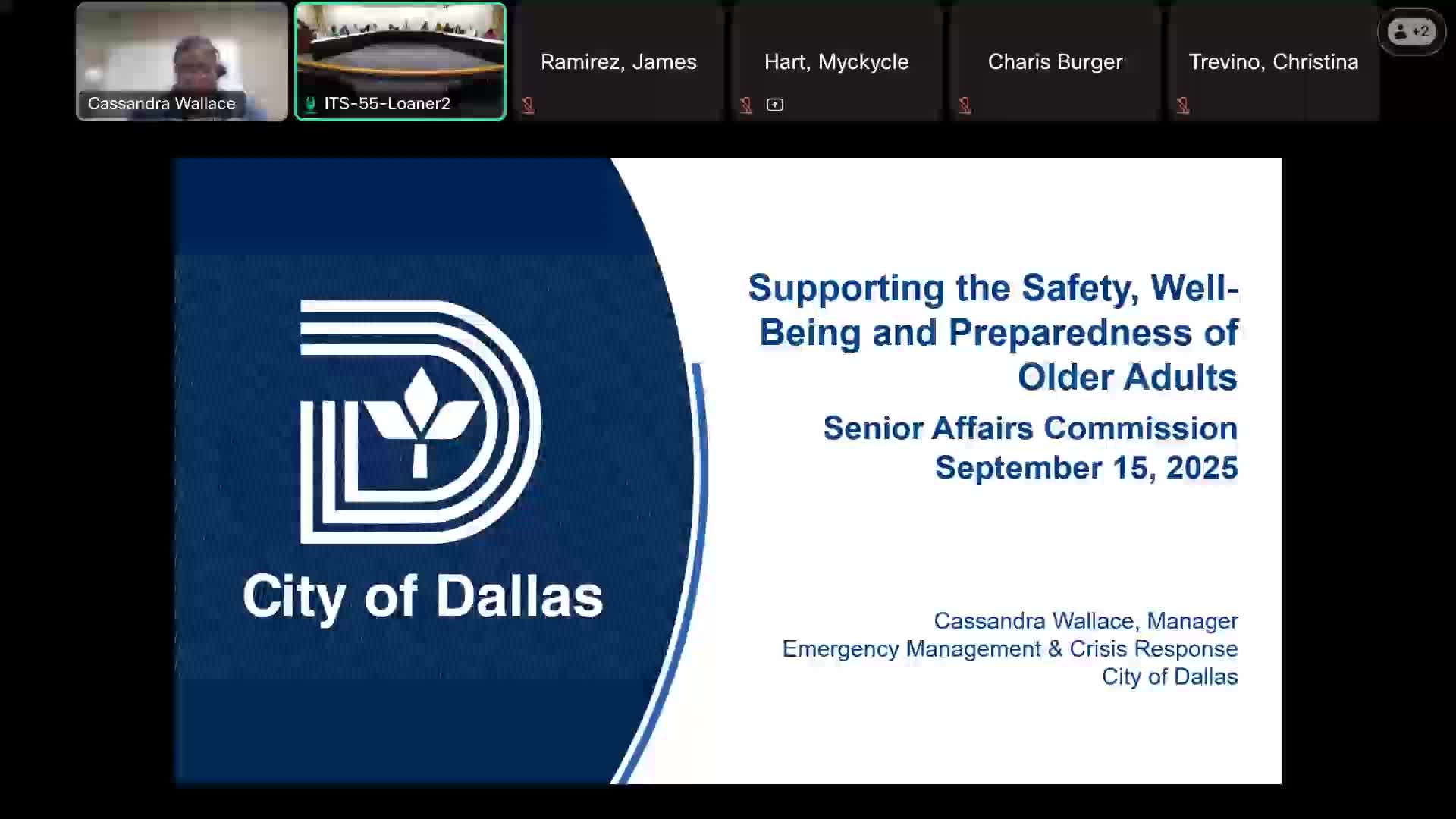
Cassandra Wallace, community preparedness program manager in the City of Dallas Office of Emergency Management and Crisis Response, briefed the Senior Affairs Commission on preparedness tools for older adults, including the State of Texas Emergency Assistance Registry (STEER) and the city’s Dallas Alert system.
Wallace said STEER is a free, voluntary and confidential state registry for Texans who may need extra help during emergencies, and that registration “does not guarantee assistance, but it does give us local emergency managers vital information to better plan.” She told commissioners that STEER and Dallas Alert are separate systems and that residents who want both types of support should register in each.
Wallace said the office uses STEER data to plan evacuations, transportation and sheltering, and that the city partners with organizations such as Meals on Wheels to help homebound residents register and to conduct wellness checks. She described Dallas Alert as the city’s mass-notification system and said the Accessible Hazard Alert System (AHAS) provides alerts in American Sign Language, English and Spanish for people who are deaf or hard of hearing.
Wallace described other outreach efforts: annual National Preparedness Month collaborations with Dallas Fire-Rescue to distribute preparedness bags, a monthly “Seniors on the Move” initiative at recreation centers, and partnerships that promote STEER at senior events. She described CERT (Community Emergency Response Team) training as a 20‑hour FEMA curriculum offered free to residents about four times a year, with one Spanish session annually.
Commissioners asked about registration counts. Wallace said about 4,400 residents were registered on DallasAlert.com but did not have a Dallas-specific STEER total available at the meeting and offered to provide that number later. She also said the office maintains local STEER data for planning, but that registration “does not guarantee assistance.”
Ending: Wallace closed by encouraging seniors to build neighborhood resiliency and to sign up for both STEER and Dallas Alert; she offered to meet with community groups and to provide additional registration figures on request.