Get Full Government Meeting Transcripts, Videos, & Alerts Forever!
Get email alerts on the Animal Welfare topic
No spam. Unsubscribe anytime.
San Antonio council approves ordinance narrowing abandonment loophole, raises enforcement questions
Summary
Council passed an ordinance amending Chapter 5 of the city code to prohibit abandonment of animals and to impose city fines; rescuers and residents urged clearer language, public education and more shelter resources before enforcement.
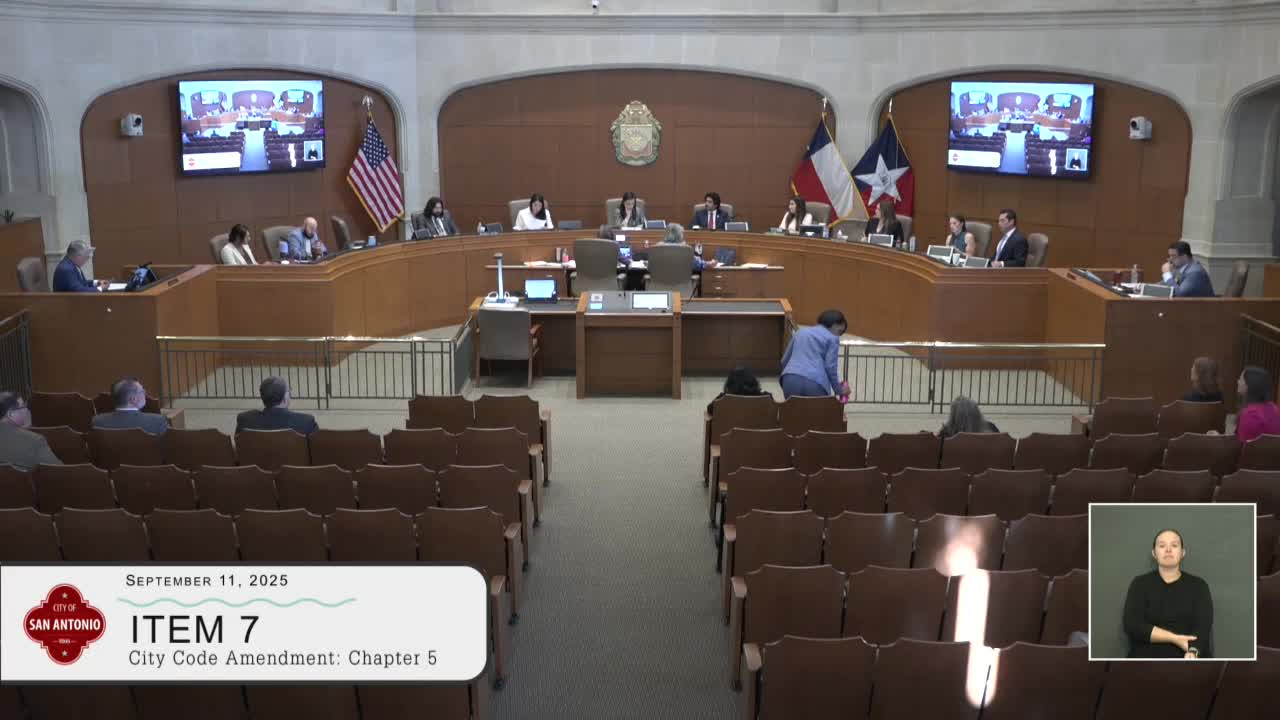
On Sept. 11, 2025, the San Antonio City Council voted to approve an ordinance amending Chapter 5 of the city code to prohibit abandonment of animals within city limits. John Gary, director of Animal Care Services (ACS), presented background on earlier community consultations and legal work that led to the ordinance. Councilmembers said the measure is intended to address repeated incidents of animals abandoned in public spaces and to increase owner responsibility.
The ordinance, as described by ACS staff, would expand the city’s prohibition on abandonment to include domestic and non-domestic animals (excluding wild animals captured and released under authorized exceptions) and set civil fines. Gary described proposed city fines starting at a minimum of $500 and up to $2,000 depending on offense and escalating for subsequent violations; the presentation said a third and subsequent offense would carry a $2,000 fine. ACS staff and the city attorney noted the proposed city ordinance would treat the offense as a city-level misdemeanor (class C under the city code provision), and they contrasted that with Texas Penal Code §42.092, which criminalizes “unreasonable abandonment” and can be a higher-level state offense depending on circumstances.
The item drew extensive public comment. Rescuers and volunteers — including Kelly Walls, who identified herself as an animal rescuer with two decades of experience — said the draft language was too broad and could inadvertently penalize volunteers who capture and relocate animals or community members who momentarily take in a stray animal. Several speakers urged that the city expand public education, clarify the ordinance’s definitions (for example, what constitutes “capture” or “release”), and increase access to spay/neuter programs and shelter resources before enforcement begins. ACS staff acknowledged the department is at capacity and said staff would prioritize connecting owners to resources where possible.
Councilmembers asked detailed questions about statutory compatibility and practical enforcement. Councilmember White said, “Abandoning animals is simply wrong and cruel,” and other members emphasized the need to coordinate legal language with state law and for ACS to develop clear public communications about how the ordinance will operate. Several members said they supported the ordinance as a tool to discourage abandonment but requested follow-up work on outreach and implementation.
The council voted to approve the ordinance at the Sept. 11 meeting; the motion passed (the transcript records the motion as made, seconded and approved but does not provide a roll-call tally). Councilmembers directed staff and the city attorney to ensure city ordinance language aligns with state law and to prepare detailed public education materials and implementation guidance for residents and rescue groups.
Context and next steps: Council members and speakers agreed the city must pair enforcement with services — expanded spay/neuter, clearer 311 guidance and shelter capacity planning — to avoid unintended consequences for low-income owners and volunteers. City staff said they will work with legal and communications teams to clarify the ordinance text and describe enforcement and resource options to the public.