Get Full Government Meeting Transcripts, Videos, & Alerts Forever!
Get email alerts on the Budget topic
No spam. Unsubscribe anytime.
San Antonio council weighs FY2026 amendments: pay increases, more police hires and delegate-agency boosts
Summary
At a Sept. 16 budget work session, the City of San Antonio City Council discussed proposed FY2026 budget amendments including a $750 base pay increase for city employees, funding to add as many as 40 additional patrol officers and restored payments for multiple delegate agencies; staff warned of larger fiscal risks in FY2027 if federal grants expire.
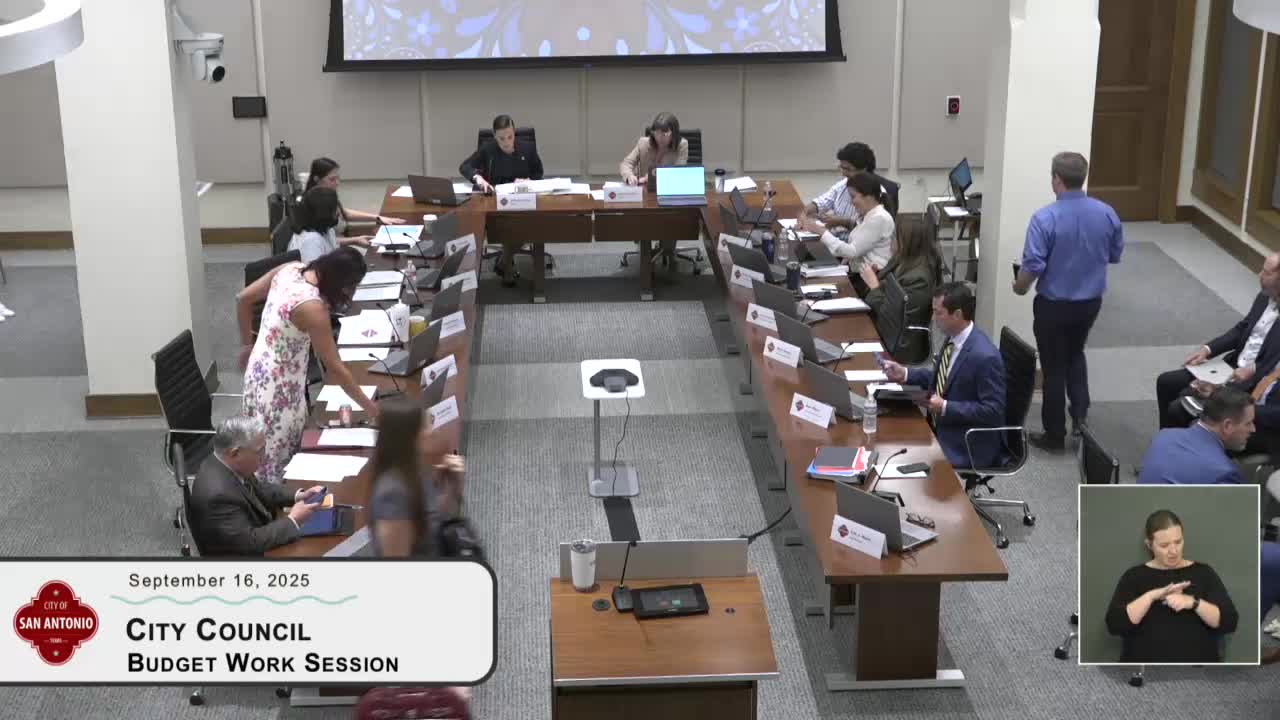
SAN ANTONIO — At a Sept. 16 budget work session, the City of San Antonio City Council discussed a slate of proposed changes to the fiscal year 2026 budget, including a proposal to add a $750 base salary increase for city employees, funding to increase police hiring and restored funding for several nonprofit service providers. City staff and council members emphasized the need to keep the FY2026 budget balanced while signaling bigger fiscal risks in FY2027 if certain federal grants expire.
Justina Tate, the city’s budget director, told the council that “the fiscal year 2026 proposed budget is $4,000,000,000” and reviewed a list of potential amendments and offset options. Tate said the proposed budget was balanced when presented on Aug. 4 but the city faces multi-year pressure as revenues slow and expenses rise.
Why it matters: City staff repeatedly told the council a balanced budget is legally required for FY2026 and that the larger risk is in FY2027 when federal funding supporting public-health and other programs may drop off. Dr. Claude Jacobs of Metro Health told the council staff had identified a looming fiscal “cliff,” saying the department expects “over $8,000,000 hit and over 80 staff impacted by those cuts” in the year after 2026 if federal grants are not renewed.
Key proposed amendments discussed
- Employee pay: Amendments would add a $750 base salary increase (described by staff as effectively a 2% across-the-board adjustment for many employees), and the budget director and multiple council members expressed broad support for preserving employee pay increases.
- Police staffing: One amendment would increase the number of new patrol officers from 25 to 65 (an addition of 40). Several council members urged funding the 65-officer goal pledged previously; others cautioned that earlier hiring expectations, life-cycle costs (vehicles, one-time equipment) and longer-term recurring personnel costs must be understood before committing additional recurring dollars. Councilman White said, “Nothing else matters if we don't keep the people of San Antonio safe,” arguing for full funding of the promised hires. Several colleagues urged staff to provide detailed per‑officer cost calculations (including vehicle and 1‑time costs) for smaller increments such as 10 or 20 hires so the council can choose a phased approach.
- Traffic safety equipment: An amendment would restore funding for 60 radar-feedback signs and 70 flashing stop signs; several council members said traffic-calming devices are a high priority and, in some districts, preferred them over additional patrol officers to address speeding complaints.
- Housing and repairs: Staff proposed restoring $1,000,000 to the minor repair program (raising the line-item from $7,000,000 to $8,000,000). Council members discussed whether a smaller “minimum-level” repair provided to more households would be preferable to larger repairs for fewer homes.
- Delegate agency funding and nonprofits: The city manager and budget director proposed increases funded from the delegate-agency reserve rather than new general‑fund appropriations. Notable proposals included $50,000 for American Gateway; $125,000 to convert Family Violence Prevention Services to a designated agency and combine two contracts; roughly $57,000 for the Alamo Area Rape Crisis center; about $91,981 for For Her; $144,000 for Big Momma Safe House; and a 50% increase to the SA Kids Breathe program (an additional $300,000 for a $900,000 total). Several council members urged adherence to the delegate-agency solicitation process and asked that TIRZ and other board‑governed items first go to their boards before council action.
- UTSA and NOW clinic: One amendment would provide funds to purchase essential equipment for a UTSA “Now” clinic (the presentation listed $300,000). Council members asked staff for more detail on current usage by first responders and whether clinic services might substitute for direct hiring of city mental‑health clinicians.
- Mental-health, TB and language access funding: Councilmembers and staff corrected a late addition: Metro Health’s memo described funding changes totaling $660,000 — $500,000 for mental-health support, $150,000 for additional TB work and $10,000 for language access — rather than the earlier rounded figure shown on the slide.
- Small-business and capital items: The package includes restoring $1,400,000 to a small-business construction grant program and adding $1,000,000 per council district to capital improvement projects in the proposed capital budget.
- TIRZ items and other pilots: Proposed TIRZ (tax increment reinvestment zone) allocations include $250,000 (total $500,000 over two years) for Prosper West, $150,000 for a pet-deposit assistance pilot, $200,000 for the Martin Luther King commemorative program and $300,000 for a feasibility study for a secondary ACS campus.
Offsets and revenue options discussed
Staff presented reductions and new revenues to keep the general fund balanced. Proposed cuts included eliminating the inner-city incentive fund ($3,000,000 over two years) and moving $1,900,000 of Alamo Promise funding to Ready to Work. A revenue option would raise the parks and environmental fee from $1.50 to $2.00 (a 50¢ increase) to generate an estimated $4,000,000 so some park expenses could be shifted off the general fund.
Council debate and concerns
Council members expressed a mix of priorities across districts. Several said employee pay should be the top priority; others urged prioritizing public-safety hires or neighborhood needs such as housing repairs, streetlights and infrastructure. Multiple members pressed staff for cost‑per‑officer and life‑cycle estimates before approving additional recurring personnel, and several asked for clearer information about how delegate‑agency increases would affect the competitive reserve for other nonprofits.
Staff next steps
City Manager’s office staff told council members they would circulate a follow‑up memo with answers to today’s questions by the evening and additional updates in the morning. The council is scheduled for another budget amendment work session on the following day and a final vote is planned at the Thursday meeting.
Ending
Council members frequently returned to two core constraints: the legal requirement for a balanced FY2026 budget and the larger FY2027 risk if federal grants and other external funding sources are not renewed. Staff and several council members said they will return with more detailed cost breakdowns — particularly for additional police hires and recurring personnel costs — before the council takes final action.