Get Full Government Meeting Transcripts, Videos, & Alerts Forever!
Get email alerts on the Domestic Violence Response topic
No spam. Unsubscribe anytime.
City staff outline domestic-violence response, high-risk team and prevention work
Summary
City presenters described multi-department efforts on interpersonal and domestic violence, shared prosecution and service data, and urged better analysis of trends and protective-order violations.
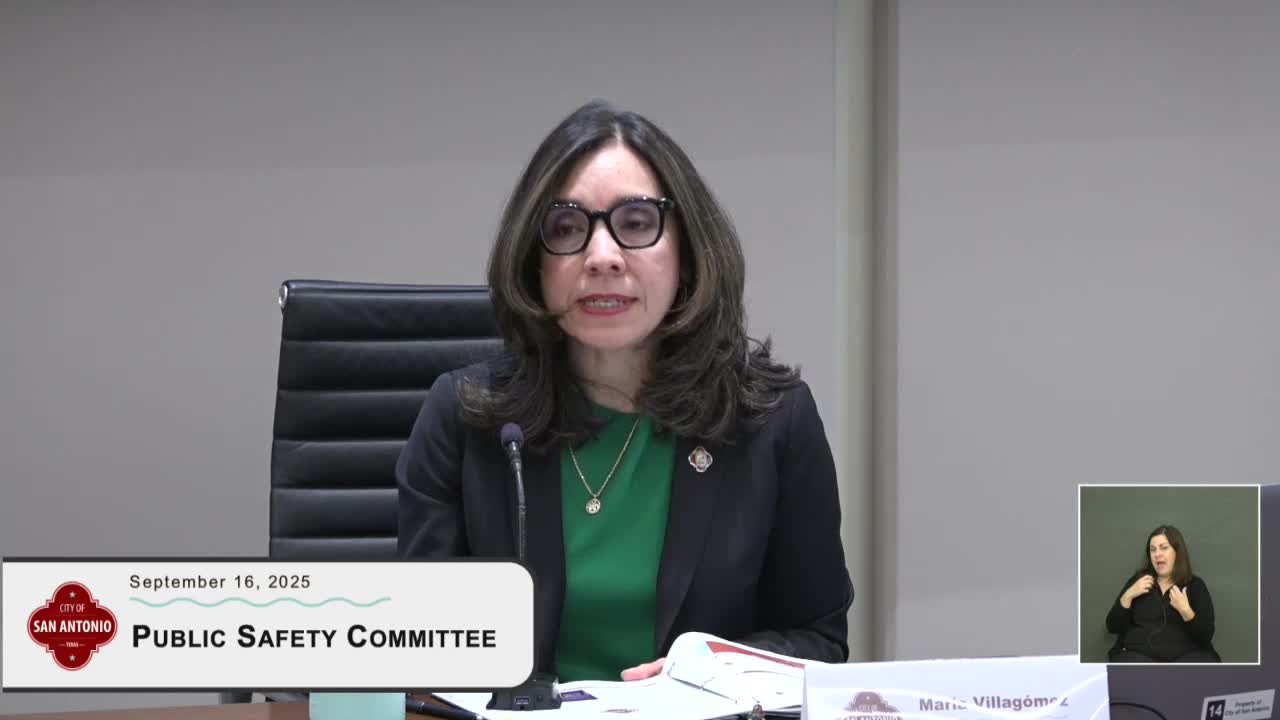
City staff briefed the San Antonio Public Safety Committee on the city’s interpersonal-violence (domestic-violence) response, available services and prevention work, including a multi-jurisdictional high-risk team and Metro Health advocacy services.
Erika Stevenson, identified in the presentation as the administrator for violence prevention, described a strategic, cross-departmental approach that links police response, Metro Health advocates, the prosecutor’s office and community organizations. Stevenson told the committee the city tracks two datasets: police calls for service and reported domestic-violence incidents; she warned the measures are complex and changes can reflect differences in reporting, population growth or victims’ willingness to contact police.
Staff cited a high-risk domestic-violence team that coordinates among state, county and city agencies and said the team helps manage cases that cross jurisdictions. Metro Health advocates and crisis-deferral services form part of a continuum intended to support victims and help arrange longer-term housing and services. Stevenson said approximately 10,000 people a year interact with crisis response and advocacy services (figure provided during the presentation). She also reported that the city is tracking homicide totals and said there were 30 homicides in calendar year 2020 and 22 so far in the current year as presented to the committee.
The city’s prosecutor’s office representative summarized criminal-case handling for misdemeanor domestic-violence charges, noting the office handles roughly 1,500 such filings per year and that filings were lower in the most recent comparison between 2023 and 2024. The prosecutor’s office described dispositional options including community service, court costs and counseling programs of 10–20 sessions depending on case history.
Councilmembers pressed staff for more than headline counts. One councilmember said numbers alone are insufficient and asked for analyses that link outcomes — for example, protective-order violations — to intervention strategies. Staff agreed to follow up with more granular breakdowns, including the categorization of calls, trends among youth, and the scope of protective-order violations. The committee was also told the Collaborative Commission on Domestic and Family Violence (CCDB) will hold an annual symposium — listed as Oct. 3 and available virtually — and staff encouraged councilmembers and stakeholders to register.
Committee members asked how the city tracks shelter access and emergency hotel placements for survivors who cannot stay in shelters (for example, those with pets or other barriers). Staff said short-term hotel placements (contracts for up to five days) are used as an interim solution funded from city program funds and tracked through the relevant programs; staff noted that hotel placement is not a solution to the broader housing shortage and pledged to return with more detail.
Members repeatedly requested clearer analyses rather than raw counts and asked staff to return with survivor-experience summaries and more explicit linkage between service responses, prosecution outcomes and protective-order enforcement.