Get Full Government Meeting Transcripts, Videos, & Alerts Forever!
Get email alerts on the Personnel Telecommuting topic
No spam. Unsubscribe anytime.
New Castle County personnel committee reviews Chapter 4; telecommuting rules draw debate
Summary
The New Castle County Personnel Committee reviewed proposed edits to Chapter 4 of the council personnel handbook, covering hours, wages, telecommuting, compensatory time, and related rules. Committee members debated telecommuting eligibility, disciplinary disqualifiers, supervisory discretion and technology and workers'‑comp provisions.
The New Castle County Personnel Committee met to review proposed updates to Chapter 4 of the council personnel handbook, which covers hours of work, wages, telecommuting, compensatory time and related personnel procedures.
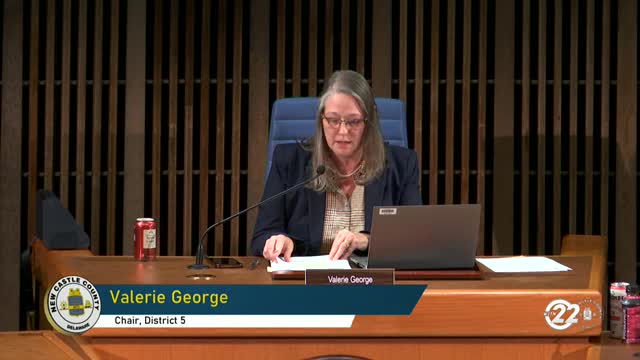
The presiding chair (unnamed) opened the discussion by summarizing Chapter 4 and reading key provisions aloud, including a provision that "telecommuting is not a formal or universal employee benefit nor is it an entitlement. Rather, it is an alternative work arrangement." The chair said staff would circulate a draft of edits after the meeting for further review.
The committee discussed multiple parts of the telecommuting policy. Under the draft, employees pursuing a college degree must "report to the office a minimum of 35 hours per week" and maintain a permanent weekly schedule for the semester. Council members raised whether that language should reflect telecommuting arrangements rather than an explicit office presence. Mike Migliore, identified in the meeting as council counsel, said he would take suggested edits into account and suggested the 35‑hour requirement could be framed as a minimum hours requirement rather than the specific phrase "reports to the office." Several council members urged removing the word "advanced" from the degree language so it would cover bachelor and other degrees.
Members spent the most time on eligibility and approval for telecommuting. The draft says an employee seeking telecommuting must submit a written request and a completed telecommuting agreement, and that the "supervisory council member with the majority of council may approve the request provided that there is no significant negative impact on council operations." The draft also said employees must have "no record of performance problems or disciplinary action within the preceding two years" to be eligible for consideration, unless telecommuting is needed for continuity of operations.
Council members expressed concern that the two‑year disciplinary lookback could have the effect of imposing an additional penalty beyond a personnel action. Council Member Street said he considered the two‑year restriction unfair; Council Member Carter said disciplinary penalties should be resolved through the disciplinary process and not create an extra bar to telecommuting. Other members, including Council Member Kilpatrick and Council Member Smiley, said supervisory discretion and the requirement that the supervisory council member bring requests forward for council approval already give supervisors tools to address performance concerns.
The draft sets a telecommuting time allocation at a 60/40 split (alternate location up to 60 percent of a pay period, capped at 42 hours; in‑office at least 40 percent or at least 28 hours per pay period). It also limits alternate work locations to Delaware, Maryland, New Jersey or Pennsylvania, and states the alternate location "is not intended to permanently replace the employee's assigned work location and council offices." Members suggested updating that language to reflect telecommuting norms established since 2020.
The committee reviewed operational obligations for telecommuting employees: maintaining a safe, designated workspace; promptly reporting material changes; protecting council materials and data; remaining available by phone, email and virtual meeting during agreed work hours; and not holding in‑person client or public meetings at the alternate location. The draft requires use of county‑assigned remote‑access tools (the presenter read examples: "Cisco Z3 aka black box or NetMotion mobility software or other similar device assigned to the employee by the county") and proposed simplifying that text to refer generally to county‑assigned remote‑access software or devices.
On technology and data security, the draft states council "reserves the right to monitor and log without notice all telecommuting activity, including email," and that employees should have "no expectation of privacy in the use of county related resources." The draft also says the county will not cover home operating or maintenance costs (for example, broadband, hardware repair, office furniture) and that out‑of‑pocket office supplies for telecommuting will not be reimbursed.
The draft addresses workers' compensation and liability: "Council will provide workers' compensation protection as obligated by state statute for the employee while in the course of employment with the agreed upon alternative work location and defined work schedule," but the draft also states the county is not liable for injury or property loss in the alternate work location that is not directly associated with job duties or outside approved work hours. Council Member Tackett asked specifically whether a work‑related injury at home would be covered; the presenter read the workers' compensation language aloud in response.
Other personnel rules reviewed in Chapter 4 included compensatory time (comp time accrual at one hour per hour worked outside the regular 35‑hour work week, with a 70‑hour accrual cap), timekeeping and sign‑in practices, pay period and payday (biweekly), unpaid 60‑minute lunch breaks, and provisions for telecommuting during emergency or inclement‑weather conditions (including a 14‑calendar‑day notice for terminating a telecommuting agreement and a carve‑out allowing limited telecommuting up to three days per pay period without a full agreement).
The chair and staff said language that reflected being primarily in‑office prior to widespread telecommuting would be updated; a draft incorporating committee edits will be circulated for review before any formal vote.
Votes at a glance: At the start of the meeting a motion to approve the minutes for August was made and the chair announced, "Minutes are approved." The minutes motion was recorded as approved; no roll‑call tally was read aloud.
Ending: The committee concluded the Chapter 4 review after additional comments and closed the public‑comment portion with no members of the public speaking. Staff said proposed revisions will be provided to the committee for further review prior to a formal vote.