Get Full Government Meeting Transcripts, Videos, & Alerts Forever!
Get email alerts on the Historic Theatre Expansion topic
No spam. Unsubscribe anytime.
Historic Hemet Theatre expansion concepts unveiled; council forms ad hoc to work with foundation
Summary
City, theater board and architect presented three conceptual expansion schemes for the Historic Hemet Theatre on Aug. 28 and described a feasibility analysis and capital‑fundraising plan; the council appointed an ad hoc committee to work with staff and the theatre foundation.
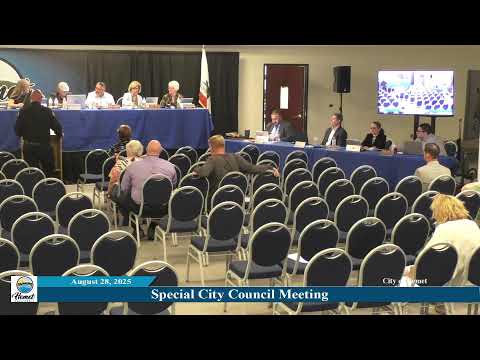
City officials, theater board members and the project architect presented conceptual designs Aug. 28 for the Historic Hemet Theatre expansion and discussed next steps, including a feasibility study and fundraising plans. After the presentation the Hemet City Council appointed an ad hoc committee to work with staff and the Historic Hemet Theatre Foundation.
The presentation and concepts
City Manager Mark Prestwich outlined the council’s prior property acquisitions adjacent to the theater and described donor terms tied to a land gift, including a requirement that an expansion be initiated within five years and completed within seven years or remaining value revert to a regional park district. He said the city purchased the property at 204–208 E. Florida (and 108 N. Harvard) for $1,500,000, which currently generates about $50,000 in annual lease revenue from tenants, and purchased the parcel at 222 E. Florida for $350,000.
Andrew Kochek, board president of the Historic Hemet Theatre, described the board’s work to stabilize and operate the single‑screen venue and introduced architect John Loomis of Thirtieth Street Architects. Loomis said his team studied three schemes: an extensive rebuild that would retain the existing façade but enlarge the house; a reuse-and-renovation approach that preserves more of the original building while expanding stage and audience capacity; and a hybrid scheme that adds a black‑box performance space and food-service spaces. Loomis said the largest studied scheme could accommodate up to about 1,400 seats in an extreme layout but that more realistic options would be near 900–1,000 seats. “My usual task is to work on an unreinforced masonry building and try and make it stand up forever,” Loomis said.
The board and architect emphasized flexibility: concepts may be combined and will be refined by a forthcoming feasibility study that Loomis and the board said will address structural analysis, theater operations and market demand. The board said it has raised roughly $1 million in assets and is planning a capital campaign; Loomis said cost ranges discussed informally were roughly $5 million to $15 million depending on scope.
Why this matters
Council members and presenters framed the theater as a potential catalyst for downtown revitalization—paired with planned railroad-corridor improvements, façade grants and other downtown incentives. Presenters and councilmembers discussed ancillary uses such as restaurants, rooftop dining, a boutique hotel (studied at about 30 rooms in the concepts) and a black‑box theater for smaller performances and daytime programming.
Public input and concerns
Multiple councilmembers and commissioners asked operational and financing questions—about parking, reuse of historic seats, ADA upgrades, and whether donors or a private investor would buy city-owned parcels. Loomis said the team will hire structural engineers and theater consultants and prepare an RFP process for consultants and vendors. Board members said they plan stakeholder engagement sessions and community meetings.
Council action
The council moved to create a downtown-theater ad hoc committee. Councilmember Mailes moved that Councilmembers Connie Clark and Linda Krupa be appointed to the downtown theater ad hoc committee to work with staff and the Historic Hemet Theatre Foundation; Councilmember Lodge seconded. The motion passed 5-0 on roll call. Councilmember Clark then proposed appointing a Planning Commission representative; the council appointed a Planning Commission member to represent District 1 on the ad hoc, and that motion also passed 5-0.
Next steps
Presenters said the next steps include commissioning a structural feasibility study, contracting a theater consultant (Loomis said they had contacted Theater DNA of Los Angeles) and running a financial feasibility study to inform a capital campaign and fundraising. City staff described available incentives—including the city's downtown hotel‑incentive program and a Qualified Opportunity Zone designation—that could be used to attract private investment alongside nonprofit fundraising. Staff and the theater board said they would convene stakeholders and return recommendations to the council as the feasibility work concludes.
Ending
Councilmembers expressed support for the project and for an ad hoc to coordinate city staff, the foundation and community stakeholders. No development applications were filed at the meeting; the presentation was described as preliminary concept review and guidance before any formal submittal or entitlement process.