Lifetime Citizen Portal Access — AI Briefings, Alerts & Unlimited Follows
Carmel-by-the-Sea staff present AMS-compatible street-address prototype to improve emergency response and utility service
Loading...
Summary
City staff on Saturday presented a prototype plan to assign standardized, AMS-compatible street addresses across Carmel-by-the-Sea, saying the change would not automatically trigger at-home postal delivery but would make the city’s property locations searchable by USPS, county GIS, mapping platforms and private carriers.
City staff on Saturday presented a prototype plan to assign standardized, AMS-compatible street addresses across Carmel-by-the-Sea, saying the change would not automatically trigger at-home postal delivery but would make the city’s property locations searchable by USPS, county GIS, mapping platforms and private carriers.
The plan’s lead presenters said the primary goals are to meet state fire-and-building-code requirements for visible street numbers, improve emergency dispatch and arrival accuracy, and allow utilities and delivery services to identify premises more reliably.
City staff member Bob, who introduced the presentation, said the town currently uses centralized mail delivery through PO boxes at the downtown post office and that “implementation of an address system and at-home mail delivery are not the same thing.” He added that the Carmel postmaster and the U.S. Postal Service have told staff that assigning AMS-compatible addresses would not compel the Postal Service to begin residential delivery in Carmel-by-the-Sea.
City staff member Emily reviewed the U.S. Postal Service address requirements staff used to design the prototype. Those include: a primary numeral up to five digits, a single street name in the address line, consistent odd/even numbering by block side, and a numeric or alphanumeric supplemental-unit suffix for subunits. Emily said the AMS (Address Management System) is the authoritative database used by Google Maps, Apple Maps and many service providers to validate addresses.
Kevin, a presenter who said the group developed four addressing models, described the “logical positional” model staff favors. That approach would use the beach as the origin for north–south numbering, keep numbers tied to numbered avenues (so a number gives a positional cue relative to nearby intersections), and generally keep numbers to four digits or fewer. Kevin said the prototype has received a preliminary “thumbs up” from local USPS addressing staff and from county reviewers.
Nancy, a planning staff member who has worked on the city’s housing element, addressed accessory dwelling units (ADUs). She said staff estimates about 70 ADUs in the city as of roughly a year ago and recommended that issuing a separate postal-style street address for an ADU be left to the property owner initially; existing ADUs would not automatically receive new addresses under the staff recommendation.
Staff outlined a five-step implementation pathway: (1) research and review for safety and technical standards with public safety and planning; (2) preliminary USPS review of the overall numbering scheme; (3) full development of an address list for every parcel; (4) county approval and incorporation into county GIS and other county systems; and (5) distribution of the approved address list to utilities, carriers and other data users for batch updating. Emily said the county indicated willingness to cooperate and that utilities (PG&E, AT&T, Comcast and others) told staff they could accept batch updates.
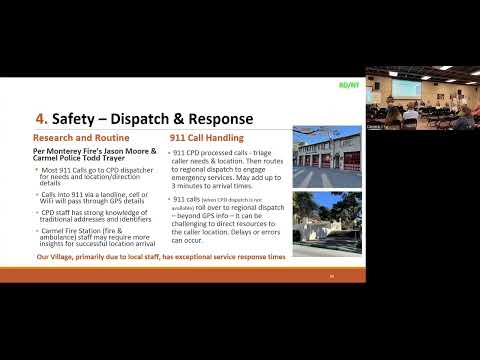
On public safety, presenters said Monterey Fire Department currently provides fire service under contract and has committed to staffing a paramedic on every response vehicle. Staff explained Carmel remains unique in Monterey County for operating its own local dispatch, which then relays calls to county dispatch; staff said that translation step can add time that is not counted in the fire department’s internal travel-time reporting. Presenters said the prototype addresses are intended to reduce on-scene searching time and make arrival times more reliable.
Staff also addressed local code and signage requirements: California building and fire codes require street numbers visible from the street, legible against a contrasting background, with characters four inches high and a minimum stroke width of one-half inch. Presenters said they would seek to preserve the village’s historic character while meeting visibility requirements; they showed examples of number styles and noted many owners could combine a numeric address with existing house names or decorative plaques.
Cost and timing questions from attendees were not resolved at the meeting. Staff said they do not yet have a final implementation cost and estimated, based on conversations with the county and utilities, a likely implementation window of three to six months after formal approval and county incorporation. Staff said they will return to the City Council in October with an update; if council directs staff to proceed, staff expected to prepare a resolution for a November first reading and a December second reading, with any major implementation tasks beginning the following calendar year.
Public comment at the meeting reflected a mix of support and concern. Several residents urged change, citing prior delayed or difficult emergency responses and problems with online or insurance transactions when a physical-street location was needed. Other residents said the community values its tradition of PO-box-based mail pickup and expressed concern about the visual impact of numeric signage on historic homes and the possibility of post office service changes.
Where residents asked about specifics, staff provided clarifications drawn from USPS and county guidance: addressing must use a primary numeral (no spelled-out numbers), odd/even conventions should be consistent, supplemental unit identifiers may use numeric or alpha characters (for example, “Apt 1” or “Suite B”), and legacy five-digit addresses associated with existing delivery points would not be changed.
No formal action or vote occurred during the presentation. The staff presenters said the next formal step is to brief the City Council; any ordinance or resolution to implement addresses would return to council for decision.
Public commenters also raised enforcement questions. Presenters said they have not yet identified a local enforcement protocol and that the fire and police chiefs said they could not imagine routine citation for lacking visible numbers; staff said enforcement details would be a council decision.
The staff presentation, supporting slides and an online “no-address guide” for residents are available from city staff and the CRA, staff said. The city asked residents to continue submitting comments by email to the address provided by staff.