Get Full Government Meeting Transcripts, Videos, & Alerts Forever!
Get email alerts on the School Closures topic
No spam. Unsubscribe anytime.
Kyrene long-range committee recommends multi-year school consolidations to address falling enrollment
Summary
A 60-member Long Range Planning Committee recommended a regional consolidation plan that would reduce the district—s operating sites over three years to preserve classroom spending and close a projected $7 million shortfall; the board did not vote on closures and will consider action in December after public hearings.
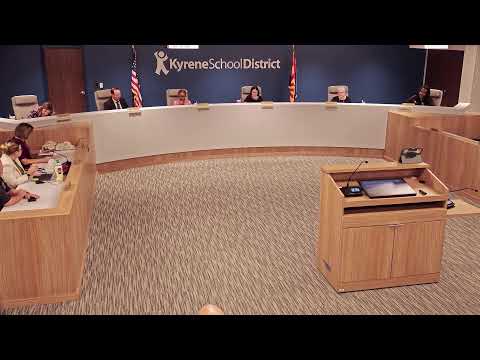
The Kyrene Elementary District—s Long Range Planning Committee presented a recommendation Sept. 16 to consolidate elementary and middle school attendance areas and close multiple school sites in a phased plan intended to address long-term enrollment decline and preserve classroom spending.
The committee, which the district said included nearly 60 parents, staff and community members, proposed a regional model with K—5 elementary schools and 6—8 middle schools, a multi-year rollout of facility closures beginning in the 2026—27 school year, and a timetable that would move remaining consolidations through 2028—29 if the board approves the plan. The superintendent said staff will continue community engagement this fall and that the earliest the governing board would consider formal action is December 2025.
The recommendation responds to a long-term decline in enrollment: district presenters said classrooms were built for about 20,000 students but now serve slightly more than 12,000. The district—s demographer and finance team told the board that projected enrollment decline could reduce operating revenue by approximately $7,000,000 over the next five years and that continuing to operate 25 sites would shift a larger share of the operating budget into plant operations (utilities, custodial, grounds and facility staffing), thereby threatening Kyrene—s stated goal of directing 75% of operating dollars to classroom spending.
Superintendent (name not specified) summarized the recommendation and the process: "For the first time in its 137 year history, Kyrene is considering school closures," she told the board, adding that the district designed a multi-month engagement process and that law requires a public hearing but the district plans seven. Assistant Superintendent Lisa Gibson and Associate Superintendent/CFO Chris Herman explained budget levers the district has used and why, they said, right-sizing facilities is now the remaining strategic lever. Herman told the board that, in Kyrene, "personnel and building costs fully realized" for a typical elementary closure would yield roughly $800,000 in annual savings and a middle school about $1.3 million, after transition costs.
Committee members described their charge: to optimize facility use, preserve programs and recommend whether to place the maintenance-and-operations (M&O) override on the ballot. Michelle Faye, a committee member, said the group examined multiple models before advancing the regional plan and emphasized that the committee prioritized minimizing the number of students displaced districtwide.
The district outlined a community-engagement timeline: a three-month public comment phase with six regional meetings and a boardroom public hearing on Oct. 28; staff said they will bring transportation options to the board Oct. 14 and begin operational planning should the board approve any consolidation package. The committee recommended a phased implementation (West-side elementary consolidations in 2026—27, East-side consolidations across 2027—28 and 2028—29) to allow time for staffing, transportation routing and program transitions.
Public comment filled much of the evening. Ninety-two in-person speakers addressed the board; most urged preservation of specific schools or programs the plan would affect. Common concerns included the future of dual-language and gifted programs, the potential loss of open-enrollment students who come from outside Kyrene boundaries, the fate of special-education (CCD) classrooms, transportation impacts, and whether the demographer—s models adequately account for choice behavior. A number of speakers asked the board to pause and seek a second independent analysis before making a final decision.
Demographer (Mr. Brammer) told the board that open-enrollment movement makes precise modeling difficult: "Open enrollment is a big thing. Open enrollment is under your control," he said, adding that the district retains levers such as open-enrollment policy to influence future service rates. Committee members and district staff repeatedly framed success metrics as maintaining the district—s "timeless spending model" (the district—s approach to prioritizing classroom spending) and stabilizing utilization rates so the district is not forced to pull more funds from classroom budgets.
No vote on school closures was taken Sept. 16. The board approved routine items and set a board goal that it will "consider, solicit community feedback, and potentially take action regarding the recommendations of the long range planning committee" by the board—s December meeting. Staff and committee members said additional technical work will follow the community engagement period, and that any implementation will be multi-year and contingent on detailed operational planning and the board—s ultimate decision.
What—s next: the district enters a formal community engagement phase through late October and will return to the board with transportation analyses and other operational details. The board may direct staff to run alternate boundary or closure scenarios if members request them during forthcoming study sessions. If the board approves consolidation, the district plans a phased transition designed to limit one-year churn and to give families and staff time to relocate programs and personnel.
Votes, motions and other formal actions taken at the Sept. 16 meeting were procedural and unrelated to adopting the consolidation plan. The board approved the meeting agenda (5—0), the consent agenda (5—0), and later adopted a board goal to consider the committee recommendations by December (5—0).