Get Full Government Meeting Transcripts, Videos, & Alerts Forever!
Get email alerts on the Budget topic
No spam. Unsubscribe anytime.
Cullman County Schools board adopts $140 million 2025–26 budget after final public hearing
Summary
At a Sept. 11 meeting, the Cullman County Schools Board of Education approved the 2025–26 budget after a final public hearing. The budget reflects a $7.5 million increase in total revenues to about $140 million, with most new state funds earmarked for specific programs and an expected general fund ending balance of about $33 million.
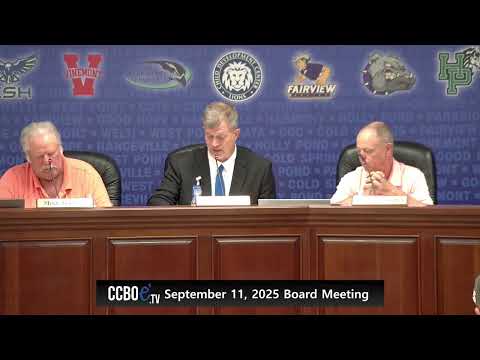
At a final public budget hearing Sept. 11, the Cullman County Schools Board of Education approved the district's 2025–26 budget, with the board voting to adopt the plan after a presentation on revenue and expenditure changes.
Miss Barriman, the district's finance presenter, told the board that average daily membership had fallen and that "units went down about 3.6," while ADM declined about 4.8 students. She said the district's total state foundation funds rose by about $159,000 but that a change in the state funding model moved previously separate allocations for gifted, English-language learners and at-risk students into the RAISE program. "So something important to say, even though the revenue is up, that's earmarked," Barriman said.
Barriman said the district is budgeting roughly $140,000,000 in total revenues for all funds — general, special revenues, capital projects and debt service — an increase of about $7,500,000 from the prior year. She described the composition of the increase: state revenues up about $3,600,000 and local revenues up about $2,100,000, driven in part by higher ad valorem assessments and slightly stronger sales-tax collections.
The district expects a $1,400,000 increase in the overall foundation program, but Barriman said much of that reflects the district's local match: "the actual total amount we're actually getting from the state is only up 159,000." She also described changes to targeted programs: the district will have more reading and math coaches (12 reading coaches, eight math coaches this year compared with one math coach last year) and will expand OSR pre-K slots (18 vs. 13 last year).
On capital and fleet funding, Barriman said state fleet-renewal funding covers $7,581 per bus for 10 years (about $75,000), which is only about half the cost of a bus. For that reason, the district plans to pay for upcoming buses with A&T (Appropriation and Transfer) funds rather than financing them: "we're actually paying for those instead of financing them because we're not getting enough fleet renewal funds as it is to pay for the financing we already have," she said.
Barriman provided a breakdown of the district's local half-cent sales tax projection of $6,100,000, noting that about 60% of that would fund instruction and technology and roughly 20% would be sent to schools and 20% used for facilities and maintenance. She also explained that some recently received supplemental appropriations (including about $10.6 million in A&T funds for textbooks, pre-K and summer/after-school programs) are already in the district's accounts and will make beginning balances higher in the coming fiscal year.
On expenditures, Barriman said the proposed general fund spending increased by about 11.9 percent year over year. She told the board that salaries increased roughly 3 percent because employees moved up step increases, while benefits rose about 10 percent largely because PHIP health insurance contributions and retirement rates increased. "PHIP went up from, $800 a month, $9,600 a year per employee to $10,008.48 per employee," she said.
Barriman said the district plans to end the year with roughly $33,000,000 in the general fund (about 91 days of operating reserves). "I tried to be very conservative with revenues and a little high on expenditures," she told the board, noting that many new funds are earmarked for specific uses.
Dr. Barnett, superintendent, recommended adoption of the budget; a board member moved to approve, another seconded, and the motion passed on a voice vote.
The board packet included school-by-school allocation reports, personnel counts by funding source and lists of projects to be funded from capital and A&T monies. Barriman identified those materials as available to board members for review and said the packet included a narrative and the actual budget with definitions.
The board did not attach new conditions to the budget approval at the meeting. Barriman and other speakers noted the district will revisit earmarks with legislators: "We'll talk to the state legislator," one board member said during discussion of restricted funds.
Votes at the meeting were taken by voice; no roll-call tallies were read into the record.
The board approved the 2025–26 budget and then moved on to a series of consent and action items later in the meeting.