Get email alerts on the Solid Waste Operations topic
No spam. Unsubscribe anytime.
Rutherford County solid waste director reflects on departmental changes and leaving post
Summary
Outgoing Solid Waste Director Bishop Wagner delivered his final report, described organizational and operational reforms at the convenience centers, noted financial improvements, and urged caution on unvetted grant commitments.
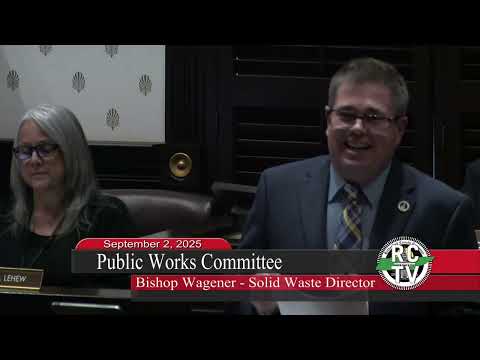
Bishop Wagner, director of Rutherford County Solid Waste, delivered his final report to the Public Works and Planning Committee on Sept. 2, summarizing organizational changes at convenience centers, staffing improvements, and recent financial results.
Wagner said he arrived to find an unstructured department with largely part‑time attendants and operational dysfunction. Under his leadership the department hired full‑time attendants, created manager and lead-attendant positions, organized administrative staff and professionalized operations. Wagner said those changes improved morale and operations and that “the level of professionalism in this department I put up right next to any other department within Rutherford County government.”
Wagner highlighted recent infrastructure upgrades to convenience centers and reported the system’s second month of operating in the black, noting the last month “gross profited approximately $96,000 — the second month of operation in the black.” He said recycling and diversion remain essential to managing costs and emphasized that grant acceptance and any required local matches must follow budgetary processes and commission approvals.
Wagner urged commissioners to support incoming staff and managers and stressed the importance of allowing department leaders to manage allocated budget lines. He also reminded commissioners that matches for grants must be budgeted and that he would not recommend budget amendments that would obligate future leaders without clear resources.
Why it matters: Wagner framed recycling and convenience-center operations as both environmental priorities and fiscal strategies to reduce long-term disposal costs. His remarks lay out the departmental changes that county leaders will inherit and flagged grant/match obligations as an area for cautious oversight.
What’s next: Wagner’s final recommendations will be part of transition briefings for his successor; commissioners thanked Wagner for his service and several members cited examples of the department’s assistance with community cleanup projects.
AI generated
The text on this page is AI generated. Summaries, highlights, analysis, and video transcripts are all produced from the original source material.
AI can make mistakes, so if you spot one, and we will fix it for everyone.
Note: the source content is unaltered by us. Any content source we link to, be it a video, an audio recording, or a document, is presented exactly as its publisher released it. That publisher is usually a government body, sometimes an individual official or another organisation.